




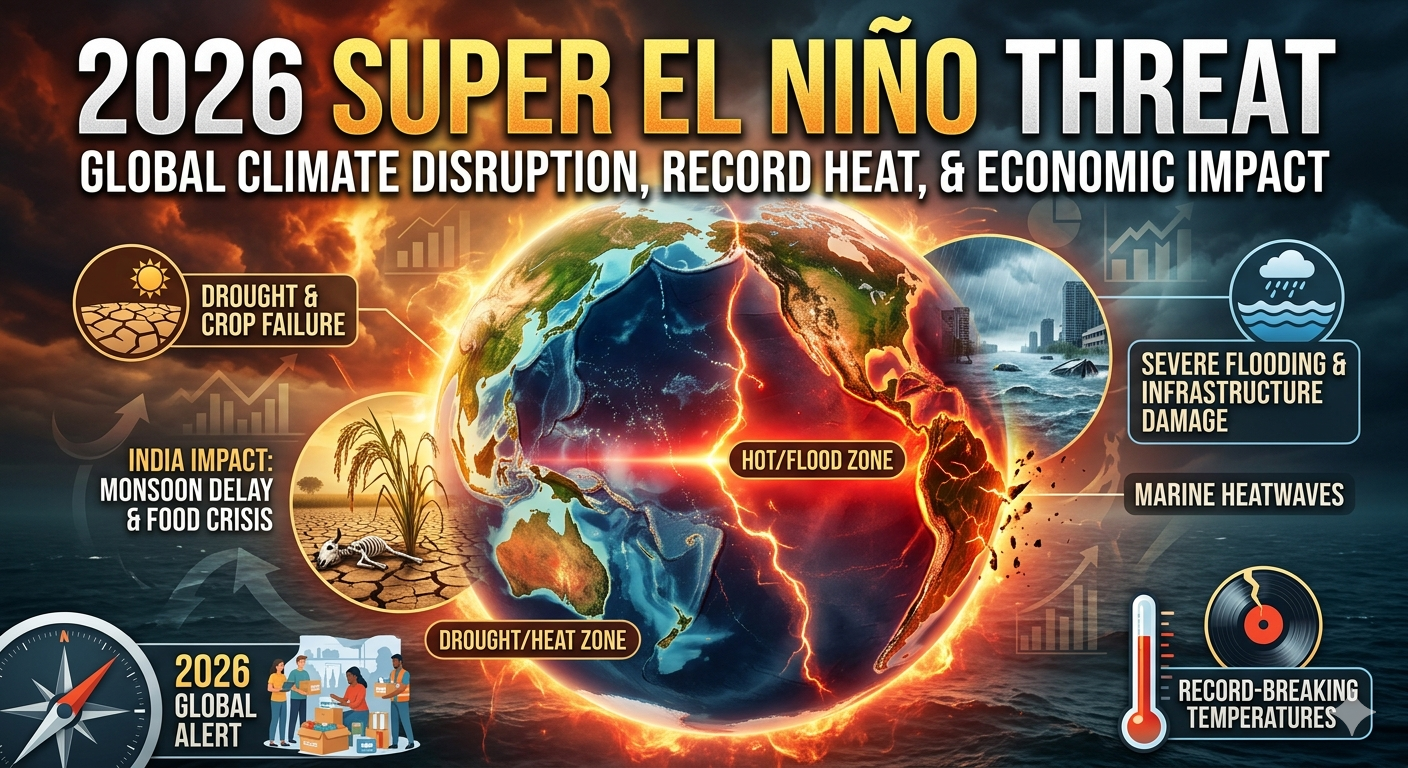
Climate experts are issuing warnings about a significant weather anomaly expected in 2026—a “Mega” or “Super” El Niño. This climatic shift threatens to trigger extreme weather worldwide, drawing unsettling comparisons to massive climate disruptions from over a century ago. Here is a clear breakdown of what this phenomenon entails and why the forecast for 2026 is a major global concern.
The Mechanics Behind the Disruption
To understand the threat, it helps to know how the ocean’s baseline system works. Typically, trade winds sweep across the tropical Pacific Ocean from east to west. This pushes warm surface water toward Asia and Australia, which helps generate stable weather systems, including the vital monsoon rains that countries like India rely on.
During an El Niño, this system breaks down. The trade winds stall or completely reverse direction, causing warm water to pool in the eastern Pacific instead. This massive oceanic shift alters the atmosphere above it, reorganizing global jet streams and rain belts. The result is a domino effect of extreme weather: severe droughts in some regions and unprecedented flooding in others.
Echoes of the 1877–1878 Crisis
When assessing the potential severity of the upcoming cycle, researchers look back to the El Niño of 1877–1878, largely considered one of the most devastating climate events in recorded history.
That historical anomaly caused a global agricultural collapse. Rains failed across Asia, Africa, and South America. In British India, the combination of extreme drought and exploitative colonial export policies led to the Great Famine. Globally, the cascading effects of this weather event resulted in the starvation and deaths of an estimated 30 to 40 million people.
Why 2026 is Uniquely Alarming
A standard El Niño is challenging, but 2026 is currently projecting to be a “Super” or “Mega” event. This classification is generally used when Sea Surface Temperatures (SST) rise 2°C or more above the historical average. Several factors make the current forecast exceptionally dangerous:
A Hotter Baseline: Unlike the 19th century, today’s El Niño is building on a foundation of climate change. Global ocean temperatures are already roughly 1°C hotter than pre-industrial levels, meaning the ocean’s ecosystems are already under immense stress.
Marine Heatwaves: Unusually intense, localized warming in the Pacific Ocean is acting as an accelerant, supercharging the conditions needed for a Mega El Niño.
Failing Trade Winds: The natural atmospheric currents that typically help regulate these ocean temperatures are demonstrating significant weakening.
Anticipated Impacts: Global and Local
The shockwaves of a Mega El Niño are not contained to the ocean; they will be felt across the globe.
Worldwide Consequences: The year 2026 could easily shatter existing global heat records. Forecasts suggest intense dry spells across Southeast Asia, Australia, and Southern Africa. Conversely, the Americas and parts of East Africa could face severe rainfall and flooding. The atmospheric conditions will also be primed for aggressive wildfires and high-intensity cyclones.
The Impact on India: Because India’s agrarian economy is heavily tied to predictable rainfall, a Super El Niño presents a direct threat. A suppressed monsoon season usually leads to stunted yields for essential crops like rice, pulses, and oilseeds. Beyond agriculture, this will likely trigger food inflation, rural economic distress, and dangerous, prolonged heatwaves that will strain the country’s power grids and water supplies.
Modern Resilience: A Silver Lining
While the environmental and economic damage of a 2026 Super El Niño will likely be immense, humanity is in a far better position to survive it than we were in 1877.
The catastrophic mortality rates of the 19th century are highly unlikely today. Modern agricultural buffer stocks, rapid international disaster response protocols, and highly connected global supply chains mean that food and aid can be quickly redirected to areas facing crop failures. However, while mass starvation can be mitigated, the economic toll, infrastructure strain, and environmental damage will be severe—making proactive preparation an absolute necessity.