



Manipur has faced ongoing tensions between different communities for years. Recently, a new debate has started regarding the National Register of Citizens (NRC). Many locals are worried that if they cannot prove their ancestors lived in the state before a specific year, they might lose their right to live there.
What is the NRC and the “Base Year”?
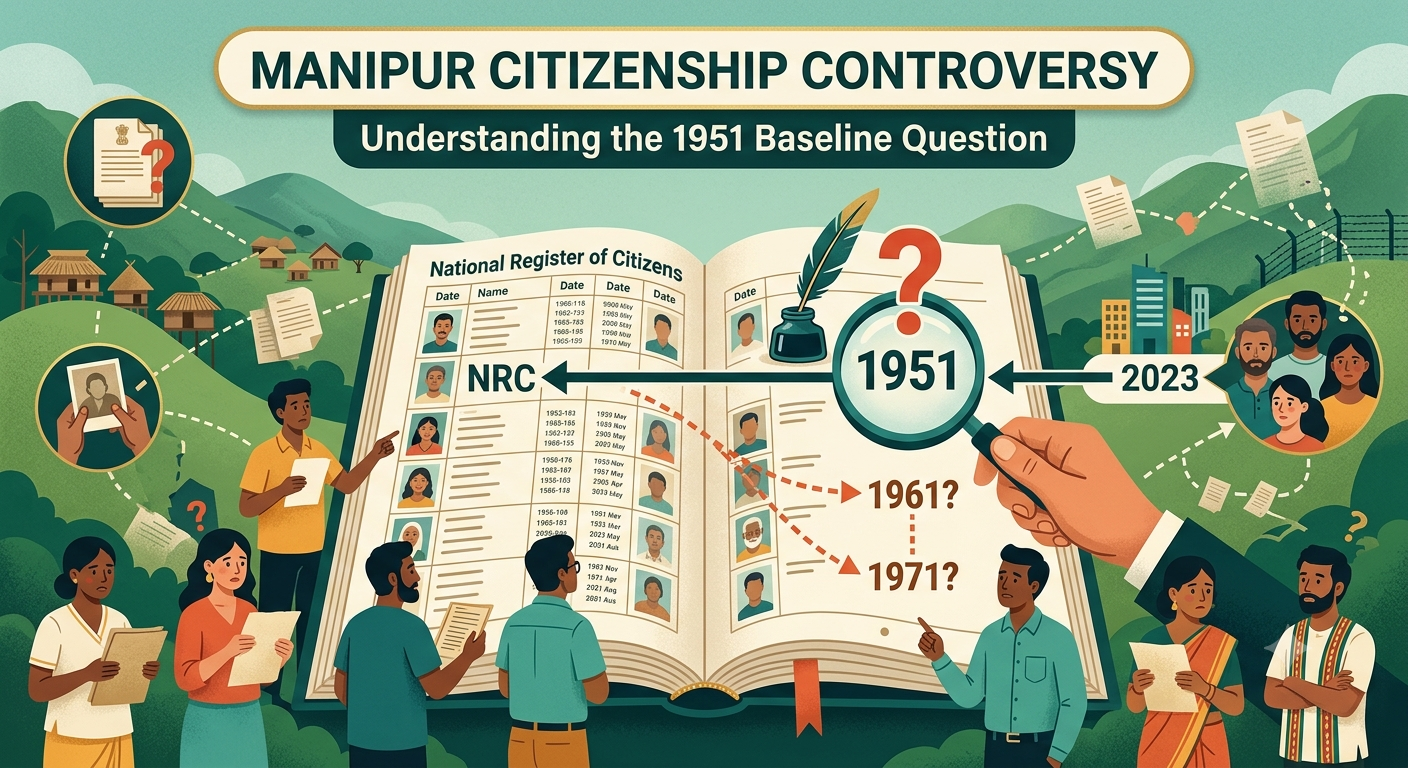
The NRC is an official government list that keeps track of legal citizens. Recently, local leaders in Manipur suggested updating this list using 1951 as the starting point, or “base year.”
If this rule is applied, residents will need to provide documents proving their family lived in Manipur in or before 1951. While the government prefers 1951, other groups argue that 1961 or 1971 would be much fairer for everyone.
Why is the 1951 Rule a Problem?
Using 1951 as a strict cutoff creates several major challenges for the people of Manipur:
Missing Records: In 1951, record-keeping was not very advanced. Many people living in remote or hilly areas were never counted properly, meaning true residents simply do not have the required old documents.
Border Communities: Communities living near the international borders have always shared family and cultural ties across the lines. Because they moved around freely in the past, finding formal paperwork from the 1950s is extremely difficult.
How Can the Situation Be Resolved?
To solve this problem peacefully, experts suggest a few important steps:
Open Discussions: The government must have honest conversations with all major local groups—like the Meitei, Naga, and Kuki—to agree on a base year that everyone feels is fair.
Help for Missing Papers: There needs to be a special support system for genuine citizens who do not have old documents, ensuring they are not unfairly punished.
Future Planning: Combining this citizenship check with the upcoming 2027 census could make the process much more organized and accurate.