




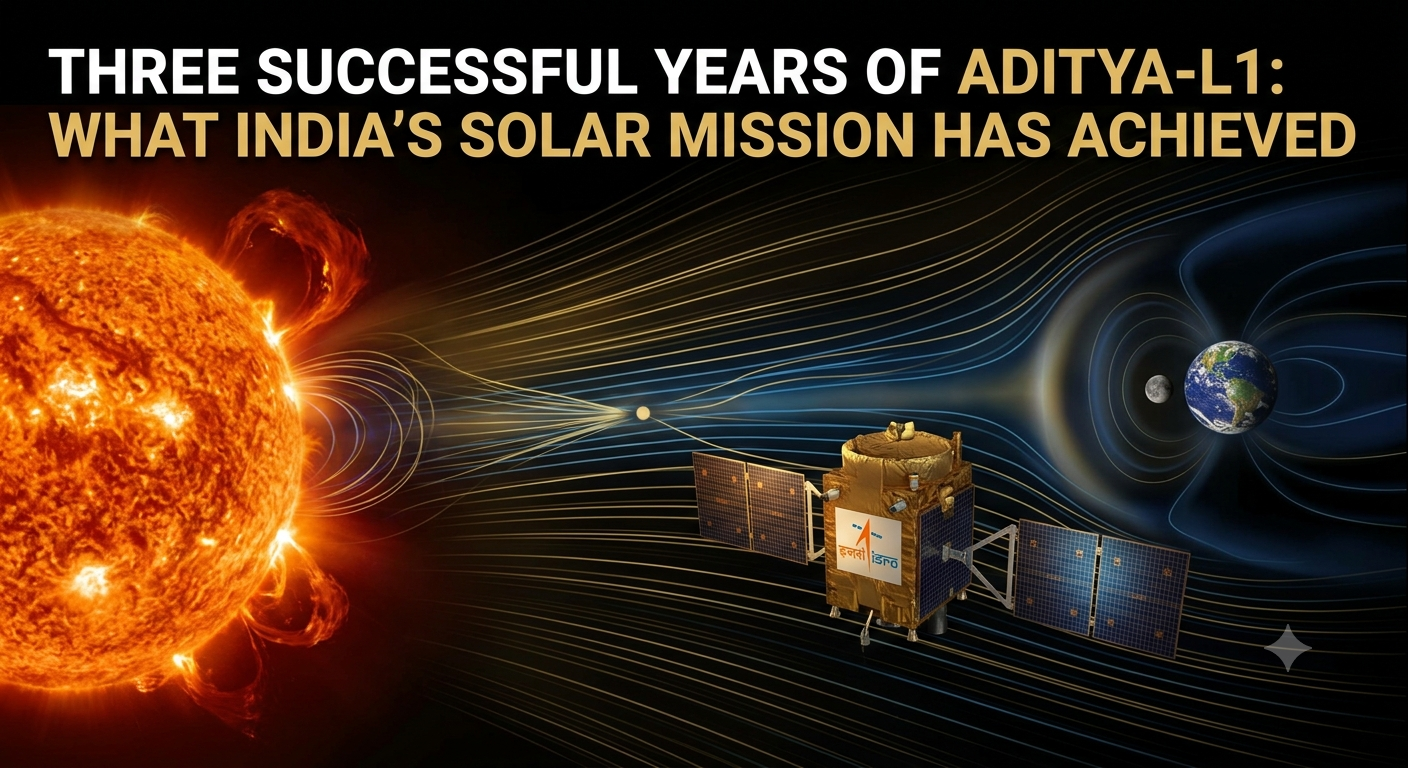
On September 2, 2023, India took a massive step in space exploration by launching its first-ever solar observatory, Aditya-L1. After a four-month journey, the spacecraft reached its special parking spot in space—called the L1 point—in January 2024. This spot is about 1.5 million kilometers away from Earth.
Today, we celebrate three years of this amazing mission. It has proven that India can do incredible things in deep space without spending a fortune, as the mission cost just around ₹380 crores.
Working Perfectly and Sharing Knowledge
Since it arrived at the L1 point, Aditya-L1 has had a clear, nonstop view of the Sun without anything blocking its way.
For the past three years, the spacecraft has been working perfectly. It constantly watches the Sun’s outer layers, its magnetic fields, and sudden bursts of energy known as solar flares. The Indian Space Research Organisation (ISRO) gathers this information and shares it with scientists around the world every six months. India is even working together with other major space groups, like NASA, to combine data and learn as much about the Sun as possible.
Why Do We Need to Study the Sun?
Watching the Sun closely from space is incredibly useful for several reasons:
Predicting Space Weather: Just like Earth has weather, space has weather caused by the Sun’s storms. Knowing when a solar storm is coming helps us protect important satellites that give us internet, GPS, and television.
Keeping Astronauts Safe: India is planning to send astronauts into space soon. Knowing the “space weather” is very important to make sure these astronauts are safe while they are working or walking in space.
Learning About New Energy: The Sun’s outer layer is strangely much hotter than its surface—reaching up to 15 million degrees Celsius. By studying how the Sun creates such massive amounts of heat and energy, scientists hope to learn how to create better, cleaner energy right here on Earth.
What’s Next for India in Space?
The success of Aditya-L1, along with the Chandrayaan moon missions, has made the whole country proud and excited about science. This huge public support gives ISRO the confidence to plan even bigger projects for the future.
Over the next few decades, India has some major goals:
The Gaganyaan Mission: Sending Indian astronauts into space.
An Indian Space Station: Building our very own station in space by the year 2035.
A Moon Landing: Sending an Indian astronaut to the Moon by 2040.
Scientists are even looking into highly advanced ideas, like collecting solar energy in space and sending it down to Earth. Thanks to missions like Aditya-L1, India has truly become one of the top space-exploring nations in the world, with a very bright future ahead.