


There is a common worry across India that Hindi is slowly replacing the country’s other native languages. When you look at official census data, it is easy to see why people think this. However, the real story is much more interesting and has less to do with language imposition than you might expect.
What the Data Shows
Over the past few decades, the percentage of people who claim Hindi as their first language has steadily increased. In the early 1970s, about 37% of Indians were counted as Hindi speakers. Today, that number is moving closer to 46%. Meanwhile, the percentage share for languages like Malayalam, Telugu, and Tamil has slightly dropped. But this data hides a bigger truth.
Why is Hindi Growing So Fast?
The rise in Hindi speakers is not happening because people in the South or East are being forced to give up their languages. It actually comes down to two main facts:
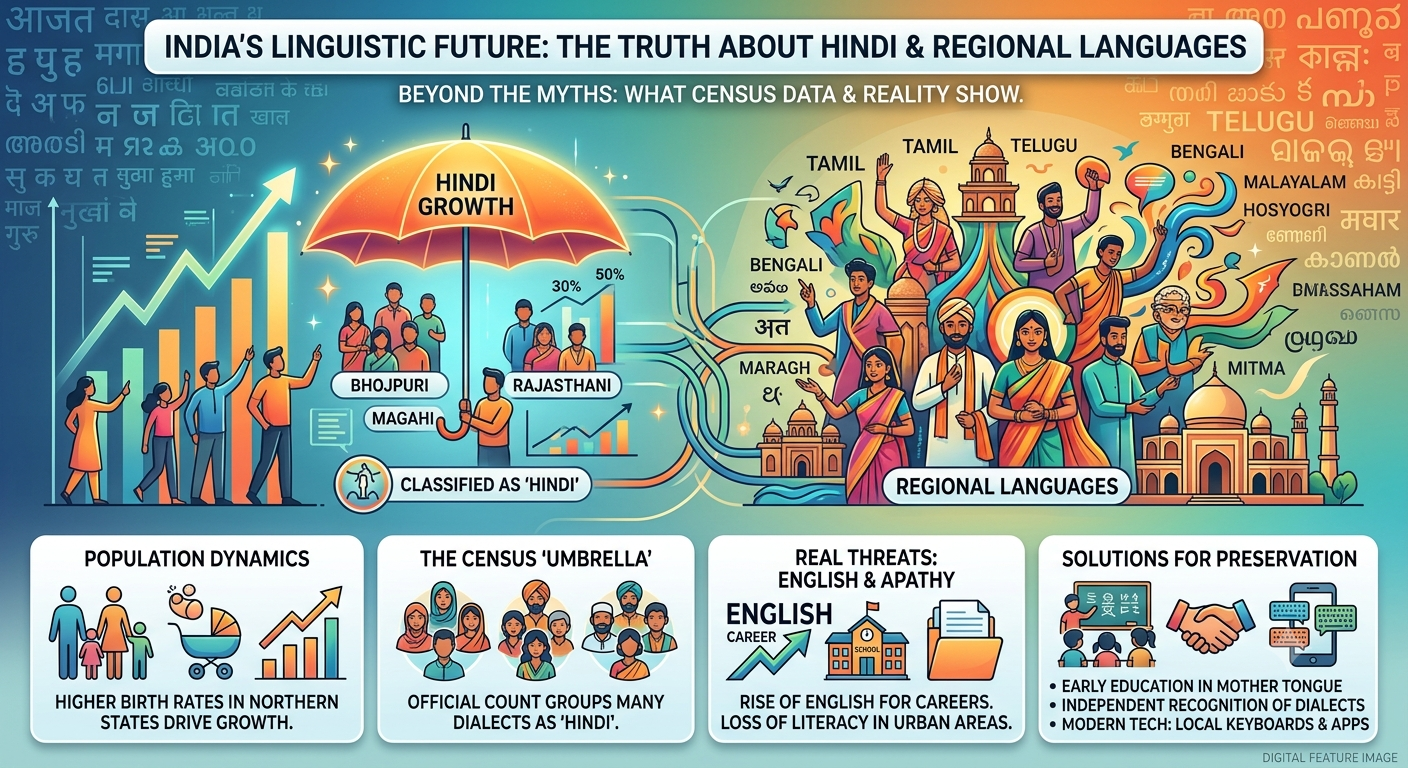
Population Growth: Northern states like Uttar Pradesh and Bihar have higher birth rates than Southern states like Kerala and Tamil Nadu. The total number of Tamil or Telugu speakers is still growing, but the population in the North is growing much faster. Because of this, the overall percentage of Hindi speakers in the country goes up.
The “Umbrella” Grouping: The Indian census counts 57 distinct regional languages—such as Bhojpuri, Rajasthani, and Magahi—simply as “Hindi.” When you combine all these massive groups into one category, the final number looks enormous. The North is actually losing its own unique dialects to a standard version of Hindi.
The Real Threats to Local Languages
If Hindi isn’t destroying other languages, what is putting them at risk?
The Shift to English: The biggest modern threat is English. In cities across India, parents prefer their children to learn English for better career opportunities. As a result, many kids today can speak their mother tongue at home, but they cannot read or write it.
Old Government Rules: In 1971, a rule was made to stop individually listing any language with fewer than 10,000 speakers. Hundreds of unique languages were suddenly tossed into an “Others” category, making them invisible in official records.
How We Can Protect Our Languages
To save smaller regional languages from disappearing, we need to take a few simple steps:
Start Early: Teach young children in their native mother tongue during their first few years of school.
Give Proper Credit: Recognize large regional dialects, like Bhojpuri, as independent languages instead of grouping them under Hindi.
Update Technology: Create better digital tools, like phone keyboards and apps, so people can easily type and text in their local languages.
In short, Hindi is not the enemy of India’s linguistic diversity. The changing numbers are just the result of how fast populations are growing and how the government counts them.
Which local languages or dialects do you speak at home, and do you feel they are well-supported by today’s digital technology?