




Recently, a lot of alarming videos went viral on social media claiming that the Chinese army had marched 60 kilometers into Arunachal Pradesh and set up camps. However, these claims were completely false. Fact-checkers and the Indian Army confirmed that the videos were actually old clips from a training exercise in Thailand and a local clash in Manipur.
So, why do these fake videos spread? It is essentially a mind game. When an adversary cannot win on the battlefield, they often use fake news to create panic and make people doubt their government’s strength.
Learning from the Past: The 1962 Mistake
To understand what India is doing today, we have to look back at the 1962 war. During that conflict, Indian soldiers fought bravely but suffered because they didn’t have proper roads, winter clothes, or enough supplies.
After that war, Indian policymakers developed a fear-based strategy. They intentionally decided not to build roads near the Chinese border, worrying that if the enemy attacked again, they could use those roads to easily enter India. Because of this fear, Arunachal Pradesh’s borders were left largely underdeveloped for decades, while China spent years building a massive network of roads and airbases on their side.
The Turning Point: Waking Up in 2020
Everything changed in 2020 after the border clashes in the Galwan Valley. India realized that it could no longer rely on old agreements or a defensive mindset. The country decided it was time to actively protect and build up its borders.
A Much Stronger Military Presence
Today, the Indian Army has completely changed its approach in the region:
More Troops on the Border: Soldiers who were previously managing internal security in the Northeast have been permanently moved to the front lines.
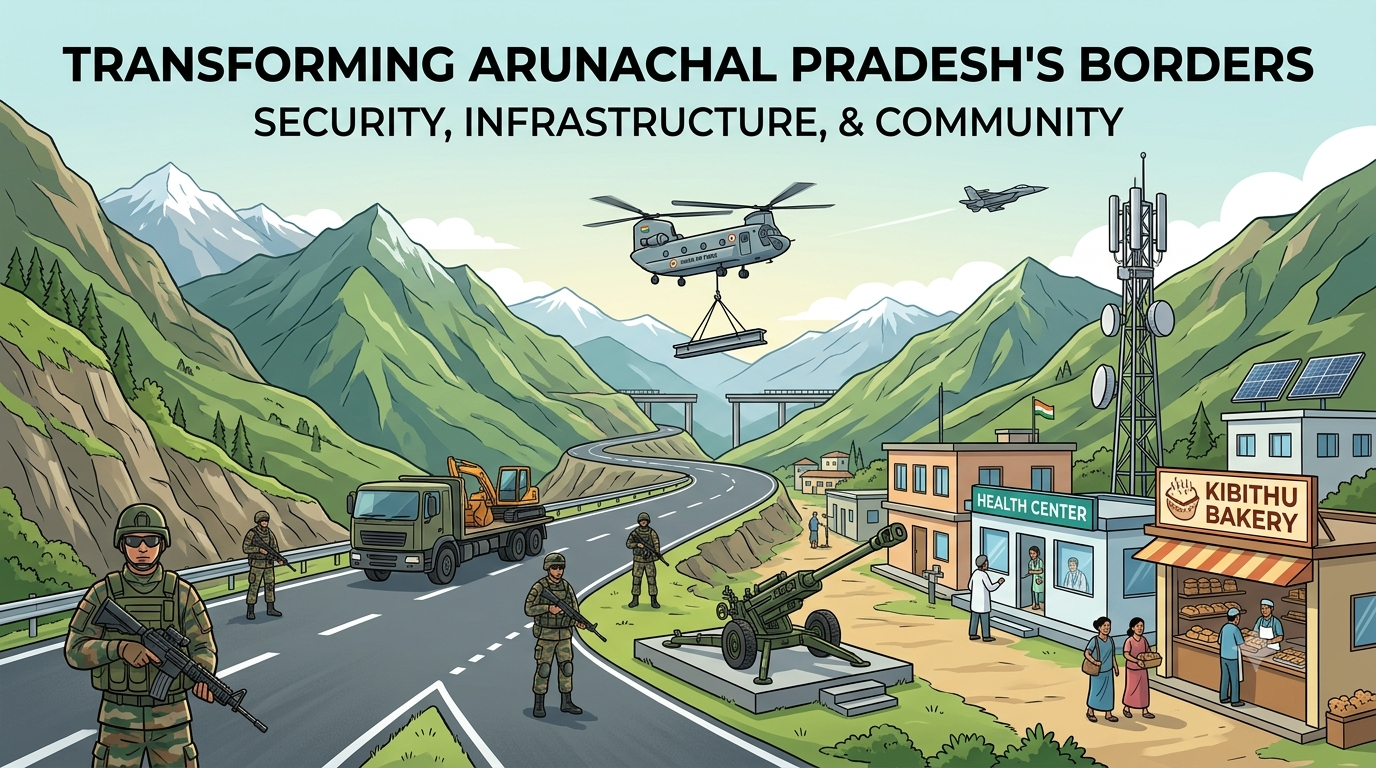
Easy-to-Move Weapons: The army now uses modern, lightweight artillery guns (like the M777) that can be easily picked up and carried across steep mountains by helicopters.
Better Gear: Soldiers stationed at the absolute edge of the border have been given highly advanced rifles and machine guns.
Guarding the Skies: The Indian Air Force is fully active in the region, using advanced fighter jets and powerful missile defense systems to ensure no enemy aircraft can cross the border.
Building Roads Through the Mountains
An army needs good roads to move supplies and heavy machinery. Today, incredible construction work is happening in some of the world’s toughest mountains:
A massive highway that runs parallel to the border (the Trans-Arunachal Highway) is mostly finished.
Another major project, the Frontier Highway, is currently being built to connect different mountain valleys directly.
Engineers have also built dozens of heavy-duty bridges that are strong enough to carry massive army tanks right up to the border areas.
Empowering Border Villages
Villages near the border are considered a country’s very first line of defense. For a long time, people in these areas struggled with a lack of basic facilities. Now, the government is investing heavily to improve their lives so they don’t have to move to the cities.
For example, in Kibithu—a village on the easternmost edge of India—new health centers and roads are being built. The army has even helped start a local bakery to give women jobs. Most impressively, new mobile towers are being installed. In the past, locals and tourists had to rely on Chinese mobile networks and pay international roaming charges just to make a call. Today, they are finally getting fast, reliable Indian mobile networks.
The Road Ahead
While progress has been massive, there are still challenges. Building the final stretches of road that lead right up to the border line is very difficult. Plus, the weather in Arunachal Pradesh is brutal; heavy rains and landslides mean construction can only happen for about four to five months a year.
However, the days of neglecting the border are over. Securing the region is now a team effort involving the military, the government, and local citizens. By encouraging tourism and boosting the local economy, India is keeping a watchful eye on its borders. Unlike in 1962, India is now fully equipped, confident, and ready to protect its territory.