




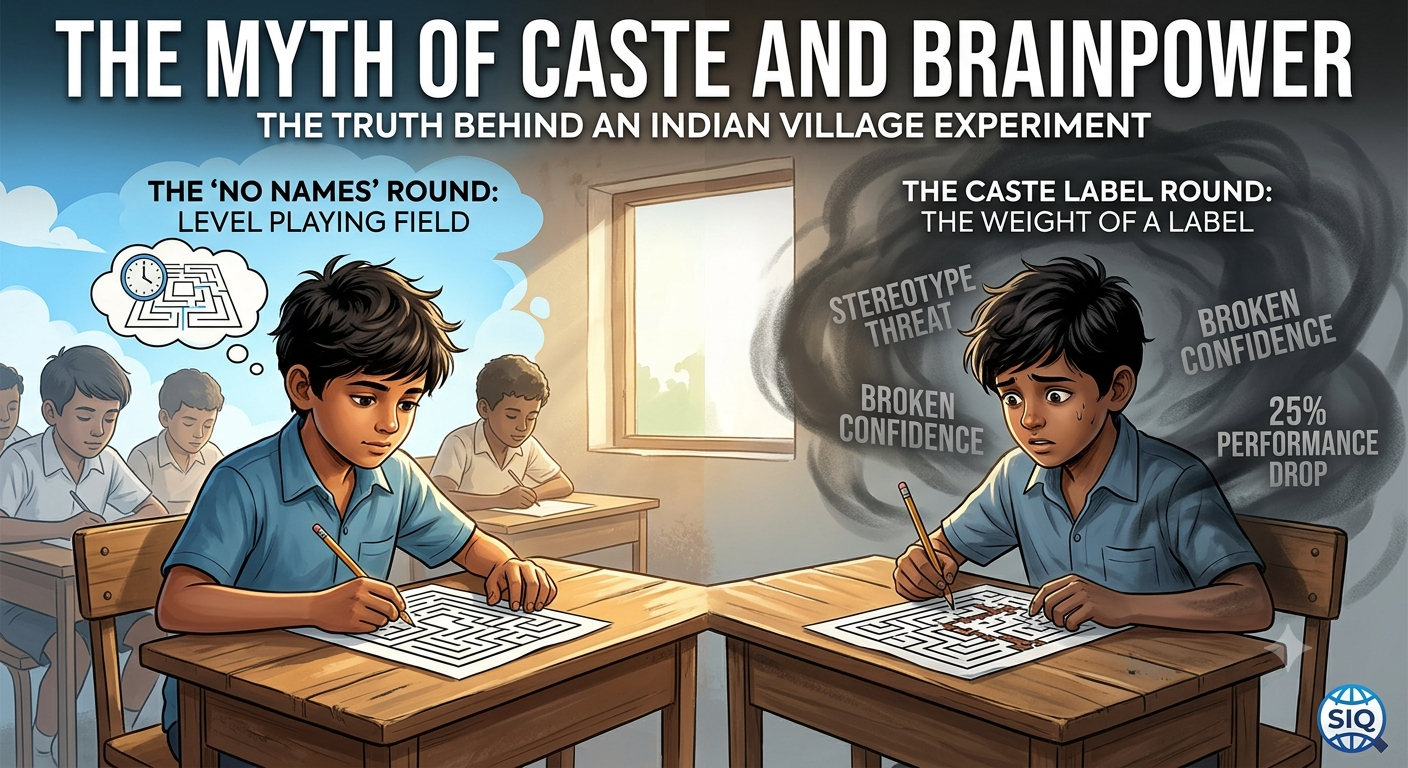
For a long time, society has secretly wondered if the social group you are born into decides how smart you are. A fascinating study done in a village in Uttar Pradesh in 2003 finally gave us a clear, scientific answer: it does not.
A Simple Puzzle Experiment
Researchers gathered over 600 boys, aged 11 and 12, from different social backgrounds. Exactly half were from historically privileged groups (often called “upper” castes), and the other half were from marginalized groups (often called “lower” castes).
The task was simple. The boys were put in a room and asked to solve paper mazes. For every maze they solved in 15 minutes, they would earn a small cash prize. To these kids, this was a very exciting and motivating reward.
The “No Names” Round
In the first round, the boys were not asked any personal questions. They didn’t have to share their names, villages, or social backgrounds. They just sat down and focused on the puzzles.
The results were completely equal:
Boys from marginalized groups solved an average of 5.72 mazes.
Boys from privileged groups solved an average of 5.54 mazes.
Without society’s labels hanging over their heads, everyone performed just as well. In fact, the marginalized group scored slightly higher, proving that natural intelligence was the same across the board.
The Weight of a Label
Next, the researchers brought in a new set of boys for round two. Everything was exactly the same—the puzzles, the time limit, and the prize money. But before starting, there was one small rule change: each boy had to stand up and announce his caste to the whole room.
That single moment changed everything:
The privileged boys’ scores went up to 6.11.
The marginalized boys’ scores dropped by a massive 25%, falling to 4.28.
The children hadn’t lost their intelligence, and the game hadn’t become harder. Instead, the marginalized boys experienced what experts call “stereotype threat.” Being publicly reminded of their social standing created an invisible mental stress that actively hurt their focus.
Ultimately, intelligence has no connection to birth. When we stop judging people by outdated labels, we give everyone the freedom to show their true potential.