




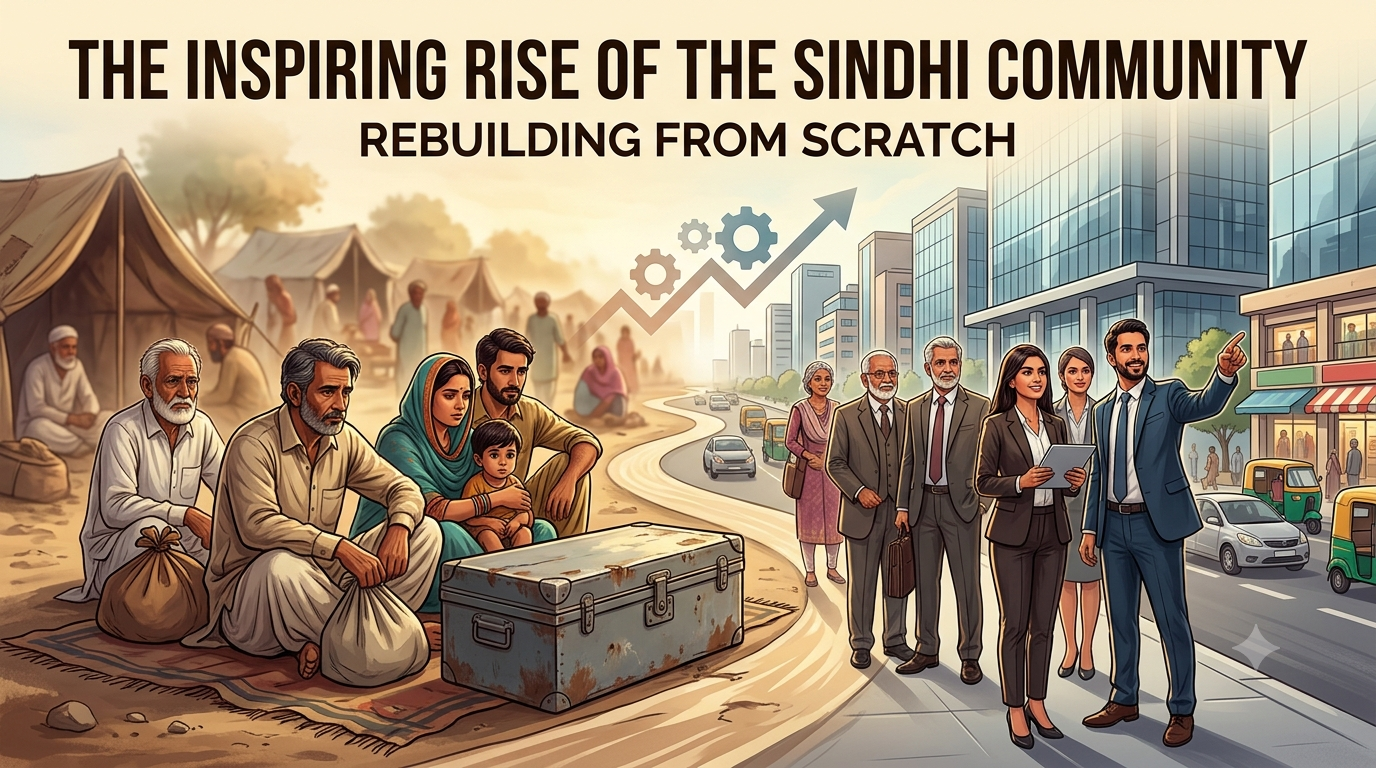
You might have seen a viral post on social media claiming that the Sindhi community makes up less than 1% of India’s population but brings in 15% of the country’s money (GDP).
Half of this post is true, and half is a myth. It is true that Sindhis are a very small group—making up just about 0.23% of India’s population. However, the 15% wealth claim is made up. The Indian government and banks do not track wealth based on a person’s caste or community, so there is no real data to prove that number. But even without that fake statistic, the true story of how the Sindhi community became so successful is incredibly inspiring.
Small Communities, Big Success
All over the world, there is a common trend of tiny communities finding massive success in business.
Parsis in India: There are very few Parsis left today, but they helped build India’s biggest early industries, like the Tata Group.
Gujaratis in America: Starting with just one small hotel in 1942, the Gujarati Patel community now runs nearly half of all the motels owned by Indian-Americans in the US.
Whether it is Lebanese traders in Africa or Chinese business owners in Southeast Asia, small, close-knit groups often achieve great things.
The Heartbreak of 1947
What makes the Sindhi story completely different from the rest is that they lost their homeland.
When India and Pakistan were divided in 1947, large states like Punjab and Bengal were cut in half. This meant people from those states still had a part of their homeland on the Indian side. But the entire region of Sindh went to Pakistan. Sindhis had to cross the border leaving behind their houses, their land, and their wealth. They had absolutely nothing left.
Yet, today, we see successful Sindhi families behind huge business empires and famous brands. How did they do it?
The Real Secret to Their Wealth
People often say that Sindhis are just “born to do business” or that it is “in their blood.” But that is not the real reason for their comeback.
When they were forced to leave their homes during the Partition, they couldn’t pack their land or houses into their suitcases. But they carried something much more valuable: their sharp minds, their hard-working attitude, and their strong relationships with one another.
No border or government could take away their skills, their knowledge, or their community bonds. They used these invisible tools to rebuild their lives from zero.
A Lesson for Everyone
The journey of the Sindhi people from having nothing in 1947 to achieving massive success today is a great lesson in survival and hard work. It leaves us with an important question to ask ourselves:
If you had to leave all your money and belongings behind tomorrow, what do you have inside you that would help you survive?
The Sindhi story proves that a person who has skills, a good mind, and strong relationships is never truly poor