





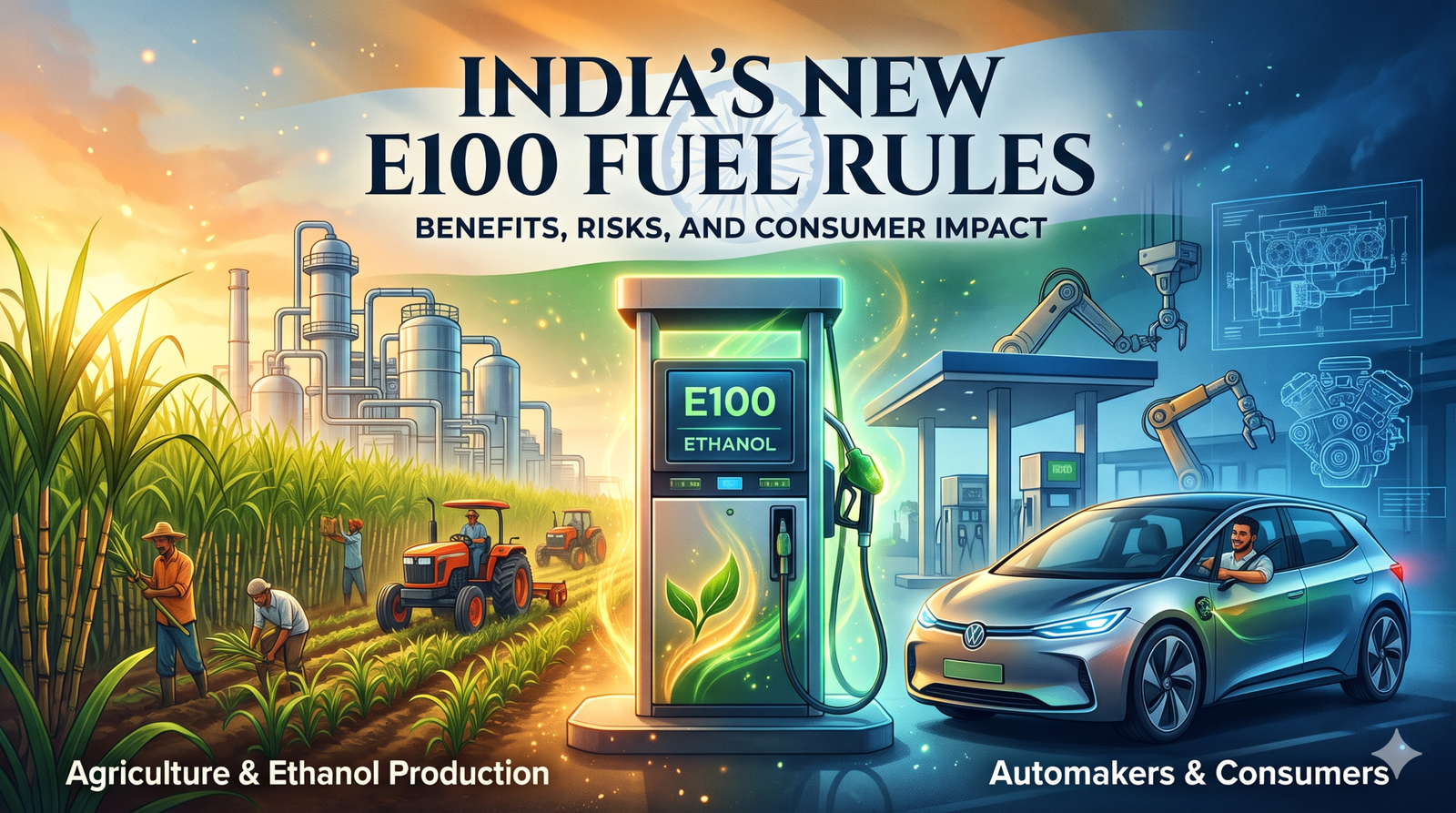
India buys roughly 85% of the crude oil it uses from other countries. Because of this massive reliance on foreign oil, any conflict or crisis in the global market quickly creates economic stress at home. To solve this problem and secure its own energy, the Indian government has been actively searching for alternatives to standard petrol. Ethanol has emerged as the leading solution, though the shift brings up several practical questions for everyday citizens.
New E100 Rules
The government recently updated the nation’s motor vehicle regulations to officially recognize E85 and E100 as vehicle fuels. The “E” stands for ethanol, and the number tells you the percentage of the fuel that is made of ethanol. E100 means the fuel is completely pure ethanol, while E85 is an 85% blend. This new rule does not mean drivers can start pumping pure ethanol into their current cars today. Instead, it serves as an official signal to car manufacturers, giving them the legal clearance to start designing and building brand-new engines capable of running on these high-ethanol blends.
The Shift From Petrol
Mixing ethanol into petrol is not a new concept, but it is speeding up. A decade ago, the ethanol mix was barely over one percent. Today, the standard mandate is E20, meaning a 20% ethanol mix. The government is pushing this transition for a few major reasons. Producing fuel domestically protects the economy from international oil shocks. It also creates a huge new revenue stream for the agricultural sector, generates manufacturing jobs, and provides a renewable energy source to help phase out fossil fuels.
Consumer Worries
Even with the national benefits, drivers are worried about how this affects their daily lives and budgets. Ethanol burns very differently than regular petrol, meaning you cannot safely swap E20 and E85 in the same engine without risking damage. Furthermore, while ethanol is generally cheaper to buy per liter, it holds less physical energy than petrol. A car running on ethanol will not travel as far as it would on the same amount of regular petrol. Drivers have to realize that a cheaper price at the pump does not automatically mean a cheaper cost per kilometer.
Hidden Environmental Costs
While ethanol is renewable, producing it on a massive scale creates new environmental and social challenges. Right now, India makes most of its ethanol from sugarcane, a crop that requires an enormous amount of water. If the demand for fuel skyrockets, growing enough sugarcane could drain groundwater in regions that are already struggling with water scarcity. Additionally, if farmers dedicate too much fertile land to growing crops for vehicle fuel instead of human consumption, it could easily lead to food shortages and higher grocery prices. Managing this shift requires balancing the country’s need for fuel with the basic need for food and water.