




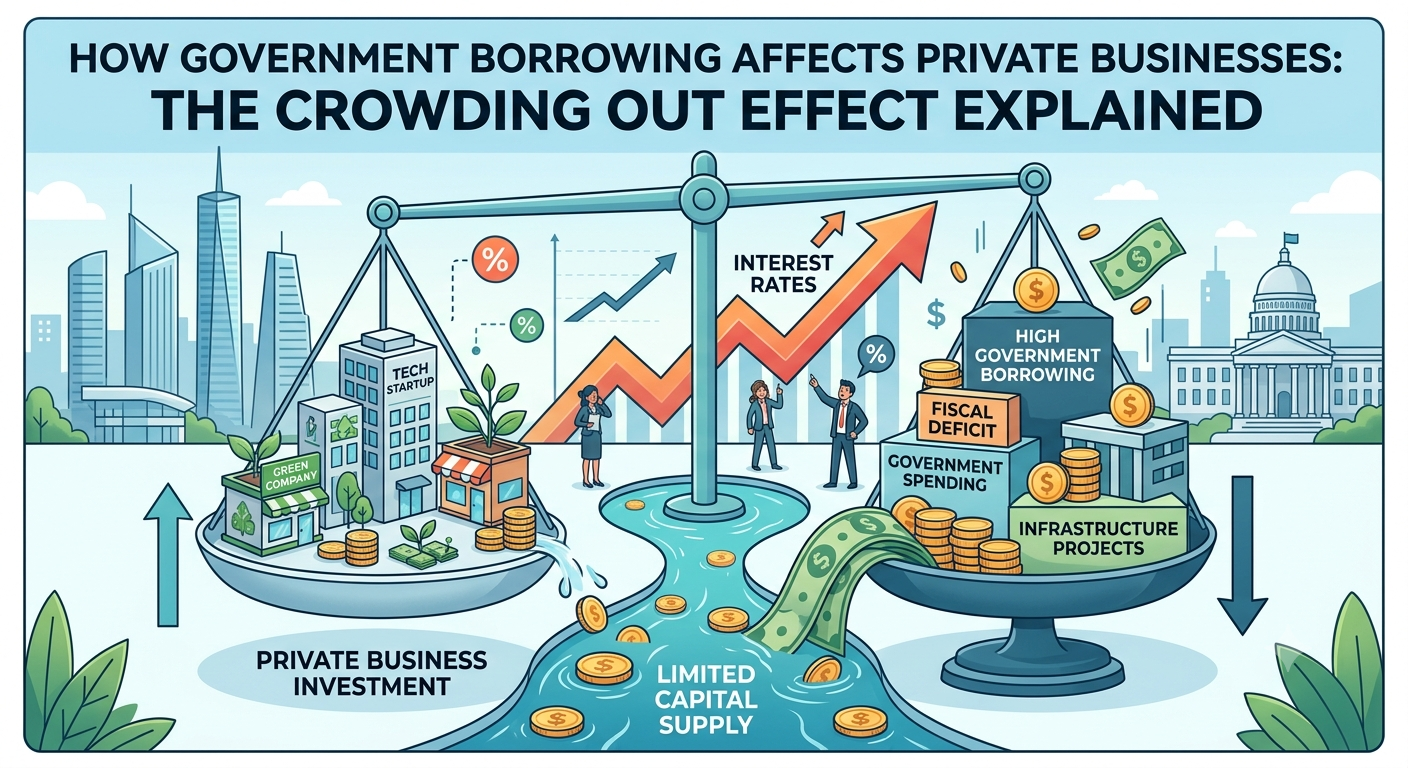
When a government manages its economy, its spending habits directly impact how much money is left over for everyday businesses and private citizens. To understand this relationship, we need to look at a basic economic concept known as the “Crowding Out” effect.
Here is a simplified breakdown of how government budgets influence private business growth, interest rates, and the broader economy.
Understanding the Budget Shortfall
Just like a household, a government has a budget that tracks what it earns (mostly through taxes) and what it plans to spend. In many developing nations, the government spends more money than it brings in.
If a government earns ₹100 but needs to spend ₹120 on public services, that missing ₹20 is called a fiscal deficit. To make up the difference, the government has to borrow money from the country’s banks and financial markets.
The Chain Reaction: What is Crowding Out?
There is only a limited supply of money circulating in the banking system at any given time. When a government needs to borrow heavily to cover its fiscal deficit, it takes a massive slice of that available money.
This creates a domino effect for the private sector:
Fewer Funds Available: With the government taking a large share of the pie, banks have much less money available to lend to private businesses and individuals.
Higher Interest Rates: Because the supply of money is low and the demand from businesses is still high, banks raise their interest rates.
Slower Business Growth: Expensive loans mean that businesses are less likely to borrow money for new factories, equipment, or expansion.
When the government essentially pushes private investors out of the borrowing market by soaking up all the available funds and driving up interest rates, economists call it the Crowding Out Effect.
How Central Banks Help Keep the Balance
While government spending on public infrastructure is important, it shouldn’t come at the cost of freezing private business growth. Finding a middle ground is crucial.
To prevent the private sector from being entirely crowded out, the central bank (such as the Reserve Bank of India) can step in using a strategy called calibrated monetary easing. This means the central bank carefully injects just enough money into the banking system to keep interest rates affordable for private businesses, even while the government is borrowing.
However, this must be done very carefully. A central bank cannot simply print endless amounts of new money to cover the government’s debts, as this would cause prices to skyrocket, leading to severe inflation.
Setting Rules for Government Spending
The most effective way to prevent crowding out is for the government to practice good financial discipline. This is often called fiscal consolidation.
Many countries have laws in place to keep government spending in check. For example, India uses the Fiscal Responsibility and Budget Management (FRBM) Act. This rulebook aims to cap the government’s fiscal deficit at a manageable percentage of the total economy (usually around 3% of the GDP).
By strictly limiting how much debt the government can take on, these laws ensure that:
The government borrows less from the public market.
Banks retain plenty of funds to lend out.
Interest rates stay low and stable.
Summary
The health of private businesses is closely tied to how responsibly a government manages its own budget. High government deficits lead to massive borrowing, which starves the private sector of affordable loans—a classic case of crowding out. By sticking to strict spending limits and carefully managing the money supply, an economy can support both necessary public projects and a thriving private sector.