





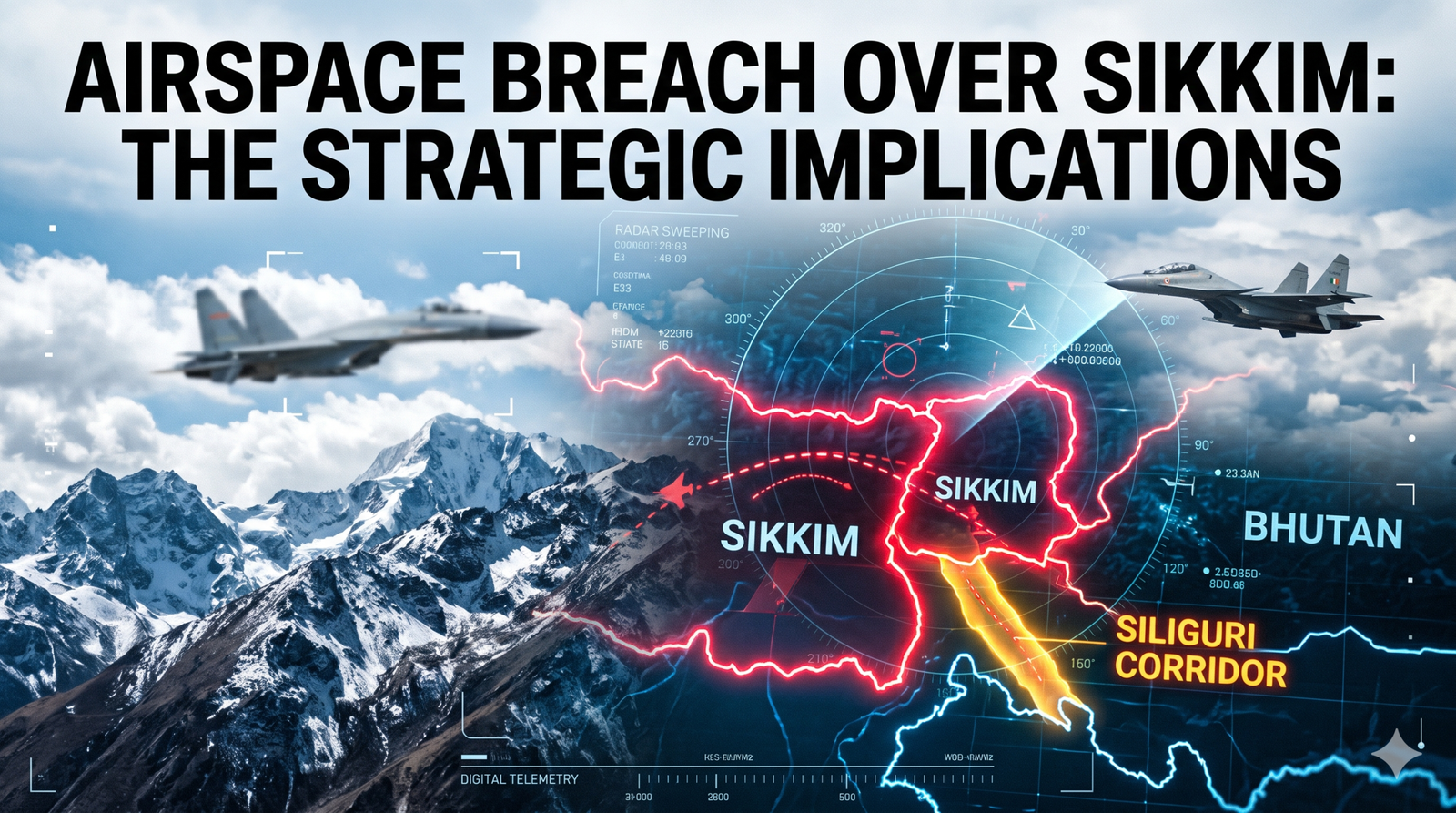
Recently, a foreign military aircraft breached Indian airspace over the Sikkim region. Rather than being an isolated navigational error, the aircraft remained in the area for a considerable duration and only retreated after repeated warnings from the Indian Air Force. This incident raises critical questions about regional stability and border security.
Why the Location is a Strategic Vulnerability
Proximity to the Siliguri Corridor: The airspace breach occurred dangerously close to the “Chicken’s Neck,” a narrow geographical strip that serves as the sole land bridge connecting mainland India to its northeastern states.
The Shadow of Past Standoffs: The area is located near the Doklam plateau, a site that experienced significant geopolitical friction and a prolonged military standoff in 2017. Disruptions in this sensitive zone threaten both logistical mobility and national sovereignty.
A Historical Warning Pattern: Similar airspace incursions took place in Uttarakhand in 2017 and Ladakh in 2020. In both historical instances, these aerial intrusions served as precursors to major on-ground border skirmishes.
Understanding the Adversary’s “Gray Zone” Tactics
Instead of engaging in full-scale conflicts, the adversary frequently utilizes “Gray Zone Warfare”—coercive actions that sit just below the threshold of traditional war but steadily alter ground realities. Key elements of this strategy include:
Salami Slicing: Making gradual, incremental territorial advances to subtly alter the status quo over time without triggering a massive military retaliation.
Military Intimidation: Conducting frequent border patrols, mobilizing troops, and flying aircraft near contested zones to keep the opposing side in a constant state of hyper-alertness.
Aggressive Infrastructure Expansion: Rapidly constructing roads, bridges, and massive dams extremely close to international borders to support future logistical maneuvers.
Information and Psychological Warfare: Attempting to legitimize territorial claims by renaming locations on official maps and exerting diplomatic and economic pressure.
India’s Evolving Response and Preparedness
Recognizing these recurring patterns, India has actively shifted its defensive posture to ensure readiness against unconventional border tactics.
Integrated Air Defense: India has vastly improved its surveillance mechanisms, heavily utilizing the Integrated Air Command and Control System to unify data from multiple sensors for rapid, coordinated responses.
Border Infrastructure Push: The Border Roads Organisation (BRO) is accelerating the construction of strategic roads, tunnels, and airfields. Initiatives like “Project Swastik” in Sikkim are specifically focused on fortifying connectivity in multi-border intersections.
Military Modernization: There is a renewed focus on modernizing fighter aircraft and radar technologies, alongside promoting joint operational readiness between the Army, Navy, and Air Force.
Diplomatic Engagement: While heavily fortifying its military capabilities, India continues to prioritize diplomatic border talks and military-level communications to de-escalate tensions and prevent minor frictions from spiraling into full-scale conflicts.