





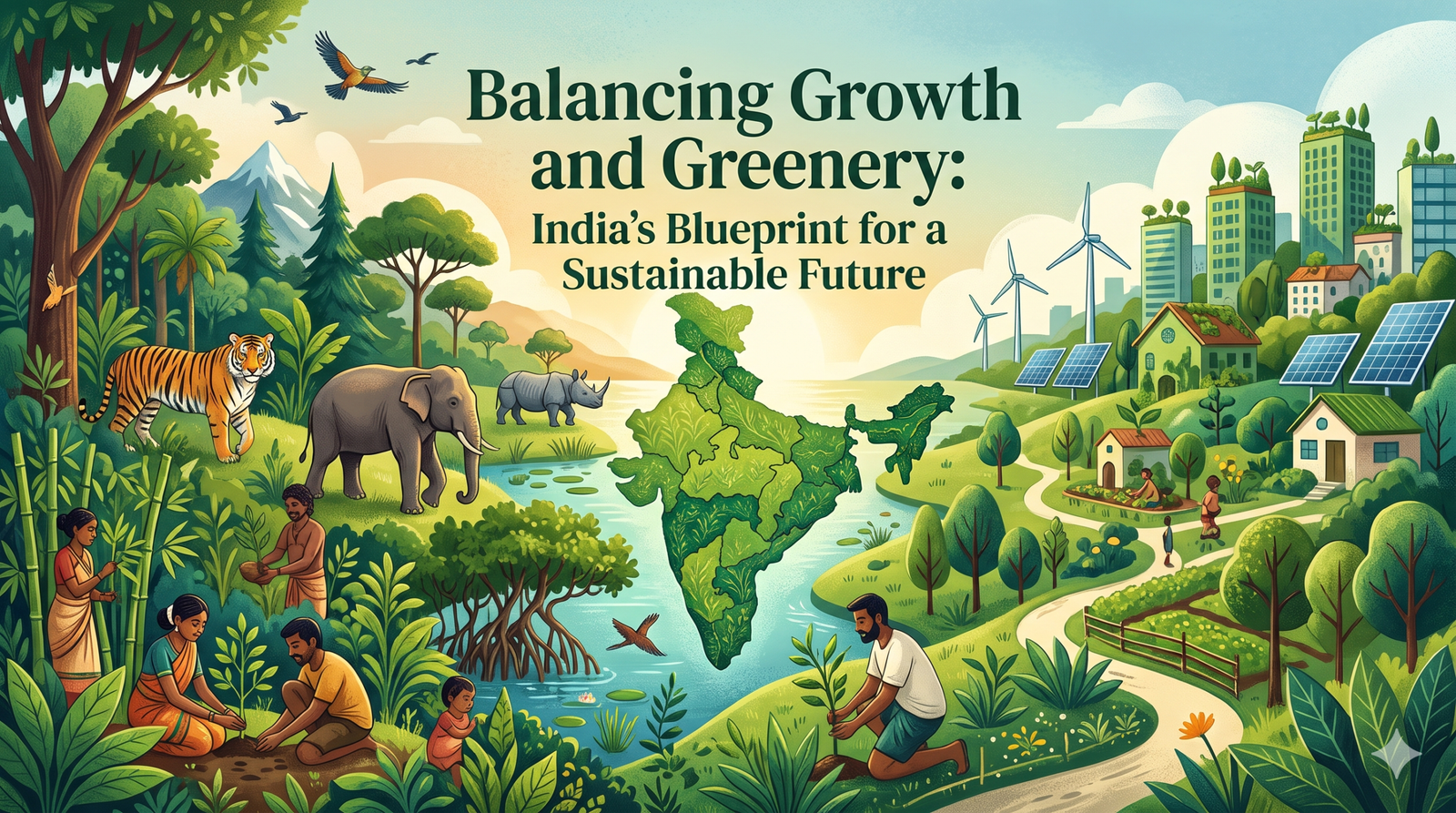
In an era where the push for economic advancement frequently collides with the need for ecological preservation, India is striving to harmonize the two. With a bold objective to rehabilitate 25 million hectares of degraded land by the year 2030, the nation is placing large-scale restoration at the forefront of its climate strategy. This forward-looking vision relies on active local community participation, the revival of native plant species, and creative funding mechanisms to fulfill global climate commitments.
A Rising Global Green Power
India has made remarkable strides on the world stage, recently climbing to the ninth position globally for its total forested area, as noted in the 2025 Global Forest Resources Assessment by the Food and Agriculture Organization. Holding roughly 2% of the world’s forests—translating to about 72.7 million hectares—India has also secured the third spot worldwide for its annual net gain in forest area.
This expansion is not limited to natural forests alone; the country is also a major leader in plantations. India currently hosts a massive 11.8 million hectares of bamboo resources and ranks fifth globally in rubber plantations. Furthermore, India and Indonesia collectively dominate the agroforestry sector, accounting for nearly all of Asia’s agroforestry area and roughly 70% of the global total.
Tracking Progress: The 2023 Forest Report
The 18th edition of the India State of Forest Report confirms a positive environmental trajectory. Between 2013 and 2023, the nation’s forest cover expanded from approximately 698,000 square kilometers to over 715,000 square kilometers. Major environmental threats are also being managed more effectively; recorded forest fire hotspots dropped significantly from over 223,000 incidents in 2021-2022 to just under 204,000 in 2023-2024. Due to these conservation efforts, India’s carbon sink capacity has surged to 30.43 billion tons of CO2 equivalent, inching the nation closer to its 2030 target.
Government Action and Grassroots Movements
Several state-backed initiatives are actively fueling this ecological resurgence:
Green India Mission & Nagar Van Yojana: Programs dedicated to sweeping forest restoration and the cultivation of crucial green spaces within urban environments.
MISHTI: A specialized 5-year initiative aimed at revitalizing and promoting vital mangrove ecosystems along the Indian coastline.
Ek Ped Maa Ke Naam: A unique campaign launched in 2024 that encourages citizens to foster a deep connection with nature by planting trees in honor of their mothers.
However, the true champions of this green movement are often found at the grassroots level. Figures like Padmashri Tulsi Gowda, affectionately known as the “Mother of Trees,” have dedicated their entire lives to turning barren landscapes into thriving, lush forests. Indigenous tribal communities also play an indispensable role, utilizing age-old sustainable practices that allow them to live off the land without depleting its resources.
A Haven for Biodiversity
Despite occupying just 2.4% of the earth’s landmass, India supports roughly 8% of the world’s known biodiversity. The country serves as the largest global habitat for tigers, Asiatic elephants, and single-horned rhinos, and it is the sole home of the Asiatic lion—whose numbers have steadily risen. Leopard populations have similarly seen a dramatic 60% increase in recent years. To protect these vibrant habitats, India has expanded its network of protected wetlands to 75 Ramsar sites and dramatically increased the number of community reserves across the nation.
Conclusion
India’s environmental journey proves that targeted, forward-thinking policies, when combined with a deep-rooted cultural reverence for nature, can yield extraordinary results. By continuing to prioritize both active conservation and sustainable livelihoods, the nation is successfully writing a blueprint for a greener, more resilient future.