




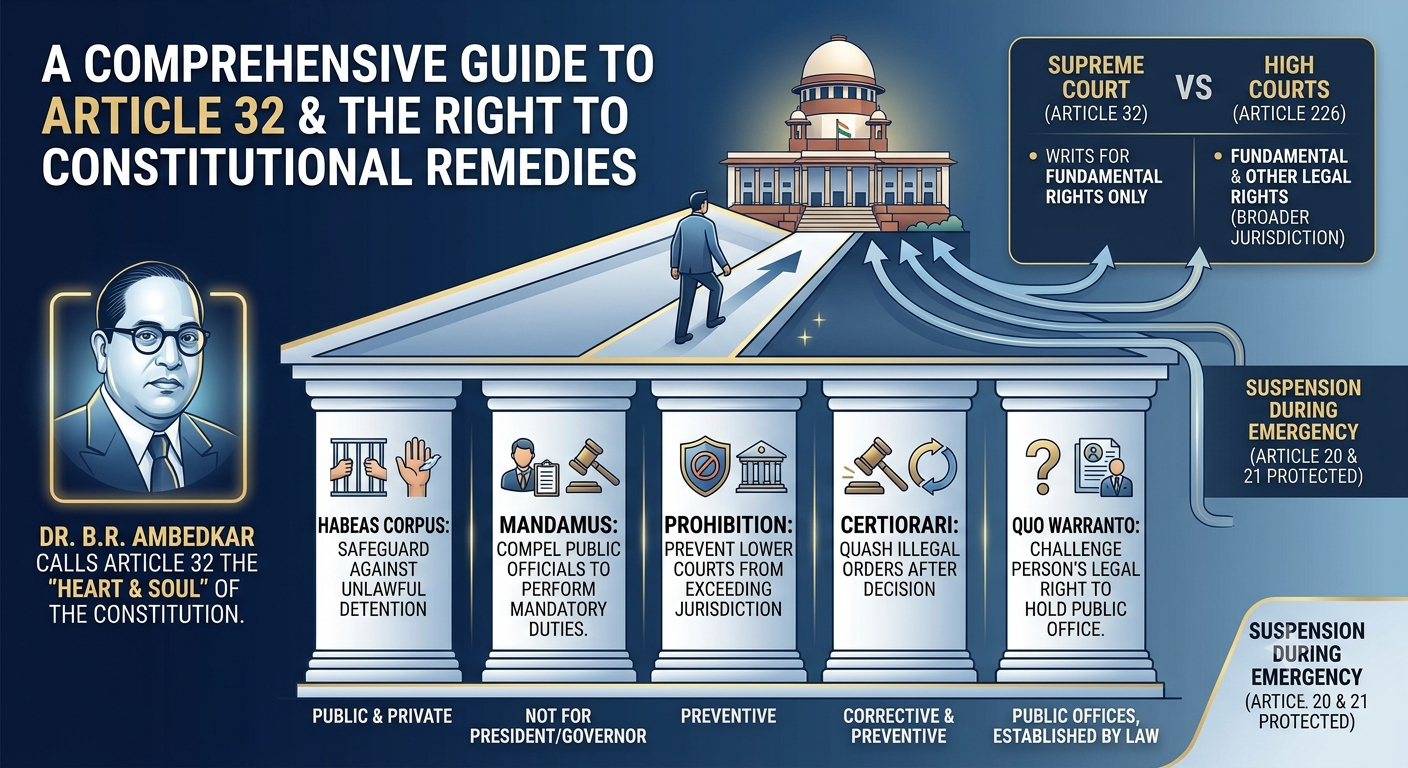
Merely writing down a list of fundamental rights in a constitution is not enough; there must be a strong legal mechanism to enforce them. In India, this crucial safeguard is embedded in Article 32. Recognizing its profound importance, Dr. B.R. Ambedkar famously referred to it as the “heart and soul” of the Indian Constitution.
Bypassing the Standard Judicial Hierarchy
Article 32 is classified as a Fundamental Right itself, found in Part III of the Constitution. Its primary purpose is to empower citizens to seek immediate justice if their constitutional rights are infringed upon.
In standard legal disputes, individuals must typically navigate a ladder of courts—starting at the district level, appealing to the High Court, and only then reaching the Supreme Court. However, because fundamental rights are so critical, Article 32 allows citizens to bypass this lengthy process and approach the Supreme Court directly for swift resolution.
The Five Constitutional Writs
To enforce these rights, the Supreme Court issues “writs,” which are formal, written legal orders commanding a party to act or cease acting in a certain way. The Constitution outlines five specific types of writs:
Habeas Corpus: Translating roughly to “produce the body,” this is a safeguard against illegal imprisonment. If someone is detained unlawfully, the court can use this writ to force the detaining party to present the individual in court. If the detention lacks legal justification, the person is immediately released. This is unique because it can be issued against both government authorities and private citizens.
Mandamus: Meaning “we command,” this writ is used to compel a public official, government body, or lower court to perform their mandatory legal duties. For instance, if a government agency arbitrarily refuses to process a valid application, the court can order them to do so. It is not applicable against private individuals, the President, or state Governors.
Prohibition: This is a preventive tool directed at lower courts or judicial bodies. If a lower court attempts to hear a case that falls outside its legal jurisdiction, a higher court will issue a writ of prohibition to halt the proceedings before a judgment is rendered.
Certiorari: While Prohibition prevents an overreach before it happens, Certiorari corrects it after the fact. If a lower court or tribunal has already issued a ruling on a matter beyond its jurisdiction, the higher court uses this writ to quash or invalidate the decision. Following legal precedents established in the 1990s, it can also be used against administrative actions that unfairly infringe on an individual’s rights.
Quo Warranto: Meaning “by what authority,” this writ is used to challenge a person’s legal right to hold a public office. It prevents individuals from illegally occupying formal government positions. Unlike other writs where the victim must file the petition, any interested member of the public can seek a writ of Quo Warranto.
Comparing Supreme Court and High Court Powers
While Article 32 specifically grants the Supreme Court the power to issue writs for the enforcement of Fundamental Rights, High Courts possess similar powers under Article 226. Interestingly, the High Court’s writ jurisdiction is actually broader than the Supreme Court’s. While the Supreme Court is restricted to issuing writs solely for Fundamental Rights under Article 32, High Courts can issue them for both Fundamental Rights and other ordinary legal rights.
Suspension During Emergencies
Fundamental Rights are not absolute. During a declared National Emergency, the enforcement of most rights under Article 32 can be temporarily suspended. However, a crucial safeguard was introduced by the 44th Constitutional Amendment: the rights to protection in respect of conviction for offenses (Article 20) and the protection of life and personal liberty (Article 21) can never be suspended, ensuring basic human security even during national crises.