




Imagine playing a highly competitive sport where the captain of one team also gets to make the rules of the game and act as the sole referee. If their team commits a foul, the captain simply changes the rule or waves it off. The game would quickly become unfair, and the opposing team would be powerless.
This same logic applies to how a country is governed. If the same group of people gets to write the laws, put those laws into action, and punish those who break them, absolute power is created. To prevent this, democratic societies use a system designed to divide these responsibilities so that no single group becomes too powerful.
The Three Pillars of Governance
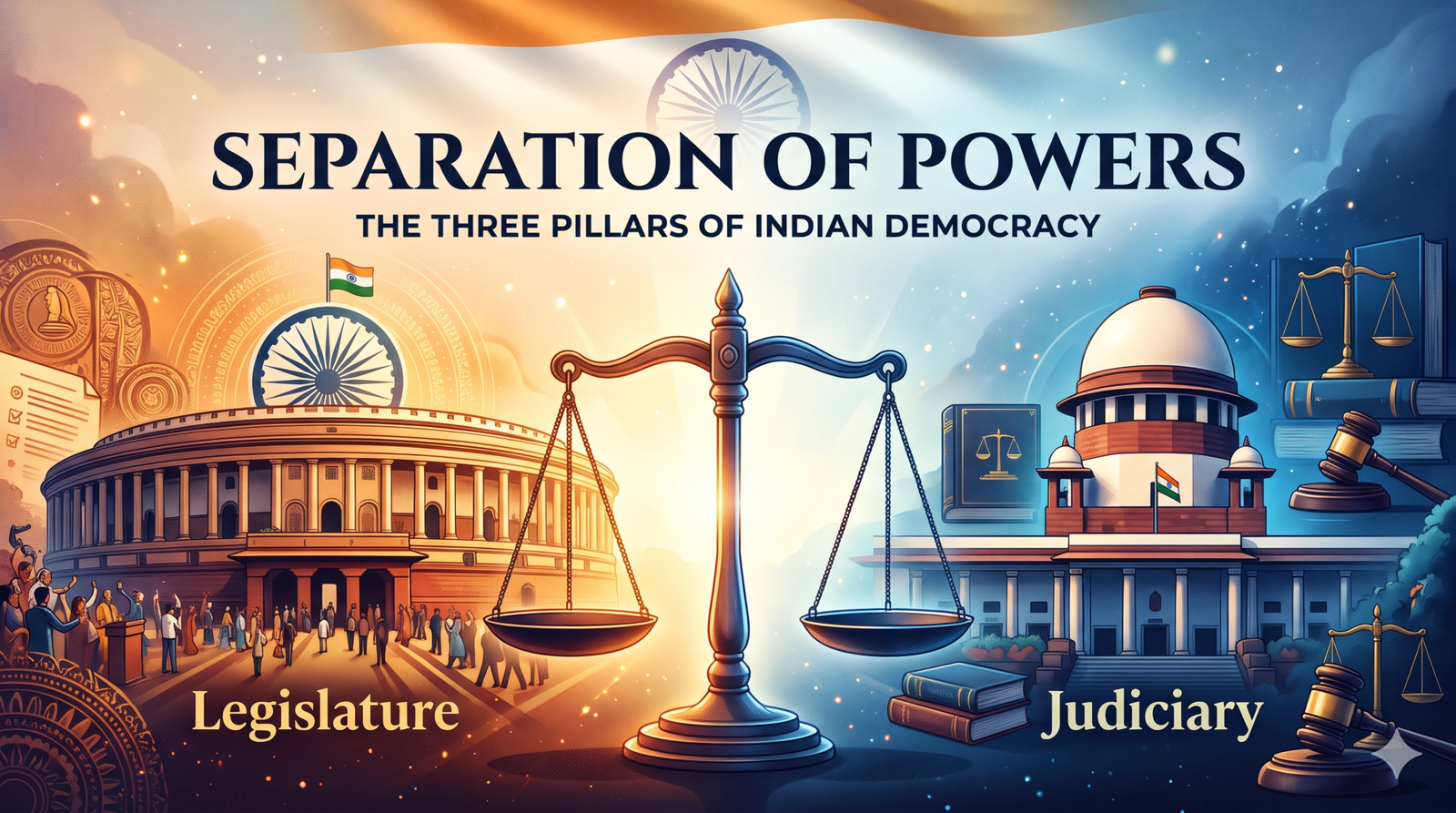
To keep power balanced, a democracy divides the heavy lifting of running a country into three distinct departments:
The Lawmakers (Legislature): This is the group of elected representatives whose main job is to debate, draft, and pass laws. They are the voice of the people and control the public budget.
The Implementers (Executive): This branch includes the head of the government, ministers, and public officials. Their job is to put the laws into action and manage the day-to-day administration of the country.
The Umpires (Judiciary): The courts make up this branch. They do not write the laws, but they interpret them, resolve disputes, and ensure that both the lawmakers and the implementers are following the rulebook—the Constitution.
The Indian Approach: Shared Responsibilities
While some countries, like the United States, build thick walls between these three branches, India’s system is more like a family business where roles occasionally overlap. Because India follows a parliamentary democracy, the leaders who implement the laws (the Prime Minister and their cabinet) are actually chosen from the group of people who make the laws (the Parliament). The executive branch can only survive as long as it has the support of the legislative branch.
Because of this interconnected design, complete separation is impossible. The Constitution allows for practical overlaps to keep the country running smoothly. For example, if an urgent issue arises while Parliament is on a break, the President can issue temporary emergency laws. Similarly, if there is a massive gap in the law that is putting citizens at risk, the courts can step in and issue temporary guidelines until the lawmakers draft a proper permanent law.
Setting the Boundaries
Over the decades, serious disagreements have naturally popped up between the elected government and the courts. When the government passes a law that the courts strike down as unfair, it sparks a massive debate over who is actually in charge. Through a series of historic legal battles, the supreme courts have established a few golden rules:
The Foundation Cannot Be Touched: The government has the right to amend the Constitution to keep up with the times. However, the courts have firmly established that lawmakers cannot alter the “basic structure” or core identity of the Constitution. Just as you can repaint a house but cannot destroy its foundation without collapsing the building, the government cannot destroy the foundational principles of democracy, justice, and equality.
Everyone is Subject to Review: The government cannot use its power to pass laws that protect itself from legal scrutiny. Every action and every law must be open to being checked by the courts to ensure it does not violate citizen rights.
Stepping In vs. Taking Over: There is a fine line between courts protecting citizens and courts trying to run the country. When the judiciary steps in to protect fundamental rights because the government is failing to do so, it is seen as a necessary safeguard. However, if judges start dictating minor administrative policies or taking over tasks meant for elected officials, it is viewed as crossing the line.
The true beauty of this system is that it relies on constant checks and balances. The lawmakers keep an eye on the implementers, the courts ensure the lawmakers play by the rules, and the lawmakers have strict procedures to hold judges accountable if they misbehave. The goal is never to declare one single branch as the ultimate boss. The ultimate winner is meant to be the citizen, protected by a system where every single exercise of power has a strict, well-defined limit.