



In the contemporary geopolitical landscape, traditional warfare and territorial conquests are no longer prerequisites for undermining a competing nation’s economy. Instead, exerting control over specific, highly sought-after raw materials can effectively stall a country’s industrial progress. This dynamic poses a significant challenge for nations with rapid growth trajectories. India has outlined expansive goals to dominate electric vehicle (EV) production, establish a robust domestic semiconductor manufacturing hub, and dramatically scale up its solar energy infrastructure. However, realizing these technological leaps requires an uninterrupted supply of specialized resources known as critical minerals. Currently, a massive bottleneck threatens these ambitions: China commands over 90% of the worldwide refining capacity for these vital elements, triggering a global race to secure independent supply chains.
Understanding the Value of Critical Minerals
Critical minerals serve as the foundational building blocks for modern technology, green energy, and advanced industrial applications. These materials include lithium and graphite, which are non-negotiable components for manufacturing high-capacity batteries and energy storage solutions. Rare earth elements form another crucial category, acting as the backbone of heavy-duty magnets, electronic motors, wind turbines, and sophisticated defense equipment. Additionally, materials like gallium are indispensable for everyday technological infrastructure, powering everything from basic electronics to the fiber-optic cables that sustain global internet connectivity. The overwhelming concentration of these resources within a single nation’s borders remains a pressing concern for international markets.
Quantifying the Market Concentration
Data compiled by the International Energy Agency highlights the sheer scale of this monopoly. Beyond controlling upwards of 90% of the broader critical mineral processing sector, China specifically refines between 70% and 75% of the world’s lithium and cobalt—materials essential for lithium-ion technology. Furthermore, more than 90% of all battery-grade graphite undergoes refinement within their domestic facilities. This intense centralization is particularly alarming given the rapid acceleration of global consumption; the worldwide demand for lithium alone surged by approximately 30% in 2024.
Leveraging Supply Chains as Geopolitical Tools
The most significant advantage held by China is its end-to-end dominance over the supply chain. While countries like India possess substantial unmined mineral wealth, they currently lack the advanced technological infrastructure required to process and refine these raw ores into commercially usable grades. China has established both widespread mining operations—often secured through international extraction contracts—and the necessary state-of-the-art refineries. This dual capability allows for the weaponization of trade. A prominent example occurred in December 2024, when export restrictions were implemented on rare earth elements destined for the United States. By tightening licensing requirements, such maneuvers inject volatility and fear into international manufacturing sectors, effectively functioning as a geopolitical pressure tactic.
Strategic Countermeasures and Domestic Policies
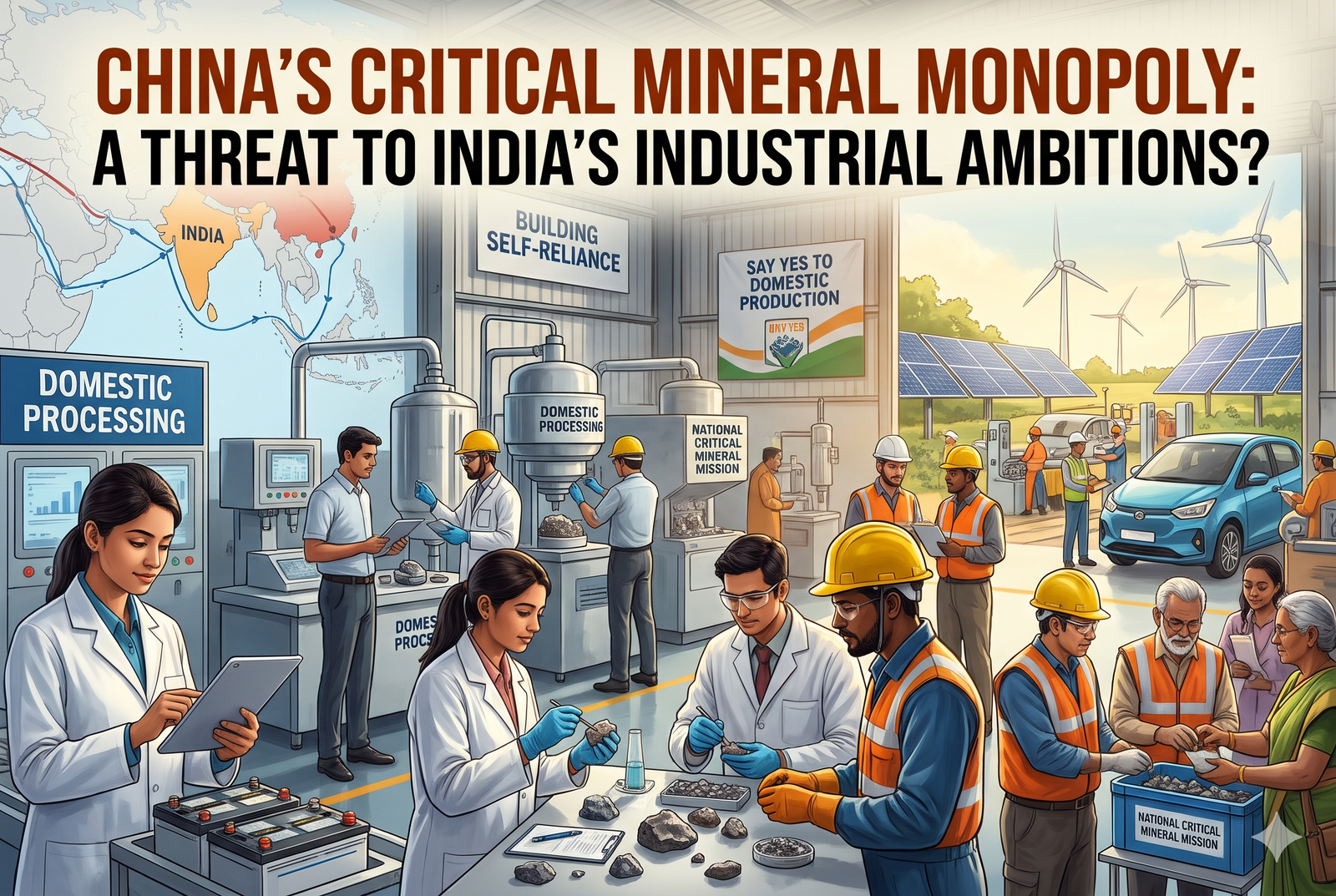
Recognizing the severe vulnerabilities tied to import reliance, the Indian government introduced the National Critical Mineral Mission in 2025. Backed by a financial commitment of ₹34,300 crores distributed over a seven-year timeline, this initiative aims to overhaul the nation’s resource independence. The framework is built on four primary pillars:
Exploration: Extensive domestic surveying to locate and evaluate the commercial viability of internal mineral reserves.
Overseas Resources: The strategic acquisition of international mining assets to diversify suppliers and dilute single-nation dependency.
Domestic Processing: Heavy financial backing for the development of local refining infrastructure, acknowledging that raw extraction is insufficient without the means to purify it.
Recycling: Robust recovery programs designed to extract valuable elements from discarded batteries and electronic waste to create a circular supply chain.
Securing a resilient industrial future requires a fundamental shift in national strategy. Rather than operating merely as a source of unrefined raw materials, developing economies must transition into fully realized industrial powers capable of processing, manufacturing, and deploying these critical technologies entirely independently.