





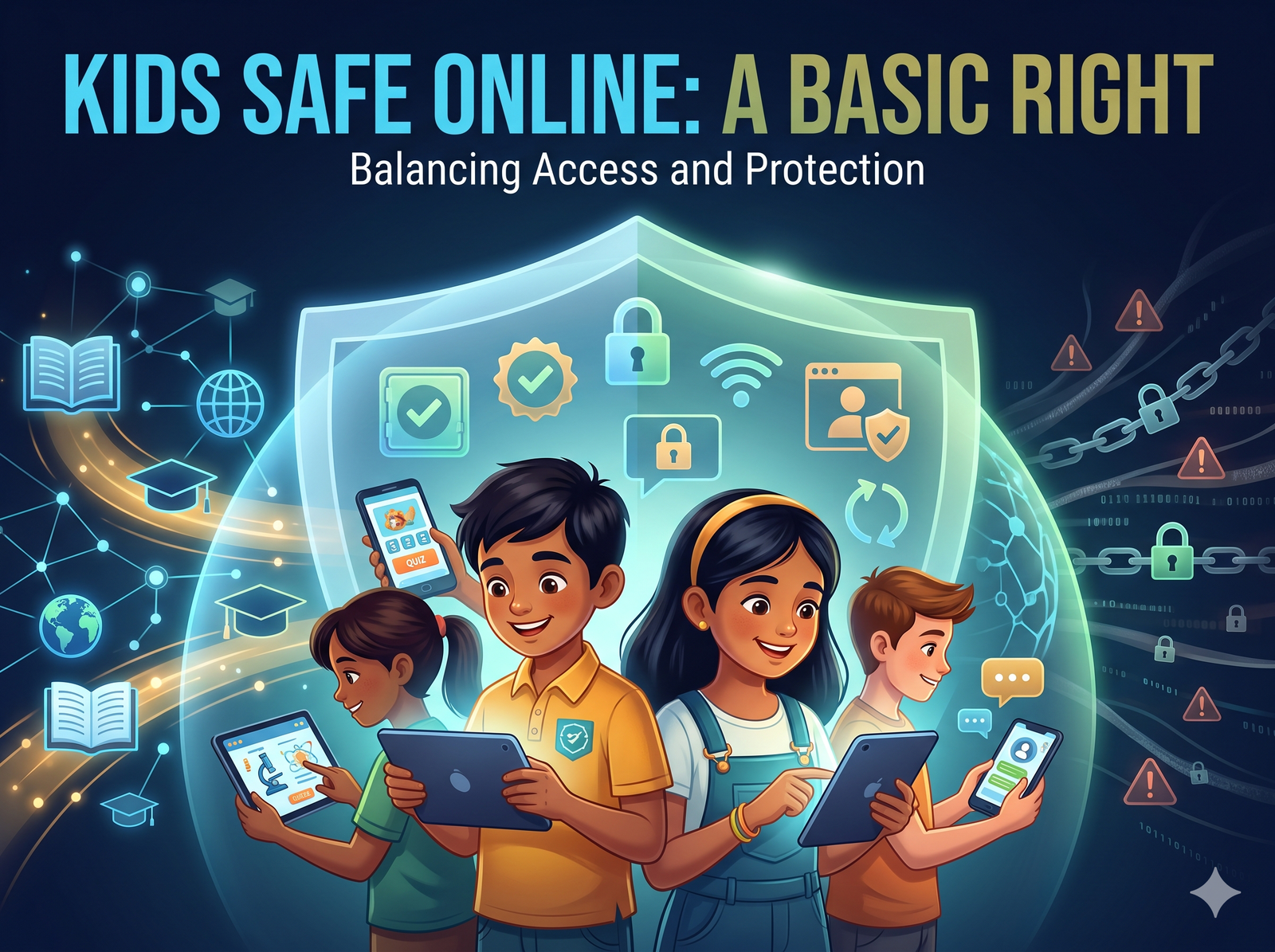
Today, the internet is an important part of growing up. Children use it to learn, share their thoughts, and find new opportunities. However, the online world also has serious dangers, such as cyberbullying, inappropriate content, and people who want to steal private information.
This brings up a big question: To keep kids safe, should we just stop them from using the internet?
A Basic Right for Everyone
Recently, the Supreme Court of India answered this question. They ruled that using the internet is a basic right for everyone, including children.
The Court explained that we cannot simply ban kids from the internet to keep them safe. Children have a right to learn and explore, but they also have a right to be protected. Instead of taking the internet away, the government and tech companies must work harder to remove bad content and make the online world a safer place.
The Gap in Online Safety
More children than ever are going online. Recent studies show that most teenagers have access to a smartphone at home, mostly using it for social media and schoolwork.
However, there is a big problem: many kids do not know how to stay safe. A large number of children do not even know basic safety steps, like how to block a stranger or change their passwords.
Why Catching Bad Actors is Hard
India has laws to protect children’s private data, but enforcing these rules is very difficult. The internet does not have borders, so an online crime can happen in one country while the criminal is sitting in another.
Another issue is how social media and gaming apps are built. Companies often use hidden computer rules, called algorithms, to keep children glued to their screens. This can expose them to harmful content over time.
Global Teamwork and Awareness
Experts point out that passing laws in just one country is not enough. Tech-savvy kids can easily find ways around local internet blocks. To truly stop online dangers, countries all over the world need to work together and create global internet rules.
Furthermore, technology alone cannot fix the problem. Just like we teach kids to look both ways before crossing the street, we must teach them “digital safety.”
Conclusion
Protecting children online does not mean hiding them from the digital world. It is a shared job for the government, tech companies, schools, and parents. The real goal is to teach children how to make smart choices online, protect their privacy, and ask for help if they ever feel unsafe.