




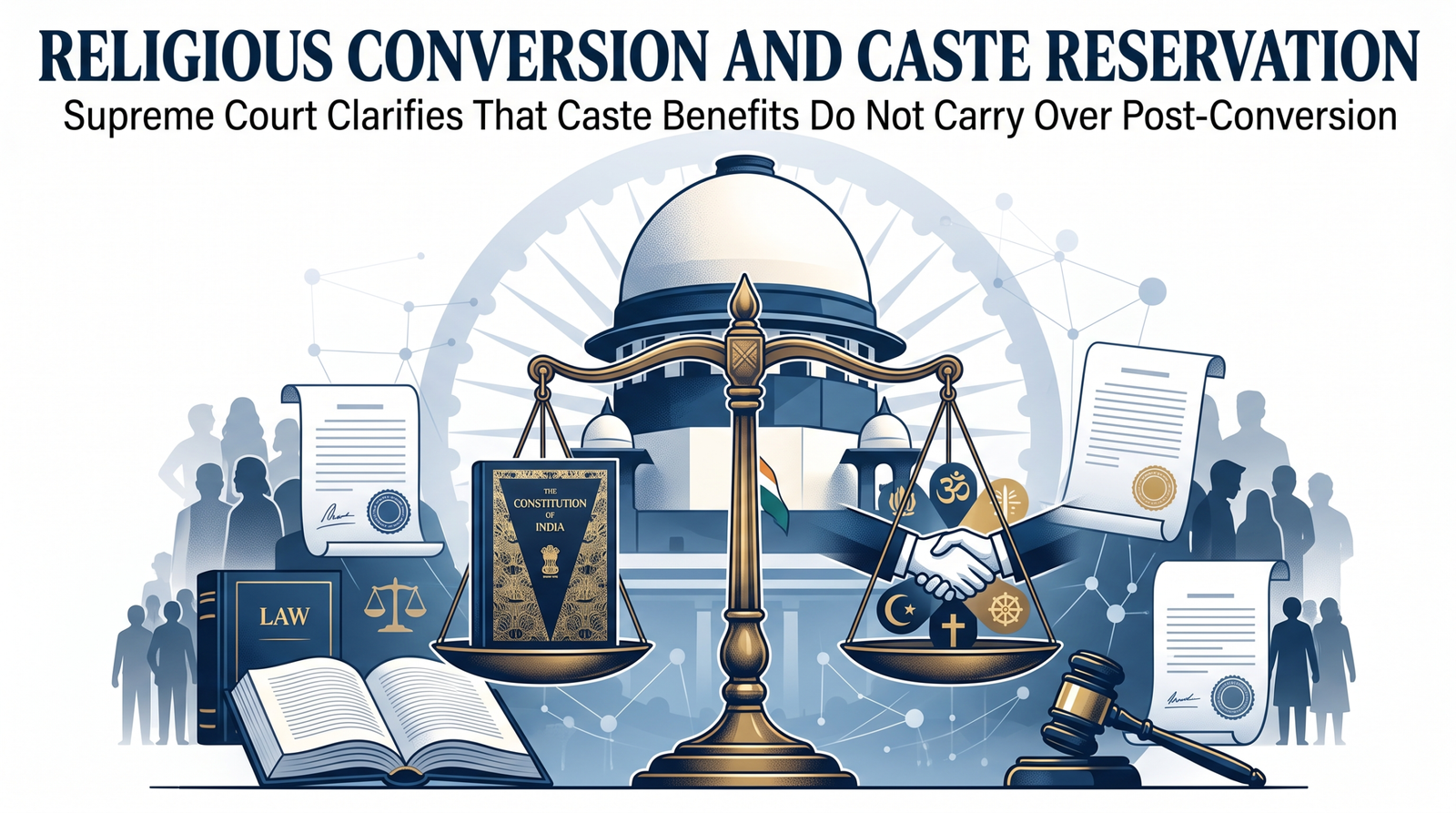
The Supreme Court of India has agreed with a Madras High Court decision regarding religious conversion and caste benefits. The ruling states that if a person changes their religion, they cannot automatically keep their old caste status to claim reservation benefits in their new religion.
What Started the Case
A person who changed their religion from Hinduism to Islam wanted to keep their previous caste status.
They applied for a certificate to be recognized as part of the Muslim Labbai community to get reservation benefits.
In 2024, the Tamil Nadu government passed an order allowing certain converted individuals to carry over their backward class or Scheduled Caste status into the Muslim community.
Why the Courts Said No
The courts canceled the Tamil Nadu government’s order for several reasons:
No Automatic Carryover: Caste status does not automatically transfer when a person joins a new religion.
Different Religious Groups: Simply joining a new religion does not instantly make someone a member of a specific backward group within that religion.
Missing Proof: The state government did not provide a logical reason for allowing only specific groups to keep their status.
Strict Rules for Benefits: Reservation benefits must follow strict legal rules and cannot be handed out based on assumptions.
The Rules in the Constitution
The Indian Constitution allows for special benefits for disadvantaged groups, but there are clear boundaries:
Under a specific 1950 order, Scheduled Caste status is only recognized for followers of Hinduism, Sikhism, and Buddhism.
This Scheduled Caste status does not apply to Islam or Christianity.
Because of this, a person cannot take their Scheduled Caste status from Hinduism and use it to get benefits after converting to Islam.
Looking at the Bigger Picture
This ruling makes the law very clear, but it also points out ongoing social problems. When a disadvantaged person changes their religion, their everyday struggles and vulnerability often stay the same. Changing religions does not erase social discrimination. To fairly help people in a diverse society, future solutions might need to look at actual social and economic hardships rather than just religious labels, as long as these changes follow the limits set by the Constitution.