




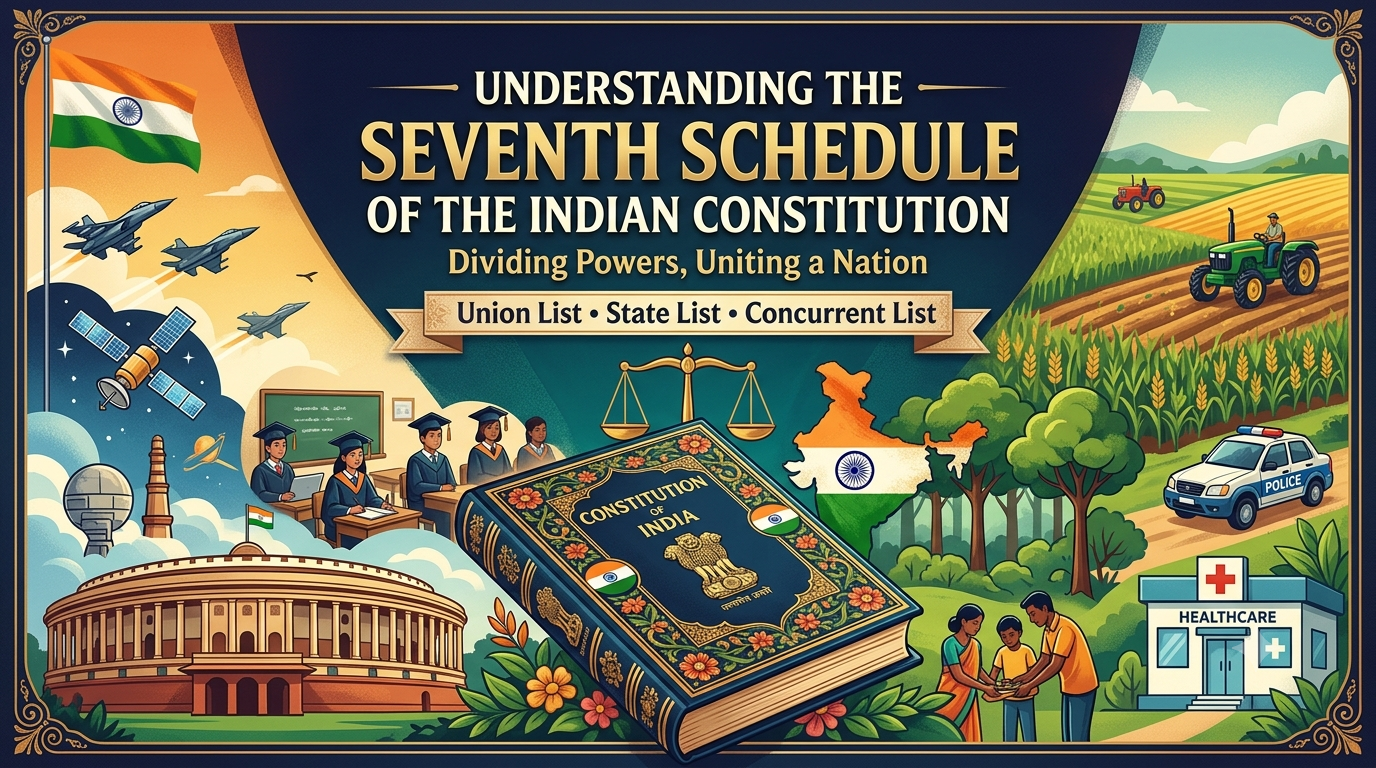
The Indian Constitution is the supreme law that guides the world’s largest democracy. When building the nation, the creators faced a major challenge: how to keep a highly diverse country united while giving local regions the freedom to manage their own affairs. To solve this, they designed a federal system that divides power between the central government in New Delhi and the individual state governments. The specific rulebook for this division of power is the Seventh Schedule.
How Power is Divided
During the creation of the Constitution, leaders knew India needed a strong central government to maintain national unity. At the same time, they understood that states needed the authority to solve their own local problems. To balance this, they divided all law-making powers into three separate categories. This system is upheld by two main constitutional rules:
Article 246: This rule officially creates the three categories—the Union List, the State List, and the Concurrent List—and clearly explains which government has the authority to make laws for each.
Article 254: This acts as a tie-breaker. If both the central government and a state government make a law about a shared topic and those laws clash, the central law usually wins. A state law can only overrule a central law if it specifically receives the approval of the President of India.
The Three Lists Explained
1. The Union List (Central Government)
This list covers topics of national importance. Because these issues require a single, consistent rule across the entire country, only the central Parliament can make laws about them.
Number of Topics: Started with 97, now has 100.
Examples: National defense, foreign affairs, railways, atomic energy, and banking.
Why it matters: If every state had its own military or foreign policy, the country would be vulnerable and chaotic. This list keeps the nation secure and unified.
2. The State List (State Governments)
This list includes topics that matter most at the local or regional level. State governments have the power to make laws here, allowing them to serve their specific populations effectively.
Number of Topics: Started with 66, now has 61.
Examples: Local police, public health, sanitation, and agriculture.
Why it matters: It gives states the freedom to govern their day-to-day internal matters based on their unique geography and local needs.
3. The Concurrent List (Shared Power)
This is a shared space where both the central Parliament and state governments can create laws. It encourages teamwork between the two levels of government on complex social issues.
Number of Topics: Started with 47, now has 52.
Examples: Education, forests, marriage, adoption, and trade unions.
Changes Over Time: Over the years, the government has adjusted this list to improve national teamwork. For example, a major change in 1976 moved important topics like education and forests from the State List to the Concurrent List so the central and state governments could manage them together.
Working Together for the Future
The Seventh Schedule is essentially a map for national teamwork. By clearly stating who is responsible for what, it prevents confusion and legal battles between the central and state governments. In today’s fast-paced world, dealing with complex issues like digital technology, environmental protection, and public health requires national guidelines combined with localized action. The Seventh Schedule makes this shared responsibility possible, ensuring that India remains a unified country while still respecting the diverse identities of its individual states.