




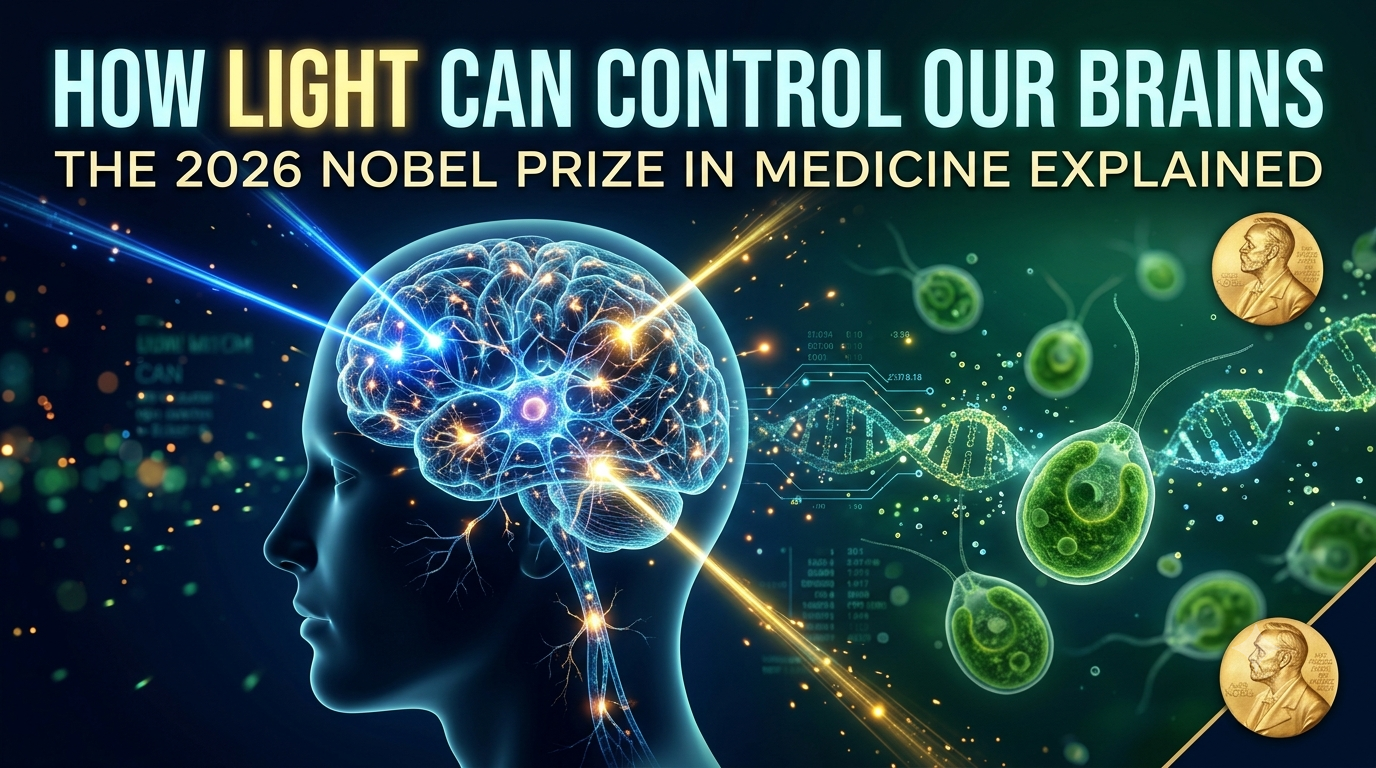
Imagine treating chronic pain, depression, or even blindness simply by flipping a light switch inside the body. While it sounds like a futuristic movie plot, this incredible concept is now a real area of science. It is the exact breakthrough that earned three scientists—Karl Deisseroth, Peter Hegemann, and Georg Nagel—the 2026 Nobel Prize in Medicine.
They were awarded for developing a revolutionary technique called “optogenetics,” which allows scientists to turn individual brain cells on or off using nothing but light.
The Secret Found in Pond Scum
The journey to this medical breakthrough actually started with common green algae. These tiny, single-celled organisms do not have a brain, yet they naturally know how to swim toward sunlight to survive.
Scientists discovered that the algae accomplishes this using a special protein that acts like a microscopic locked door on the surface of the cell. When a specific type of light—blue light—hits this protein, the door pops open. This allows energy-carrying particles to rush inside, sending a signal that tells the algae to move.
Moving the Switch to the Brain
The brilliance of the Nobel-winning scientists was realizing that this light-activated “door” from algae could be used to control the complex nervous systems of animals and humans.
Our brains are made of billions of nerve cells, called neurons, which communicate by firing tiny electrical signals. Through genetic engineering, scientists figured out how to copy the light-sensitive protein from the algae and insert it directly into targeted brain cells.
Once these specific brain cells have the protein, they can be controlled with absolute precision. By shining blue light onto them (often through extremely thin fiber-optic cables), scientists can instantly turn those specific brain cells “on.” Using a different protein and yellow light, they can turn them completely “off.”
A Massive Leap for Medicine
Before optogenetics, trying to treat a specific problem in the brain was like shutting off the main power breaker to your entire house just to turn off a single reading lamp in the bedroom. Older treatments, like broad medications or electrical shocks, affected large areas of the brain all at once.
Optogenetics allows doctors to target only the exact cells causing a problem without disturbing the rest of the brain. This opens up incredible possibilities for the future of medicine:
Restoring Sight: Researchers are actively testing if injecting these light-sensitive proteins into damaged eyes can help blind people see again.
Mental Health: Conditions like severe anxiety, depression, and drug addiction could potentially be treated by pinpointing and switching off the exact brain circuits that cause those feelings.
Stopping Tremors and Seizures: Abnormal brain signals that cause epileptic seizures or the shaking associated with Parkinson’s disease could be blocked instantly.
Turning Off Pain: Doctors could potentially silence the specific neurons that tell the brain a patient is in chronic pain, providing immediate relief.
The Hurdles and Ethical Questions
While the science is breathtaking, it is still largely in the experimental phase for humans. The process requires gene therapy to insert the proteins and physically getting a light source deep inside the brain, which are difficult medical hurdles.
It also brings up serious ethical debates. The ability to literally switch a person’s emotions, fears, or physical sensations on and off raises major concerns about “mental privacy” and the concept of mind control. Strict rules and patient consent will be essential as this technology advances.
Despite these challenges, the ability to control brain cells with light remains one of the most exciting medical discoveries of our time, proving that sometimes the biggest medical miracles can start with a simple organism in a pond.