




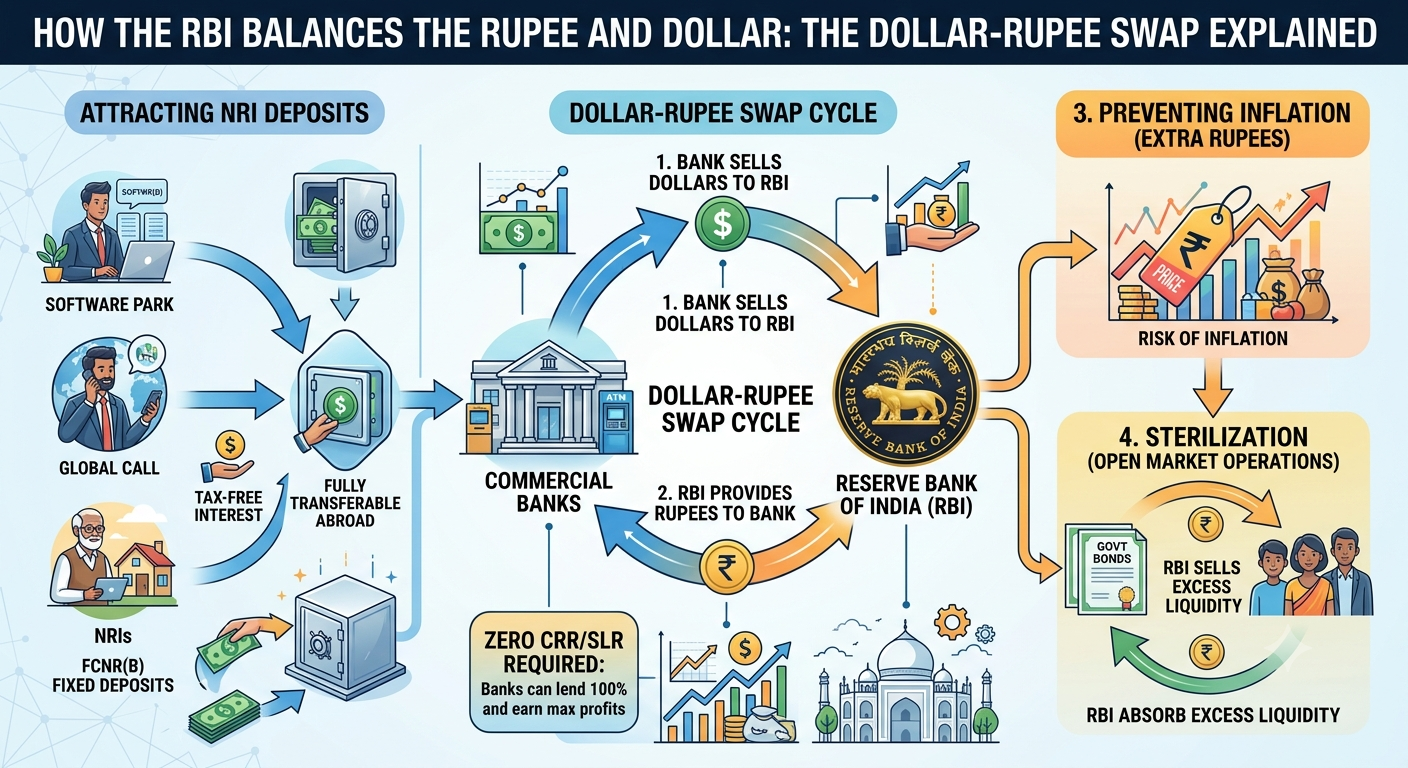
The Reserve Bank of India (RBI) uses specific strategies to balance the value of the Indian rupee against the US dollar. When there is a shortage of dollars and an oversupply of rupees in the market, the rupee loses value. To fix this without raising interest rates—which can slow down economic growth—the RBI encourages Non-Resident Indians (NRIs) to deposit their foreign earnings into Indian banks.
Types of NRI Bank Accounts
To bring dollars into the country, the banking system offers three main types of accounts to NRIs:
NRE (Non-Resident External): A basic savings account for foreign earnings. The money is converted to rupees, the interest is tax-free, and funds can be easily transferred back out of India.
NRO (Non-Resident Ordinary): Used to manage income earned inside India, like property rent. The interest is taxed, and the RBI strictly limits how much money can be taken out of the country each year to prevent sudden currency drops.
FCNR(B) (Foreign Currency Non-Resident – Bank): A fixed deposit account where money is kept in foreign currency, like dollars, for one to five years. It is tax-free, fully transferable back abroad, and the local bank takes on the risk of any currency value changes.
The Dollar-Rupee Swap
To boost the country’s dollar reserves, the RBI uses a specialized system called a Dollar-Rupee Swap, largely relying on FCNR(B) deposits.
NRIs are encouraged to deposit dollars into long-term accounts (typically 3 to 5 years).
Local commercial banks take these dollars and sell them to the RBI in exchange for rupees at the current exchange rate.
As a major incentive, the RBI allows banks to lend out all of these newly acquired rupees without having to hold back the usual mandatory cash reserves (CRR and SLR). This allows banks to earn maximum interest and profit.
When the deposit term ends years later, the transaction reverses: the RBI returns the dollars to the bank, and the bank returns the rupees.
Controlling Inflation
While the swap successfully brings needed dollars into India, it also floods the local market with extra rupees, which can trigger inflation. To prevent prices from rising, the RBI uses a tactic called “sterilization” through Open Market Operations. The central bank sells government bonds to the public. When people buy these bonds, they hand their excess rupees back to the RBI.
By strategically attracting foreign deposits and pulling excess cash back out through bonds, the central bank maintains a healthy balance between the rupee and the dollar, keeping the economy stable and attractive for investment.