




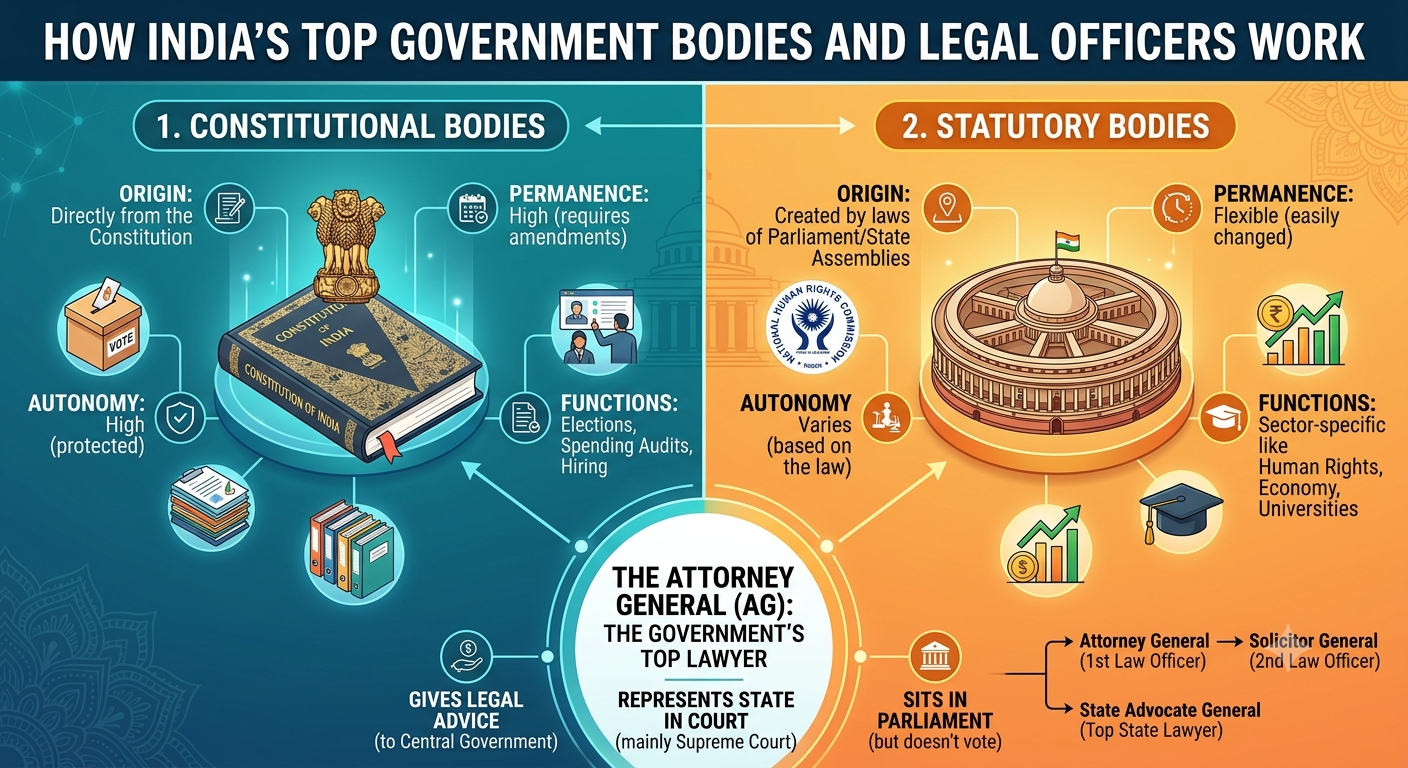
In India, the government uses special organizations to make sure the country runs smoothly, the law is followed, and power is balanced. These organizations are mainly divided into two types: Constitutional Bodies and Statutory Bodies.
Here is a simple breakdown of how they work, along with a special look at the most important legal officer in the country: the Attorney General.
Two Main Types of Government Bodies
1. Constitutional Bodies
What are they? These are groups created directly by the Indian Constitution. The Constitution itself explains their powers and duties.
Are they permanent? Yes. To change how they work, the government has to go through the difficult process of amending (changing) the Constitution.
How independent are they? They are highly independent and protected from everyday government interference.
What do they do? They handle the core jobs of a democracy, like running elections, checking government spending, and hiring civil servants.
2. Statutory Bodies
What are they? These are not mentioned in the Constitution. Instead, they are created when the Parliament or a State Assembly passes a specific law (a statute).
Are they permanent? They are much more flexible. The government can easily change or close them by simply updating the law that created them.
How independent are they? Their freedom depends entirely on the rules written in the law that created them.
What do they do? They focus on specific sectors, such as protecting human rights, managing the economy, or regulating universities.
The Attorney General: The Government’s Top Lawyer
One of the most important Constitutional Bodies is the office of the Attorney General (AG) of India. Mentioned in Article 76 of the Constitution, the AG is basically the chief legal advisor and the number one lawyer for the Central Government.
How is the AG Chosen?
The President of India appoints the AG based on the advice of the ruling government. To get this job, a person must:
Be a citizen of India.
Have worked as a High Court judge for at least 5 years, OR as a High Court lawyer for 10 years, OR be an outstanding legal expert in the eyes of the President.
What Does the AG Do?
Gives Legal Advice: Guides the government on complex legal matters.
Fights Court Cases: Represents the Indian Government in important cases, mostly in the Supreme Court, but sometimes in High Courts too.
Advises the President: Speaks for the government whenever the President asks the Supreme Court for a special legal opinion.
Sits in Parliament: The AG is allowed to sit and speak in Parliament meetings to give legal input, but they are not allowed to vote.
How Long is the Job?
The Constitution does not set a strict time limit for this role. The AG works during the “pleasure of the President,” meaning they can be removed at any time. Usually, when the ruling political party changes, the AG resigns so the new government can pick their own advisor.
Rules the AG Must Follow
To make sure there are no conflicts of interest, the AG has strict rules. They cannot:
Give legal advice against the Indian Government.
Defend accused criminals in court unless the government gives permission.
Become a director of any company without asking the government first.
Give direct advice to individual government departments (all requests must go through the Law Ministry first).
The Legal Team: Who’s Who?
To keep things organized, the government has a hierarchy of top lawyers:
Attorney General: The supreme legal officer for the Central (National) Government.
Solicitor General: The second-in-command. They, along with Additional Solicitors General, help the AG manage the heavy workload of Central Government cases.
Advocate General: This is the top legal officer for a State Government. Every state has its own Advocate General who does a job very similar to the AG, but only at the state level.
Summary
Institutions like the Attorney General are vital to India’s legal system. By giving honest advice and standing up for the Constitution, these bodies make sure that the country’s laws are respected and applied fairly.