




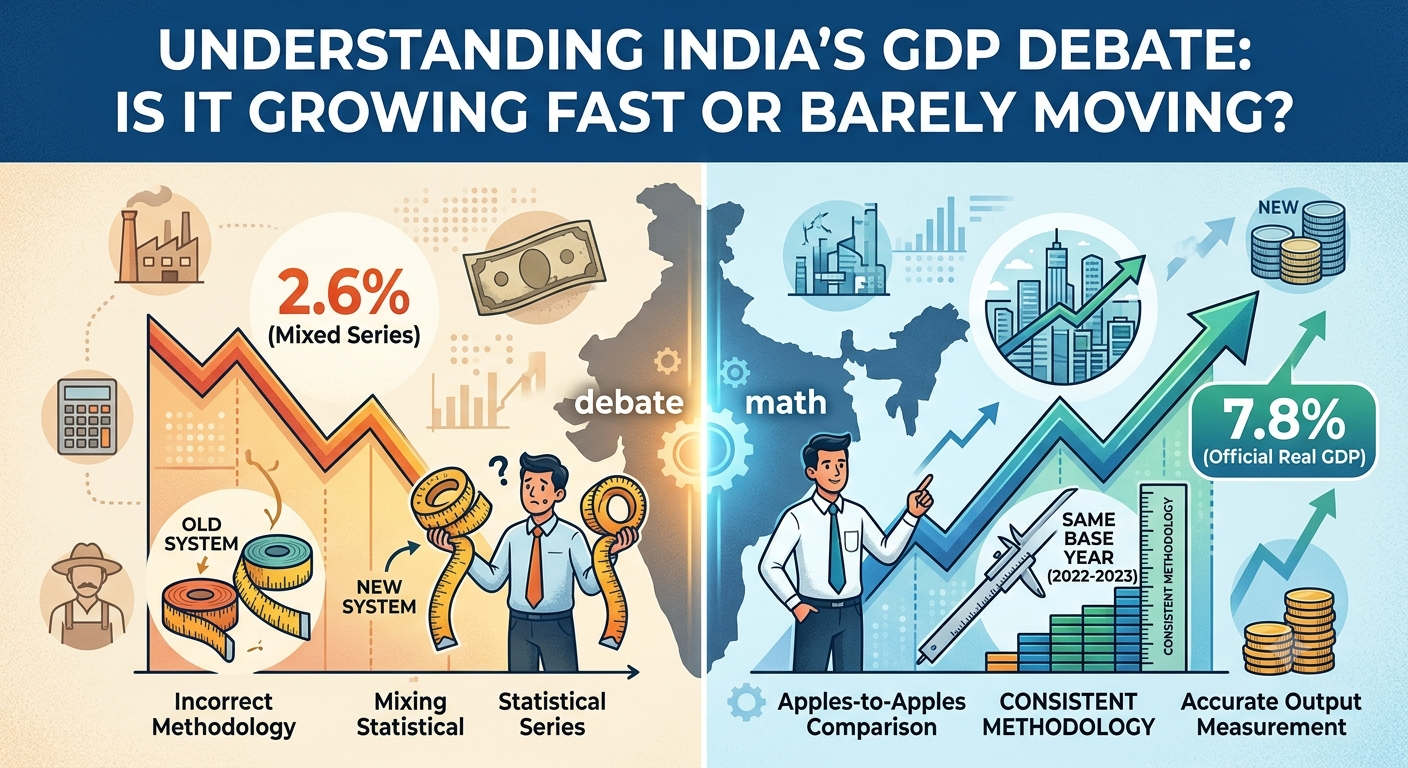
Recently, there has been a major argument about how fast India’s economy is actually growing. For the period between April and June 2026, the Indian government announced a healthy economic growth rate of 7.8%. However, some critics argue that the actual growth is only about 2.6%, and some even claim it is close to zero. To figure out who is right, we have to look at the math behind the numbers.
Two Ways to Measure Growth
To make sense of this debate, you need to know the difference between the two main ways we measure an economy (the Gross Domestic Product, or GDP):
Nominal GDP: This calculates the total value of everything a country produces using today’s prices. Because prices tend to go up over time (inflation), this number can look very high just because things are getting more expensive, not because the country is actually producing more.
Real GDP: This strips away the illusion of rising prices to show the actual physical growth in production. Economists do this by picking a “base year” and pretending prices never changed from that year.
An Easy Example
Imagine a tiny country that only makes notebooks.
Year 1: They make 100 notebooks and sell them for ₹100 each. The total economy is worth ₹10,000.
Year 2: They make 105 notebooks, but because of inflation, the price jumps to ₹110 each. The total economy is now worth ₹11,550.
If you just look at the money (Nominal GDP), the economy looks like it grew by a massive 15.5%. But in reality, they only produced 5 extra notebooks. Real GDP ignores the price change and shows the true physical growth of just 5%.
Why the Government Says 7.8%
The government recently updated its statistical rules, choosing 2022-2023 as its new “base year” to keep prices constant. When the government calculated the Real GDP for the spring of 2026 and compared it to the exact same period in 2025—using the exact same base year and the exact same rules—the growth was 7.8%. This is a fair, apples-to-apples comparison.
Where Does the 2.6% Come From?
The critics who got 2.6% did their basic math right, but they made a major statistical mistake. They took the economic numbers from the new system and compared them to older numbers calculated under the old system. In statistics, you cannot mix two completely different formulas together to find a growth rate. It is like trying to measure your weight loss by comparing a scale that uses pounds to a scale that uses kilograms.
The Bottom Line
Statistically speaking, the 7.8% growth rate is the correct and accurate number for measuring India’s economic output.
However, it is crucial to remember that a high GDP does not mean everything is perfect. A strong GDP number alone does not show if regular people are struggling to find jobs, if wages are stuck, or if the gap between the rich and the poor is growing.