




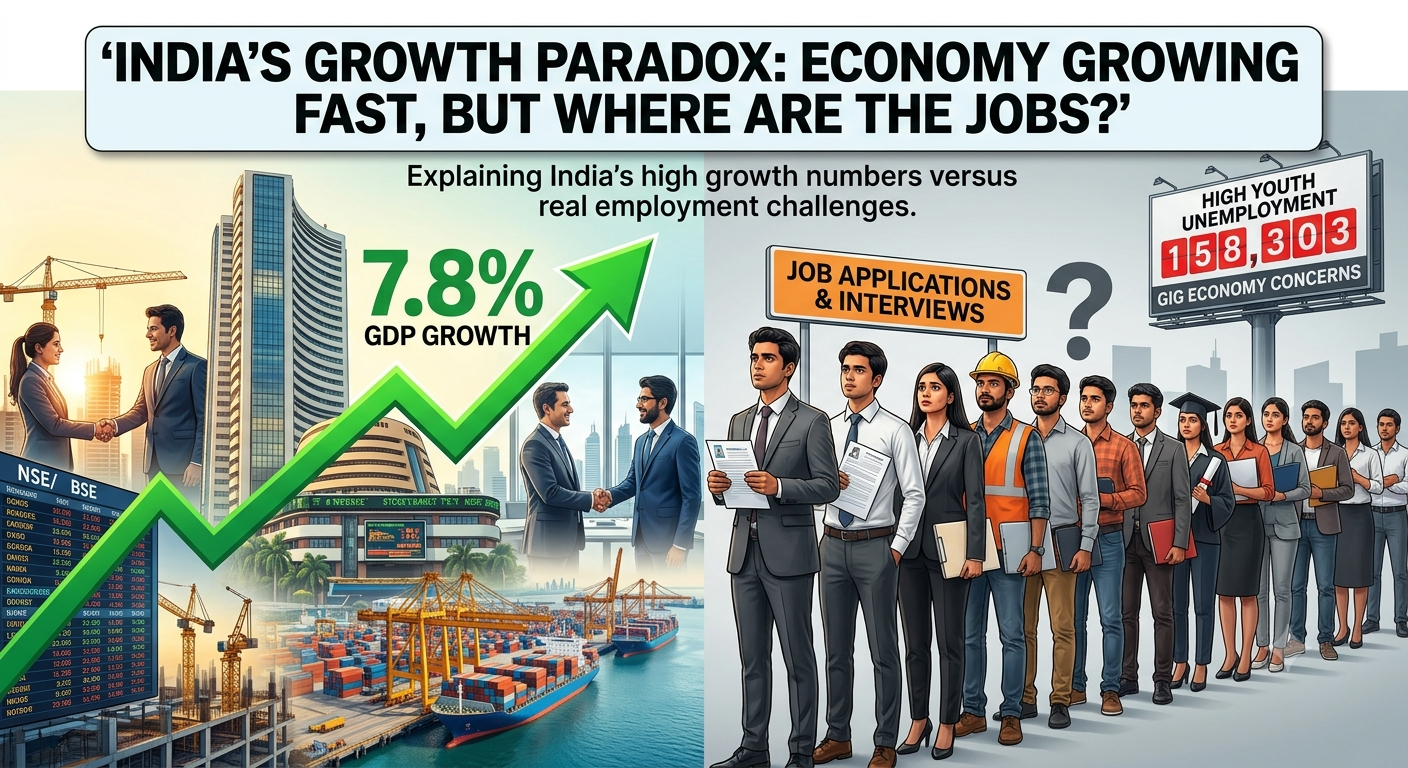
India recently shared some impressive news: the country’s economy grew by a strong 7.8% in the first quarter of the year. This number beat the expectations of both market experts and the Reserve Bank of India. Factories are making more goods, investments are flowing, and people are continuing to spend.
Achieving this kind of growth while the rest of the world faces tough times is a huge victory. However, behind these glowing numbers is a major challenge. The country is facing a “growth paradox”—our economy is getting bigger, but we are struggling to create enough good jobs for our people.
Economic Growth vs. Job Creation
To understand this problem, we have to look at what GDP (Gross Domestic Product) actually means. GDP is simply the total value of everything a country produces. When it goes up, the country is getting richer. But does a rising GDP mean more jobs are being created?
In India, the answer is complicated. Even though businesses are growing, we are not seeing a matching increase in secure, well-paying jobs. We need to ask hard questions: Are wages going up? Do workers have job security? Are the new jobs actually good ones?
The Reality for Young People
It would be unfair to say India is creating zero jobs. In fact, government reports show that the overall unemployment rate is quite low, sitting at about 3.1%. Also, the number of people earning a regular salary has gone up slightly.
However, looking at the big picture hides the real struggle of the youth. When we look at young Indians between the ages of 15 and 29, the unemployment rate jumps to nearly 10%. The situation is even tougher in cities, where almost 14% of young people cannot find work. For young women living in urban areas, it is especially difficult, with nearly 24% facing unemployment.
Because of this lack of good private-sector jobs, millions of young people choose to spend years preparing for highly competitive government exams, hoping for a safe and secure future.
The Education Mismatch
Why is it so hard for graduates to find work? A big part of the blame falls on the gap between what schools teach and what companies actually need.
Today, more young people have college degrees than ever before, which naturally raises their expectations. They do not want to settle for low-paying or low-quality work. On the other hand, businesses complain that they cannot find candidates with the right practical skills to do the job. We have educated youth who want to work, and companies that need workers, but the two sides aren’t matching up.
The Real Problem: Speed and Quality
People sometimes say India is experiencing “jobless growth,” but that isn’t entirely accurate. Jobs are being created in manufacturing and services. The real problem comes down to two things: speed and quality.
Speed: Millions of young people enter the job market every year, but we are not creating new jobs fast enough to hire all of them.
Quality: Many of the jobs that are available do not offer long-term security. For example, the rise of app-based delivery jobs has given many people a way to earn money. However, these “gig” workers usually do not get basic benefits like health insurance, paid leave, or a guaranteed fixed income.
What Needs to Change?
India has a massive advantage right now: a very young population. This young workforce can push the country to new heights, but only if they have productive and secure work.
A 7.8% economic growth rate is something to be proud of. But, if India wants to achieve its dream of becoming a fully developed nation by 2047, we have to look past the GDP numbers. The country’s top priority must be creating better-quality jobs at a much faster pace.