




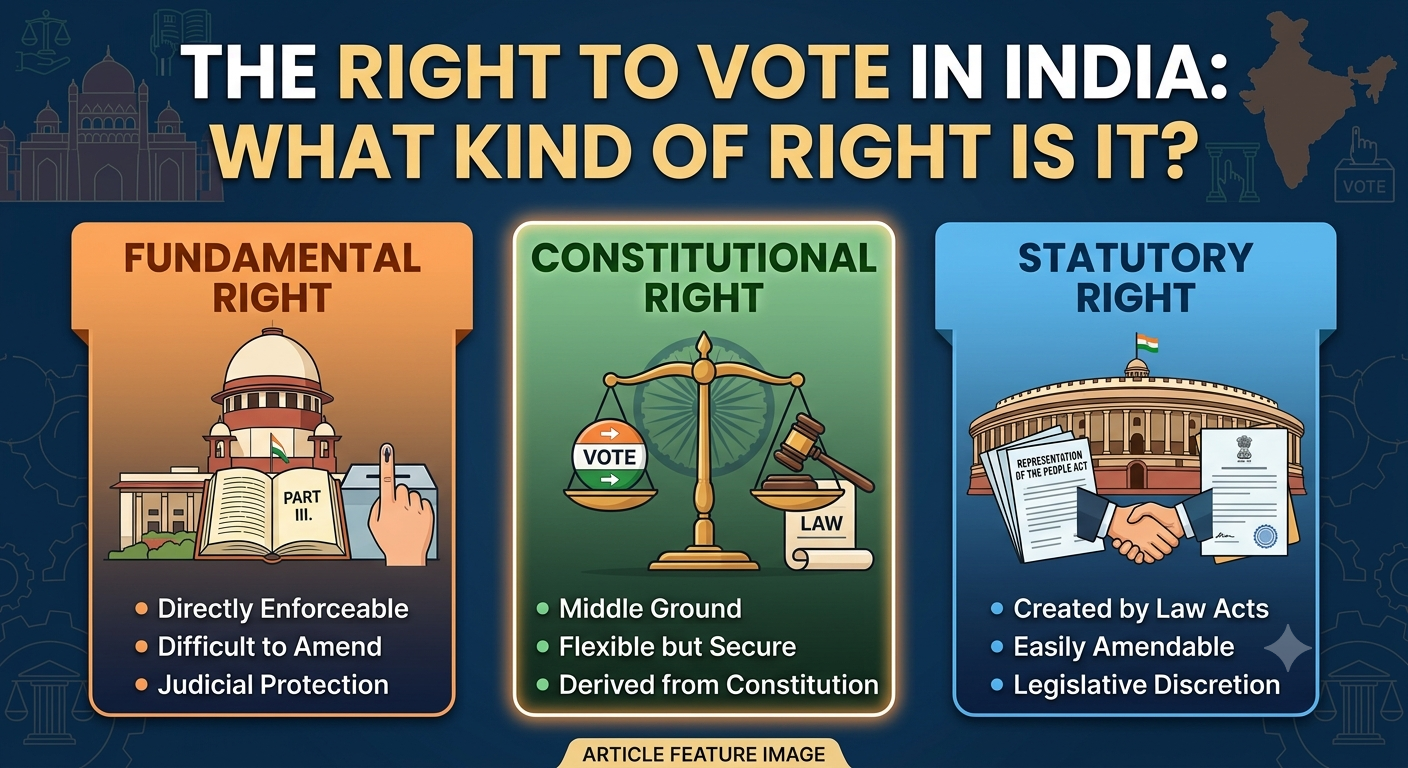
Many people, especially students preparing for exams, often get confused about the exact legal status of the right to vote in India. Is it a fundamental right? Is it just an ordinary law? Let’s break it down in simple terms.
Two Main Types of Rights
To understand voting, we first need to know the difference between two types of rights:
Fundamental Rights: These are the strongest rights given to us by the Constitution (in Part III). The Supreme Court fiercely protects them. The government cannot easily change or take these away because they are part of the core structure of our Constitution.
Statutory Rights: These are regular rights created by everyday laws passed by the Parliament. The government can easily change, update, or remove these laws without much difficulty.
The Voting Dilemma
If the right to vote was a Fundamental Right, it would be incredibly difficult for the government to make necessary updates to election rules. Every tiny change would end up being challenged in the Supreme Court.
On the other hand, if voting was purely a Statutory Right (an ordinary law), it would be very dangerous. The government in power could simply pass a new law saying something unfair—for example, “only certain groups of people can vote”—and the courts would have a hard time stopping them.
What Does the Law Say?
Our Constitution has Article 326, which says that any Indian citizen who is 18 or older has the right to vote, regardless of their religion, caste, or gender. However, this rule is not placed in the “Fundamental Rights” section of the Constitution.
Instead, the actual rules for voting are handled by a regular law called the Representation of the People Act, 1950. This law states that if your name is on the voter list, you can cast your vote. Because it is controlled by this regular law, early court decisions (like the famous Ponnuswami case) said voting was just a statutory right.
The Middle Ground: A Constitutional Right
Over time, legal experts and courts realized that voting needs to be balanced. It cannot be so rigid that election rules can’t be updated, but it also cannot be so weak that politicians can steal the right to vote away from citizens.
Because of this, the right to vote is today considered a Constitutional Right.
This classification is the perfect middle ground. It gives the Election Commission and the Parliament the flexibility to update voting rules and manage the world’s largest elections smoothly. At the same time, because it is backed by the Constitution (Article 326), the government cannot arbitrarily pass senseless laws to stop everyday citizens from voting.
Summary
The right to vote is not a basic fundamental right, nor is it just an ordinary law. It holds a unique and special place as a Constitutional Right, ensuring that our elections remain both flexible to manage and protected from unfair political changes.