



If you have heard about India’s new time rules for 2026 and wondered if you need to reset your watch, you can relax! Your clocks, phones, and daily schedule will stay exactly the same. India is keeping its standard time (UTC +5:30).
Instead of changing the time itself, the new “One Nation, One Time” policy is a massive, behind-the-scenes upgrade to how computers and digital systems track time across the country.
Here is a simple breakdown of what is actually happening and why it matters.
1. The Problem with “Almost” Accurate Time
Right now, if you compare the internal clocks of different computer servers, banks, or telecom networks in India, there are tiny differences. We are talking about fractions of a second—milliseconds or microseconds.
For you and me, a millisecond doesn’t matter. But in the digital world, it is a huge deal. When millions of digital payments, high-speed stock market trades, and railway signals happen at the same time, a tiny delay or mismatch can cause transaction failures, crashes, or mixed-up records.
2. The Solution: Perfect Digital Synchronization
To fix this, the government is requiring all official networks, commercial systems, and digital records to run on one perfectly synced national clock.
Big organizations, banks, and tech companies have been given a transition period of 180 days (aiming for March 2027) to upgrade their backend servers. Once finished, every major computer system in India will tick at the exact same microsecond.
3. Becoming Self-Reliant (Digital Independence)
Why is the government pushing for this now? A big part of the answer is independence.
Currently, many digital systems in India rely on foreign technology, like the American GPS system, to keep their clocks perfectly synced. By building our own time-keeping network, India is securing its digital borders. If a foreign satellite system ever goes down or restricts access, India’s banks, power grids, and internet will continue to run smoothly.
4. How Will India Do It?
Keeping time perfectly accurate requires some of the most advanced technology in the world. Here is what India is using:
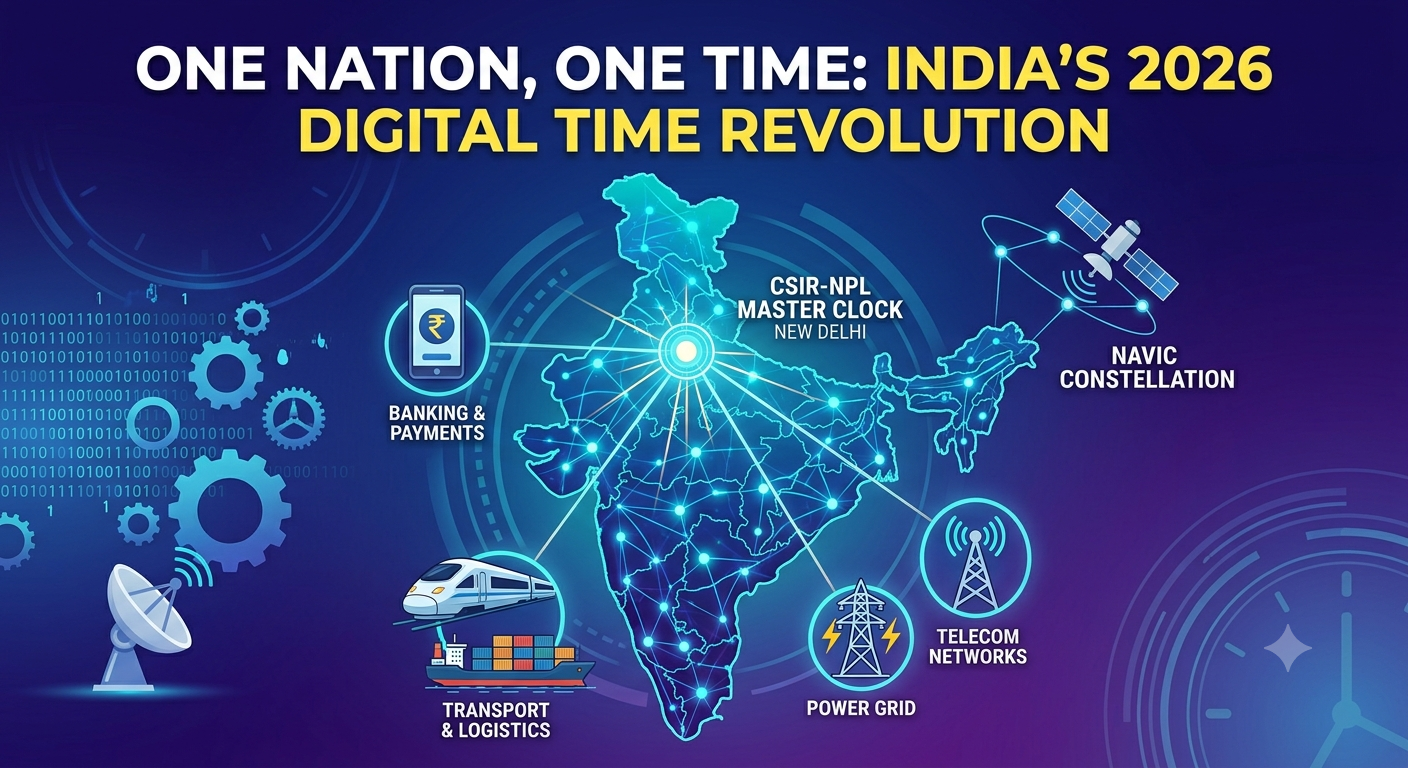
The Master Clock: A scientific lab called CSIR-NPL uses highly advanced atomic clocks to measure the exact time for the country.
NavIC Satellites: Instead of relying on foreign GPS, India will use its own satellite network (NavIC) to beam this precise time down to earth.
Super-Fast Sharing: The government is rolling out specialized labs and advanced networking systems (like “White Rabbit” technology) to share this perfect time with tech companies and government offices without losing a single millisecond.
Are There Any Exceptions?
Yes. While businesses and government offices have to follow the new standard time rules, scientists, astronomers, and certain navigation experts are allowed to use different timing systems if their specific research requires it.
The Bottom Line
You don’t need to do a thing. The “One Nation, One Time” rule is essentially a massive software and infrastructure update for the country. It is designed to make digital payments safer, prevent technical glitches, and make India’s technology truly independent.