




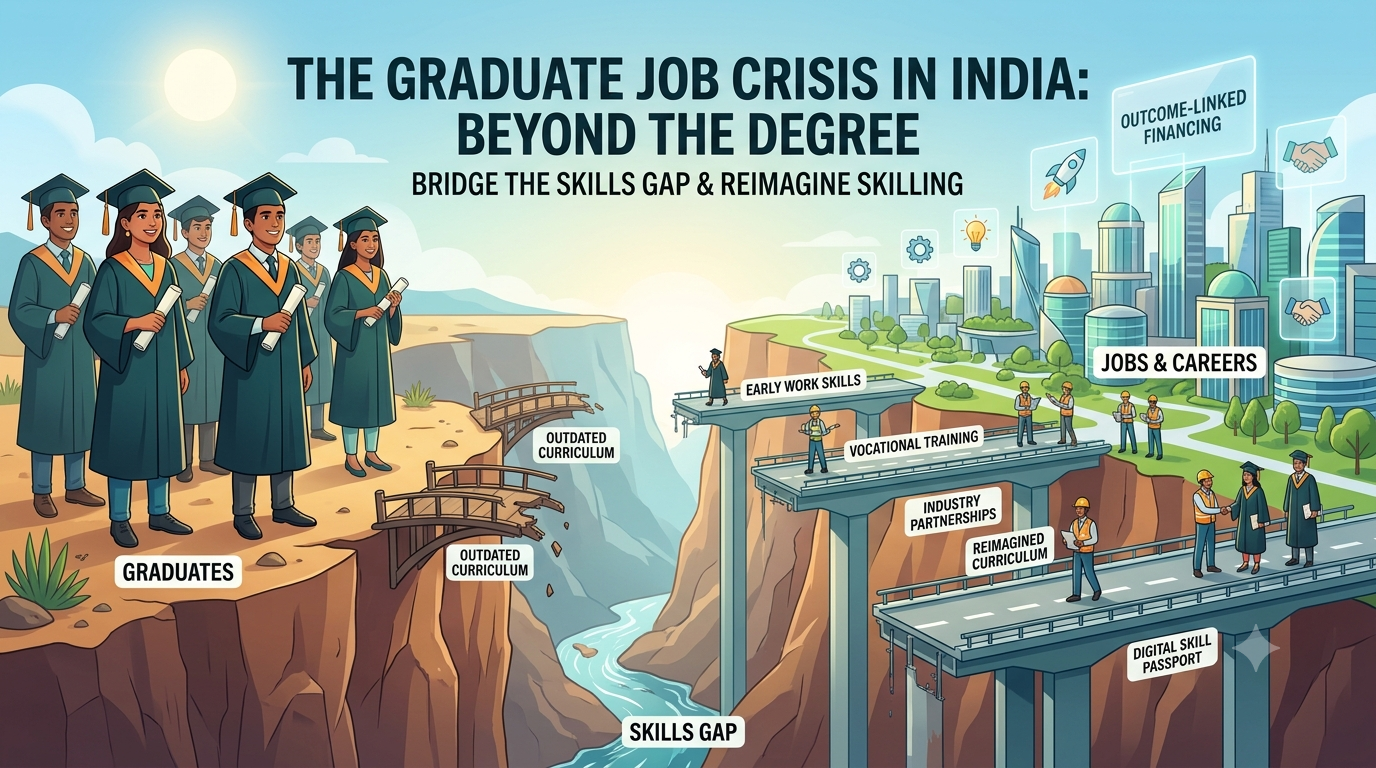
It can be incredibly frustrating to spend years working hard for a college degree, only to face endless rejections when applying for jobs. If you or someone you know is going through this, you aren’t alone. A recent report by NITI Aayog sheds light on a major issue in India: millions of young people are graduating with degrees, but they are struggling to find work because there is a massive gap between what schools teach and what employers actually need.
Here is a simple breakdown of what is happening in the job market, why it is happening, and how the government suggests fixing it.
The Real Numbers Behind the Job Hunt
The statistics show that just having a college education does not guarantee employment anymore:
Graduates Face the Hardest Time: The overall national unemployment rate is fairly low (around 3.2%), but for college graduates, that number jumps to 13%.
Women Face Extra Hurdles: For female graduates, the unemployment rate is over 20%. Many women are held back by safety concerns, lack of safe transport, or pressure to take on unpaid household duties.
Studying One Thing, Doing Another: Less than 1 out of 10 graduates (only 8.25%) actually find a job related to their college major.
The “Off-the-Radar” Youth: There are roughly 8.7 crore young Indians who are entirely disconnected from the system—they are not working, not studying, and not receiving any training.
Why is it So Hard for Graduates to Find Jobs?
The report points out a few core reasons why our current system is leaving young people behind:
1. Basic Degrees Lack Direct Job Links
General degrees like a BA, BCom, or BSc are great for foundational knowledge, but they rarely train students for a specific career path the way a specialized medical, teaching, or engineering degree does.
2. The Rush for Government Jobs
Many families still view college simply as a ticket to sit for competitive government exams. However, the competition is fierce. Recently, nearly 1.86 crore people applied for just 55,000 government spots. People spend their most energetic years studying for exams they might never pass, rather than building real-world skills.
3. The Experience Trap
Companies almost always want to hire people with hands-on experience. But fresh graduates are stuck in a loop: they cannot get a job without experience, and they cannot get experience without a job.
4. Outdated Classrooms
The world is rapidly moving toward artificial intelligence, electric vehicles, and modern tech, but classrooms are largely stuck in the past. Students are still focused on memorizing theory from textbooks rather than solving practical problems.
How Can We Fix the System?
To make sure young people are actually ready for the modern workforce, NITI Aayog has suggested a few big changes:
Teach Life Skills Early: Schools shouldn’t wait until college to teach things that matter. Basic finance, communication skills, and computer literacy need to be taught early on.
Change the Way We See Vocational Work: We need to remove the stigma around trade and vocational schools. Setting up local training centers tailored to what local businesses need will help students find guaranteed work.
Partner with Private Companies: The government cannot do it alone. Private industries need to step up and offer internships, up-to-date equipment, and on-the-job training so students learn what is actually useful.
Focus on Actual Jobs, Not Just Admissions: Instead of schools celebrating how many students they enrolled, they should be judged on how many of their students actually landed good, well-paying jobs after finishing the course.
Create a “Digital Skill Passport”: Every student should have an official, digital record that tracks all the practical skills and training they have picked up over the years. This would act as a powerful, verified resume for employers.
Ultimately, a degree is just a piece of paper if it isn’t backed by real-world abilities. To succeed today, the focus has to shift from passing exams to actually being ready for the workplace.
What specific practical skills do you think schools should start teaching right now to better prepare students for the real world?