




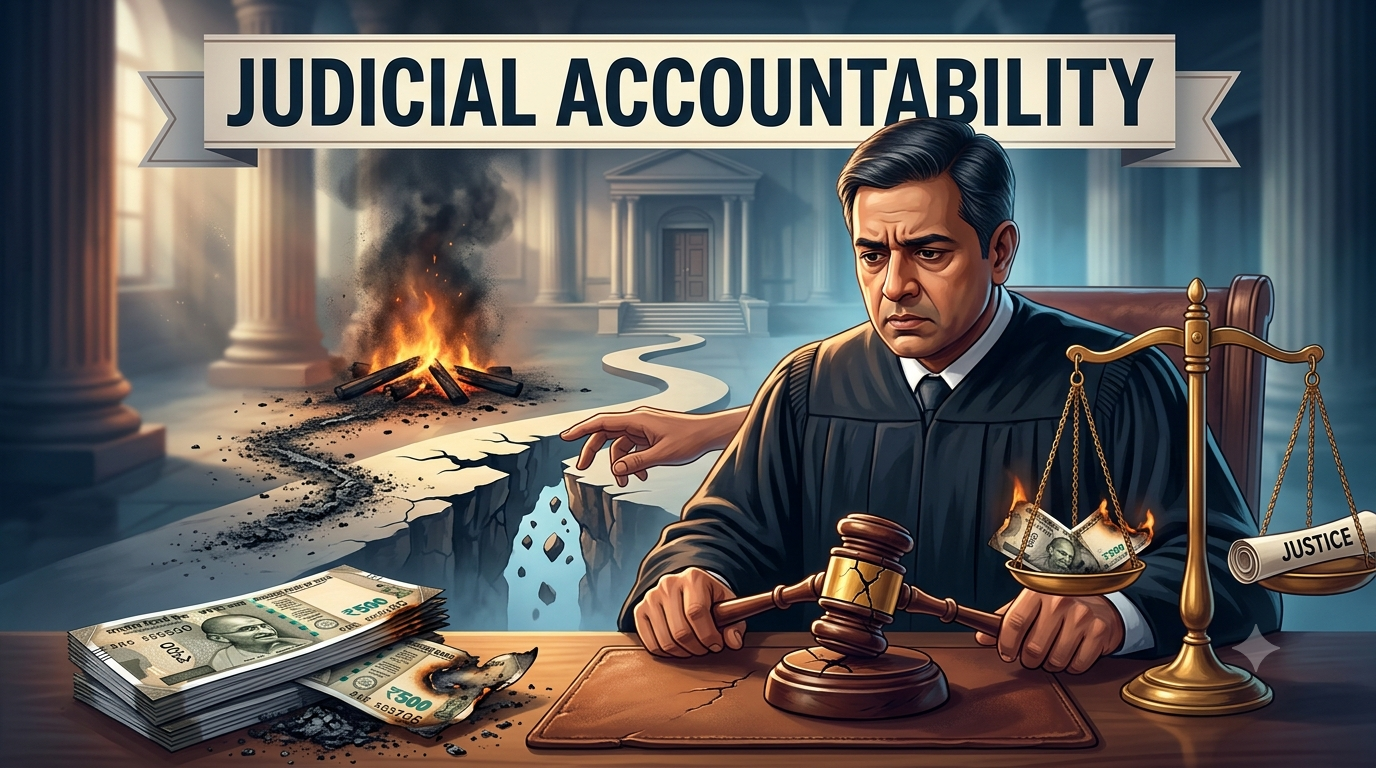
A recent controversy involving a former Delhi High Court judge, Justice Yashwant Varma, has raised big questions about how judges are held responsible for their actions in India. The case features a house fire, unexplained cash, and a loophole in the law that allowed the judge to avoid being officially fired.
The Fire and the Missing Cash
The story began in March 2025. A fire broke out in the storeroom of Justice Varma’s official home in Delhi while he was out of town. When firefighters went inside to put out the flames, they were shocked by what they saw: large piles of burnt 500-rupee notes.
However, before the authorities could officially collect the money as evidence, it mysteriously disappeared. This raised serious suspicions that the evidence was intentionally hidden, putting the judge’s honesty into question.
The Investigation
Because removing a High Court judge is a very serious and difficult process, it requires lawmakers to step in. In August 2025, 146 Members of Parliament (MPs) signed a proposal to investigate and remove the judge from his position.
A special committee was formed to look into the matter. By August 2026, they released their findings and concluded that the judge was at fault. The committee noted three main things:
The judge could not explain where the massive amount of cash came from.
He was guilty of failing to protect the evidence, leading to the disappearance of the cash.
He did not cooperate with the investigation, failing to show up on promised dates and giving misleading answers.
The Resignation Loophole
Even though the committee found him guilty of misconduct, the Parliament could not go through with the final vote to remove him.
This happened because Justice Varma resigned in April 2026, before the process could be finished. Under Indian law, a High Court judge’s resignation takes effect immediately—it doesn’t even need to be accepted by the President. Since he was technically no longer a judge, the special process to fire him (called impeachment) had to be dropped. This isn’t the first time this has happened; other judges in the past have also used early resignation to escape being formally removed by Parliament.
What Happens Next?
While the judge managed to avoid being officially fired, he is not entirely off the hook. Legal experts point out that since hiding evidence and having unexplained cash are crimes, normal police investigations and criminal charges can still be filed against him.
More importantly, this case has shown that India’s legal system needs some updates:
Changing the Rules: The laws need to be fixed so that judges cannot simply resign to escape a parliamentary investigation.
Better Selection: It has also sparked conversations about how judges are chosen in the first place, highlighting the need for a more transparent and strict selection process.
In the end, the case is a strong reminder that for a democracy to work well, everyone—even those who sit in the highest courts—must be held accountable for their actions.