




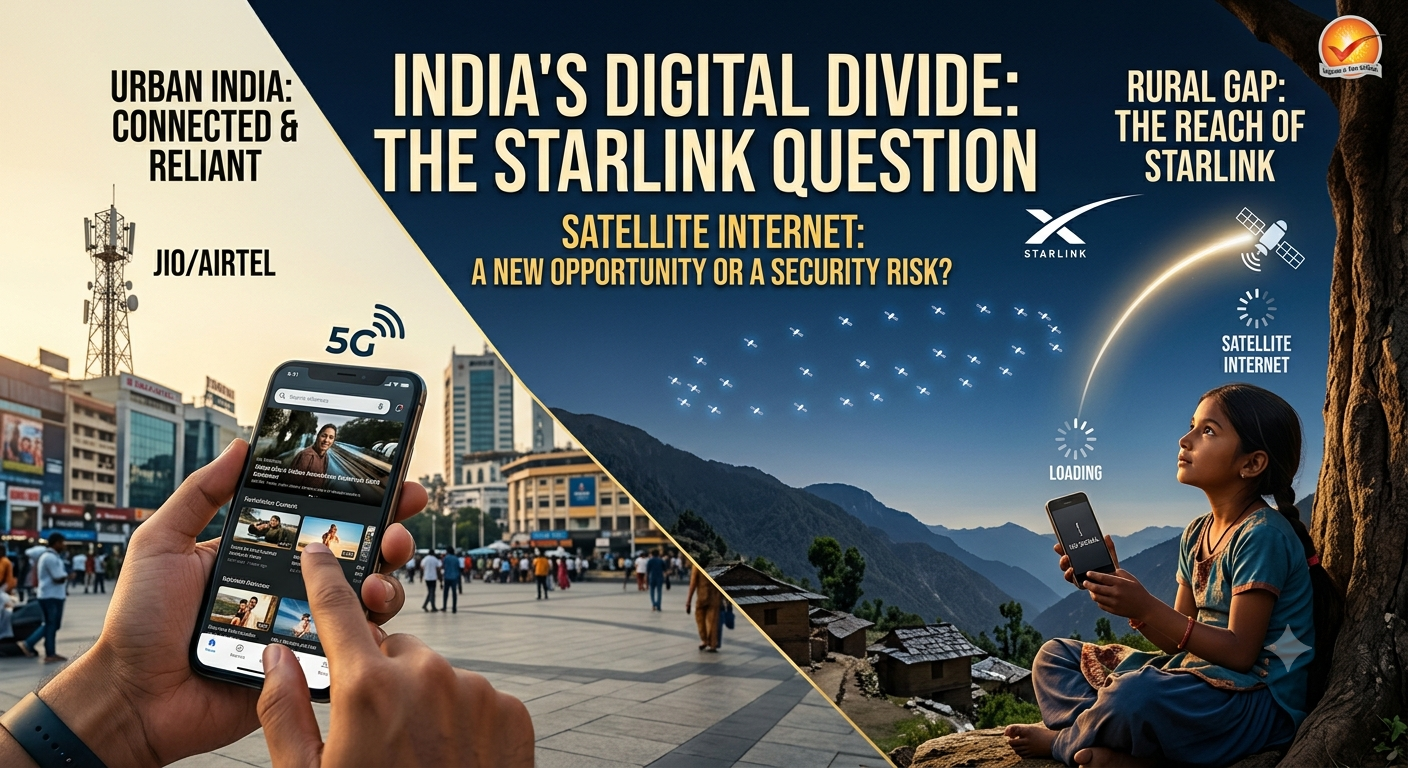
Elon Musk is trying to bring his satellite internet company, Starlink, to India once again. After being turned away the first time, Starlink is now offering a new technology that connects satellites directly to mobile phones and devices. This brings up an important question: is this a great opportunity for India’s digital growth, or a potential security threat?
Why Does Starlink Want to Come to India?
India is a massive market with over a billion internet users, but Starlink is targeting a very specific gap:
Unreached Areas: Many rural and remote villages still struggle with poor or inconsistent internet connections.
Tough Geography: It is very expensive and difficult to build traditional mobile towers and lay cables in places like the Himalayas, deep forests, and remote islands.
A Space-Based Solution: Starlink’s internet beams directly from space, completely skipping the need for ground towers and easily reaching isolated areas.
Do We Really Need Starlink?
India has made huge leaps in connectivity, but a divide still exists between fast-paced cities and slower rural networks.
The Rural Gap: While urban areas enjoy high-speed internet, many rural communities are left behind with spotty access.
Not a Replacement: India already has strong, affordable local telecom companies like Jio and Airtel. Starlink is not needed to replace them.
A Helping Hand: Instead, Starlink could act as a helpful backup. It can provide high-speed internet specifically to those hard-to-reach places where traditional companies cannot easily build infrastructure.
Why Was Starlink Rejected Before?
The Indian government said “no” to Starlink in the past for very valid national security reasons, and these concerns remain today:
Data Privacy: Because the data travels through foreign-owned satellites in space, the government is worried about where this data is stored and who has access to it.
Lack of Control: It is incredibly hard for a country to monitor or control a global satellite network during a national emergency.
Risky Dependence: Relying on a foreign company for vital communications—especially for border security or disaster relief—is a massive risk. If the company suddenly decides to turn off the service, India could be left in the dark.
The Bottom Line
India does not need to reject satellite internet completely, but the country must protect its digital borders. If Starlink agrees to strictly follow India’s security rules and keep user data safe within the country, it could be welcomed. If not, the risks might outweigh the benefits.