




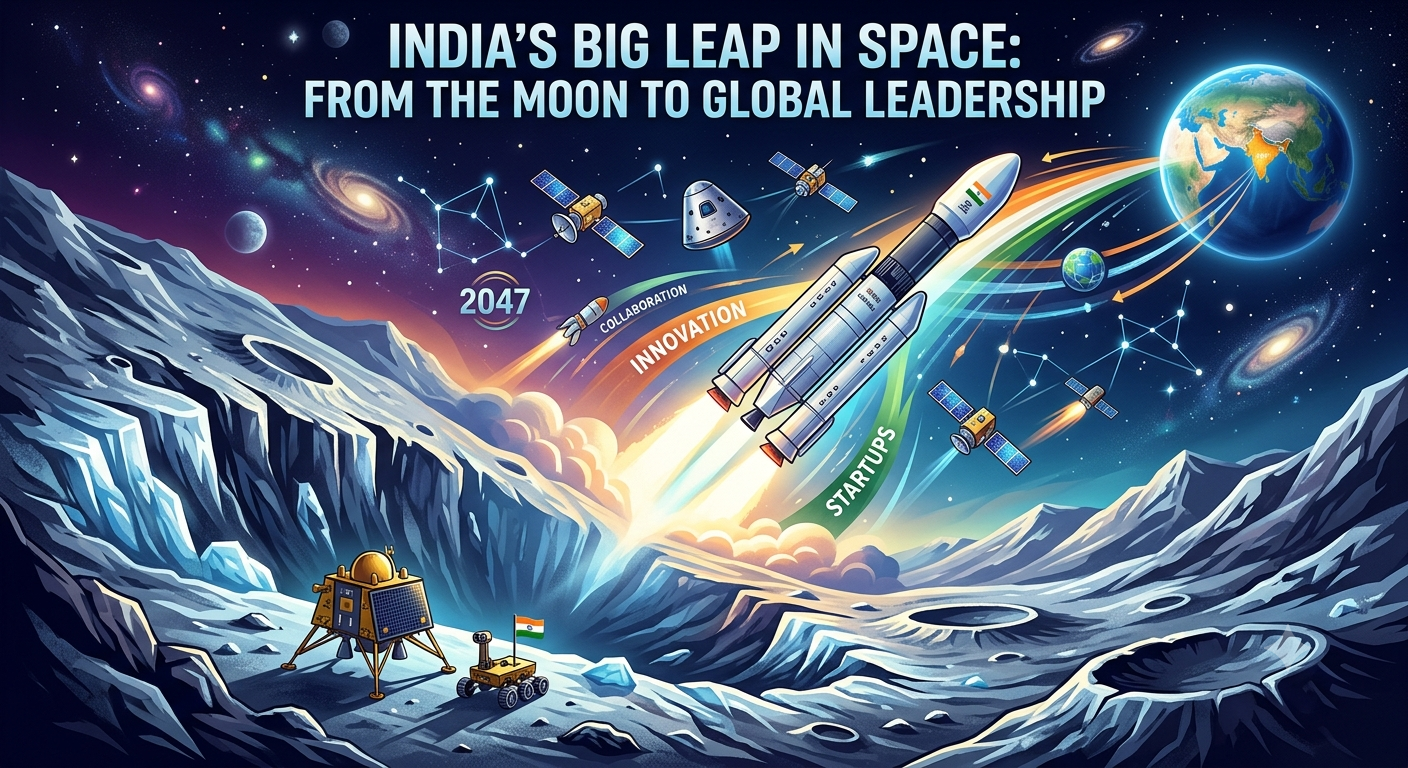
On August 23, 2023, India made history by safely landing Chandrayaan-3 near the Moon’s South Pole. This made India the first country to land in that difficult area. Today, India’s space goals are much bigger than just reaching the Moon. As the country celebrates National Space Day, the main goal is to become a top leader in the global space industry by working together with new businesses and young minds.
The Three Steps of India’s Space Journey
Experts explain that India’s space agency, ISRO, has grown in three main stages:
Helping the Common Man: In the beginning, India used space technology to make daily life better. Satellites were launched to help with farming, weather tracking, TV signals, and saving lives during natural disasters.
Proving Its Power: Next, India focused on showing the world that it could build strong, reliable rockets. Over time, the country went from launching very small satellites to building massive rockets capable of carrying humans into space.
Working with the World: Today, India is in its third stage. The focus is no longer just on what the government can do, but on how India can help the whole world. This means teaming up with schools, private factories, and young inventors.
A Big Change: From Government Jobs to New Businesses
For a long time, young Indian engineers dreamed of just getting a job at ISRO. But after the success of Chandrayaan-3, that thinking changed. Today, young people want to start their own space companies.
India’s new space rules allow private businesses to build satellites and rockets. Because of this, many space startups are popping up. They are building new types of rocket engines and even planning rockets that can fly back to Earth to be used again. Even big international groups like NASA are inviting India to work on future Moon bases.
Teamwork: Who Does What?
To grow faster, the Indian space industry is splitting up the work:
ISRO (The Government): ISRO will step back from making everyday rockets. Instead, they will focus on the hardest, most risky science missions, like exploring Venus or sending astronauts into space.
Big Private Companies: Established factories will take over building the standard rockets and satellites that the country needs in large numbers.
Startups: Small, new companies will focus on inventing exciting, brand-new technologies.
The Biggest Challenge: Training the Right People
Even with all this progress, there is one big problem. India has thousands of engineering graduates, but very few of them actually have the specific skills needed to build rockets and satellites.
Experts agree that money and factories are easy to get, but highly skilled human beings are the most important part of space science. To fix this, schools and colleges need to change the way they teach. Students need to learn hands-on, modern skills so they are ready to work in the space industry the moment they graduate.
Looking Ahead
India’s space journey is no longer just about exploring the stars—it is about growing the country’s economy and creating amazing technology. By updating its education system and letting private businesses take the lead, India is on the right path to becoming a true global superpower in space.