



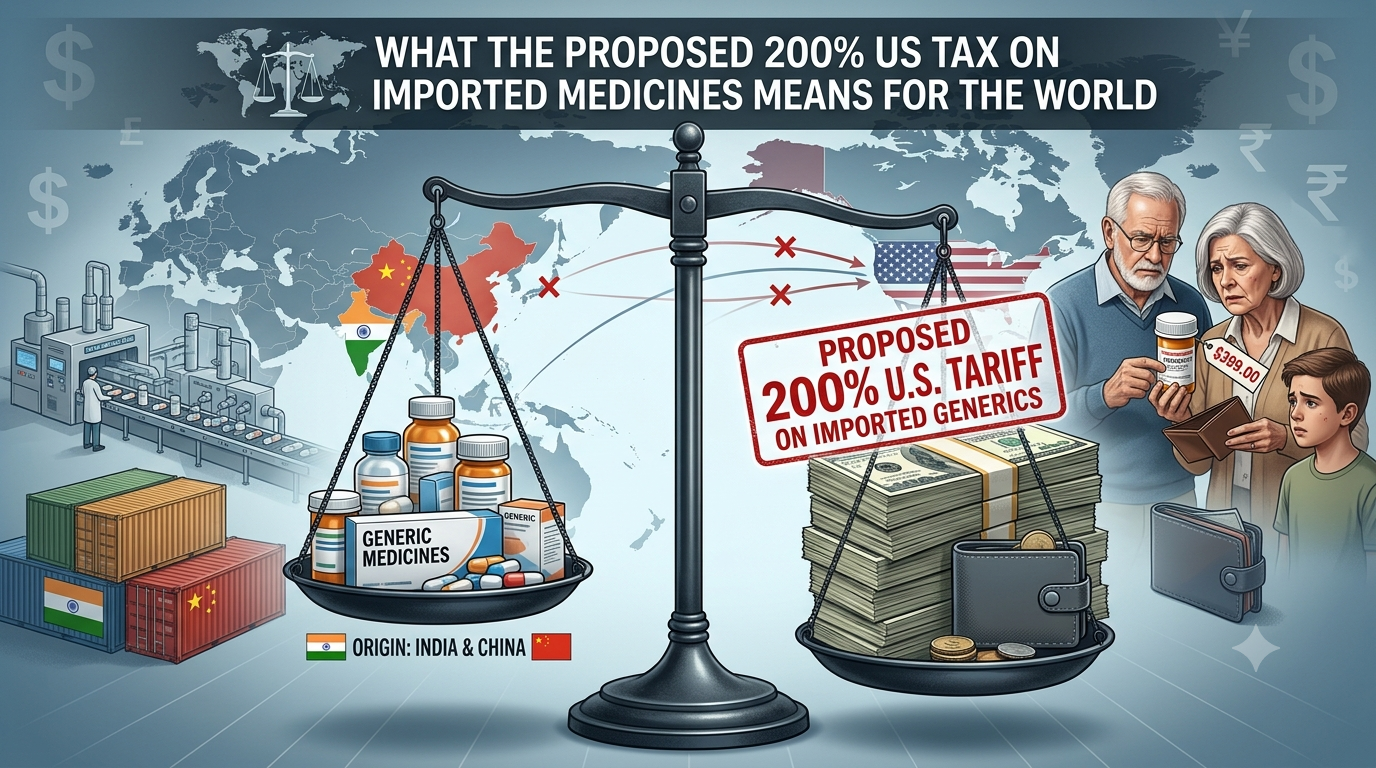
The US government is looking to change how it buys medicines from other countries. A new policy proposed by Donald Trump involves placing a massive tax—up to 200%—on generic drugs made outside the United States.
While the official goal is to force companies to build factories and create jobs inside the US, experts are highly concerned. This plan could end up hurting everyday Americans who rely on affordable healthcare, while also causing major financial disruptions for medical suppliers in India and China.
The Three-Year Tax Plan
The proposed tax wouldn’t happen overnight. It is designed to roll out in stages, acting as a ticking clock for foreign companies to relocate to the US:
Year 1: A 0% Tax. The government knows that adding a huge tax immediately would be a medical disaster for patients relying on these drugs, so the first year acts as a grace period.
Year 2: A 100% Tax. In the second year, the cost to import these medicines would effectively double.
Year 3: A 200% Tax. By the third year, the tax becomes so steep that buying foreign generic medicines would be entirely unaffordable.
The Human Cost for Everyday Americans
Right now, healthcare in America is incredibly expensive. For instance, a life-saving medicine bought directly from a major US pharmaceutical brand might cost as much as $10,000. For an average worker making $3,000 to $4,000 a month, paying for that is simply impossible.
To survive, many Americans buy the exact same generic medicine from India. Even with international shipping, it costs a tiny fraction of the domestic price. India produces high-quality, low-cost generic drugs that act as a lifeline for patients worldwide. If the US implements this 200% tax, that affordable option vanishes, potentially forcing sick people into severe debt just to stay alive.
Who Actually Wins?
If this rule becomes law, the effects will create a clear divide between winners and losers:
The Winners (Large US Corporations): Massive American pharmaceutical companies (often called “Big Pharma”) would benefit the most. With cheaper foreign drugs heavily taxed and pushed out of the market, these corporations would basically have a monopoly, allowing them to keep their prices extremely high.
The Losers (India and China): India currently exports billions of dollars worth of generic medicines to the US. Furthermore, India relies on raw materials (called APIs) from China to make these drugs. If India cannot sell to the US, both the Indian manufacturing sector and the Chinese raw material sector will take a massive financial hit.
What Happens Next?
This proposed policy is already causing international friction. US officials, including Secretary of State Marco Rubio, have noted that while direct talks haven’t fully happened yet, they expect Indian leaders, such as External Affairs Minister Dr. S. Jaishankar, to raise the issue very soon.
India could potentially negotiate a special trade agreement to avoid these taxes. But until a solution is found, this massive tax proposal remains a dark cloud over the future of global, affordable healthcare.