



Recently, the leaking of the NEET medical exam paper caused massive protests across India. Angry students and opposition leaders demanded immediate answers and action from the government.
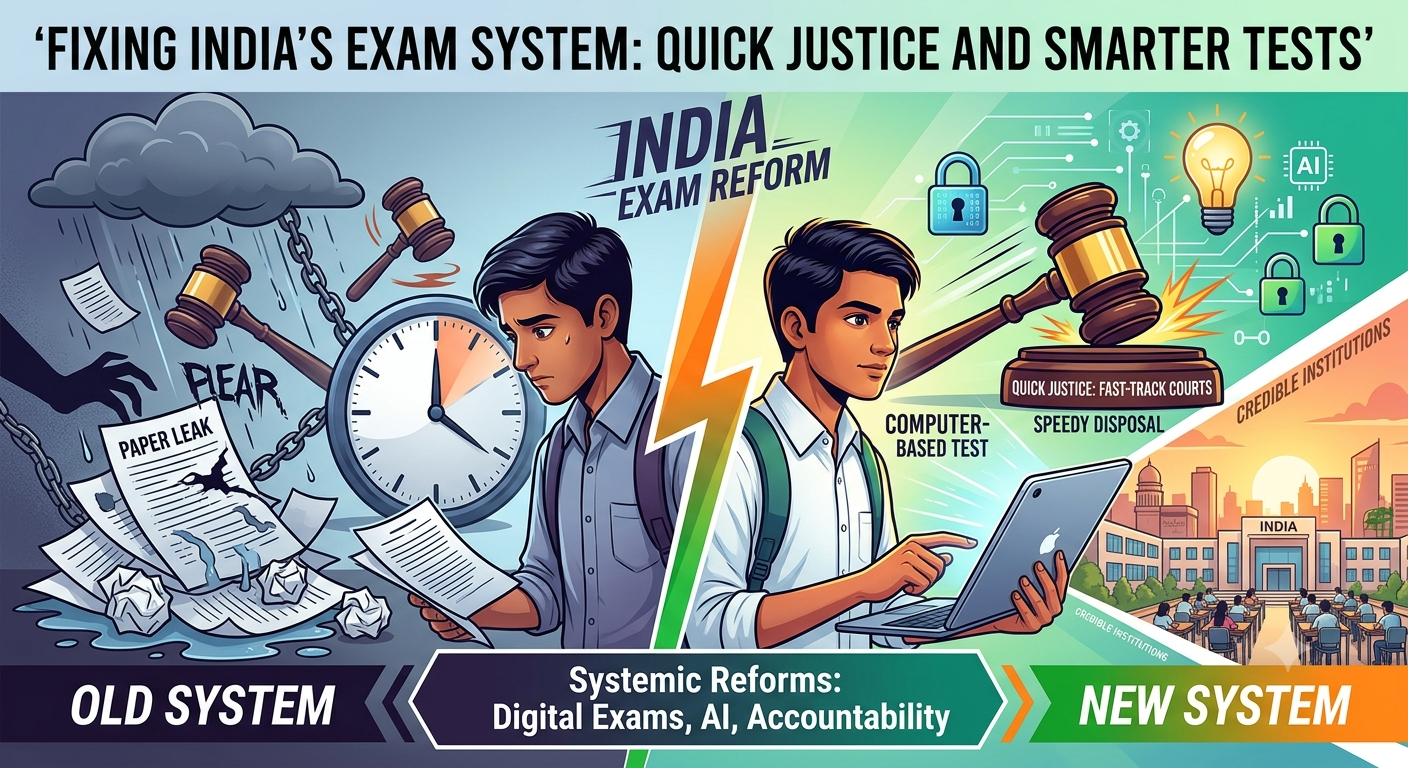
To solve this crisis, Prime Minister Narendra Modi announced the creation of “fast-track courts.” These special courts will quickly try and punish anyone caught leaking exam papers. The Prime Minister stated that protecting the future of the youth is the top priority. But this raises an important question: is punishing criminals quickly enough to fix the problem, or do we need to completely change how exams are conducted?
Why Do We Need Fast-Track Courts?
In regular courts, cases can drag on for years. Fast-track courts are designed to speed up justice for serious crimes. While a normal court might clear about 10 cases in a certain time, a fast-track court can resolve 40 to 50 cases.
By using these courts for paper leaks, the government wants to send a strong warning. Whether the culprits are corrupt officials, greedy coaching centers, or cheating parents, they will face justice and heavy fines quickly. This fear of quick punishment is meant to stop people from even thinking about stealing exam papers.
The Real Reason Behind the Leaks
While strict punishment is a good step, experts say we need to look at why these leaks happen in the first place. The biggest issue is the massive gap between the number of students and the number of available seats.
For example, the government has increased medical seats over the last ten years to about 1.46 lakh. However, more than 20 lakh students take the exam every year to fight for those spots. Because the competition is so fierce and the pressure to succeed is so high, desperate people try to find illegal shortcuts. Criminals take advantage of this desperation to make money.
How Can We Stop Leaks for Good?
To truly fix the problem, the exam system itself needs an upgrade. A special government panel, the Radhakrishnan Committee, has suggested several smart changes:
Go Digital: We should stop using pen-and-paper exams, which are easy to leak. Instead, exams should be taken on computers, similar to the JEE engineering exams.
Use Smart Technology: Artificial Intelligence (AI) and strict technical checks should be used to monitor exams and spot cheating instantly.
Use Government Centers: Large exams should only be held in government schools and colleges. It is easier to control and monitor permanent government staff to make sure the rules are strictly followed.
Winning Back the Trust of Students
Right now, many students have lost faith in the National Testing Agency (NTA), the body that conducts these exams. To win back that trust, the NTA needs to prove it can run fair and safe tests, much like the highly respected UPSC exams.
Experts also point out that we need to support the mental health of students. The pressure put on young teenagers by parents and society is overwhelming, and that burden needs to be reduced.
The Bottom Line
Setting up fast-track courts is a powerful way for the government to show that it will not tolerate exam fraud. However, fear of punishment alone won’t solve the issue entirely. To guarantee a fair future for students, India must also use secure computer-based testing, rely on better technology, and fix the root causes of exam stress. Only by combining quick justice with a foolproof exam system can students trust that their hard work will actually pay off.