

India is famous for its abundant sunshine and traditional diets rich in dairy. However, the nation is currently facing a massive health paradox: it is fast becoming a global hotspot for osteoporosis. Today, a huge portion of the population—including one in three women and one in eight men—is struggling with bones so fragile that even a minor stumble can cause a serious fracture.
How does a sunny, milk-loving country end up with such a severe problem? The answer lies in three quiet biological processes that are slowly weakening the skeletons of millions.
1. Stealing from the Bone Bank
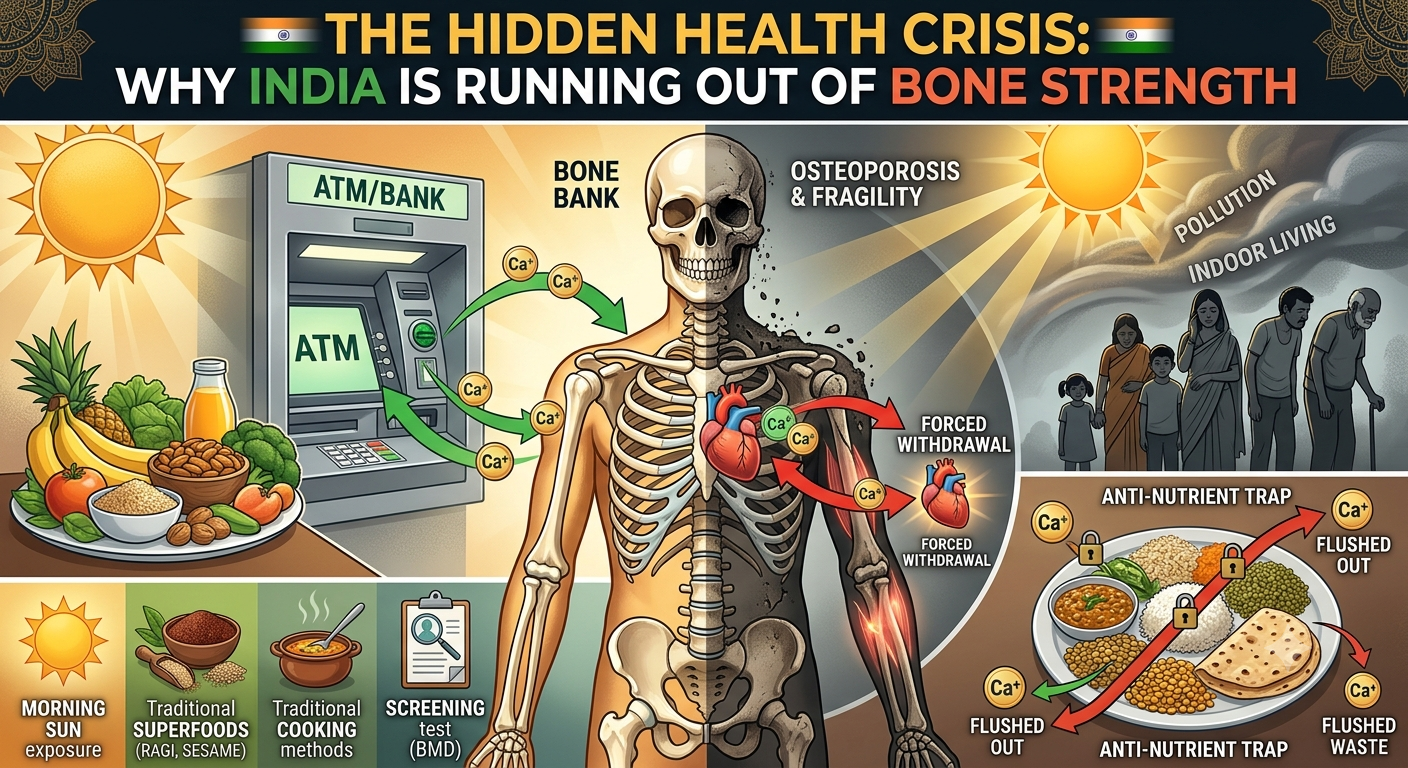
To keep bones healthy, an adult needs about 1,000 to 1,200 mg of calcium every day. Unfortunately, the average Indian consumes less than half of that amount, taking in only around 429 mg daily.
Calcium does much more than build bones; it is absolutely vital for keeping your heart beating, your nerves firing, and your muscles moving. Because the human body cannot make its own calcium, it enters panic mode when you don’t eat enough. To keep your heart and muscles functioning, the body starts treating your skeleton like a bank account, withdrawing the calcium stored in your bones.
Over time, this constant draining leaves the bones hollow and brittle. Because it happens silently, most people do not realize their skeleton is being starved until a bone breaks.
2. The Vitamin D Blockade
Eating enough calcium is only half the battle. Your body also needs Vitamin D, which acts like a key to unlock your digestive system so the calcium can enter your blood.
Even though India gets plenty of sunlight year-round, an estimated 70% to 80% of the population lacks enough Vitamin D. This happens for three main reasons:
Indoor Living: Most people spend their entire day working inside offices.
Screen Time: Both adults and children are spending more time indoors looking at screens instead of playing outside.
Air Pollution: Heavy smog and pollution in cities block the specific ultraviolet (UVB) sun rays needed to create Vitamin D.
Without enough Vitamin D, your body only absorbs about 10% to 15% of the calcium you eat. The rest is simply flushed away, making even a great diet highly ineffective.
3. The Hidden Traps in Daily Meals
It is not just what you eat, but how your food interacts in your stomach. The standard Indian diet relies heavily on grains like wheat and rice, as well as lentils (dals). While healthy, these foods contain compounds called “phytates.” Certain leafy greens also contain “oxalates.”
These compounds act as anti-nutrients. When you eat them alongside calcium, they bind to the calcium in your stomach and carry it out of your body as waste. Adding to this problem, modern urban diets have largely abandoned traditional, easily absorbed calcium sources like ragi (finger millet), sesame seeds, and pure dairy.
Who is in the Most Danger?
This crisis affects everyone, but certain groups are at a much higher risk:
Women After Menopause: Estrogen is a hormone that naturally protects bone density. When estrogen levels drop significantly after menopause, women lose bone strength at a highly accelerated rate.
Growing Children: Kids who spend all day indoors are missing out on building maximum bone strength during their critical teenage years, setting them up for a lifetime of weak bones.
The Elderly: For older adults, weakened bones can turn a simple fall into a devastating hip fracture. This limits their ability to move and heavily increases the risk of life-threatening complications.
Simple Steps to Protect Your Bones
Fixing this problem requires small but consistent lifestyle changes. Here is what you can do to protect your skeleton:
Get Morning Sun: Try to spend 15 to 20 minutes in the sunlight every day, ideally in the morning when the sun’s rays are safest and most effective.
Eat Traditional Superfoods: Bring calcium-heavy foods like ragi, sesame seeds (til), and dairy back into your daily meals.
Cook Smart: Soaking your grains before cooking them, or eating fermented foods (like idli and dosa), helps break down the anti-nutrients that block calcium absorption.
Check Your Bone Health: If you are experiencing unexplained back pain or notice a slight decrease in your height, do not wait. Ask a doctor about getting a Bone Mineral Density (BMD) test.
The stark reality of this health crisis is that you can eat full meals every single day and still be starving on the inside. If we do not step outside into the sun and adjust our diets, our bodies will continue to forcefully take what they need from our bones—a painful debt that will eventually have to be paid.