


The garment industry is much more than a commercial enterprise in India; it is an economic lifeline that connects farmers, weavers, and small businesses to the nation’s broader growth story. This massive ecosystem is currently taking center stage at Bharat Tex 2026, hosted at New Delhi’s Bharat Mandapam from July 14 to 17. Going far beyond a standard trade show, this event marks a strategic push to cement India’s position as a global powerhouse for textile manufacturing, innovation, and sustainable investment.
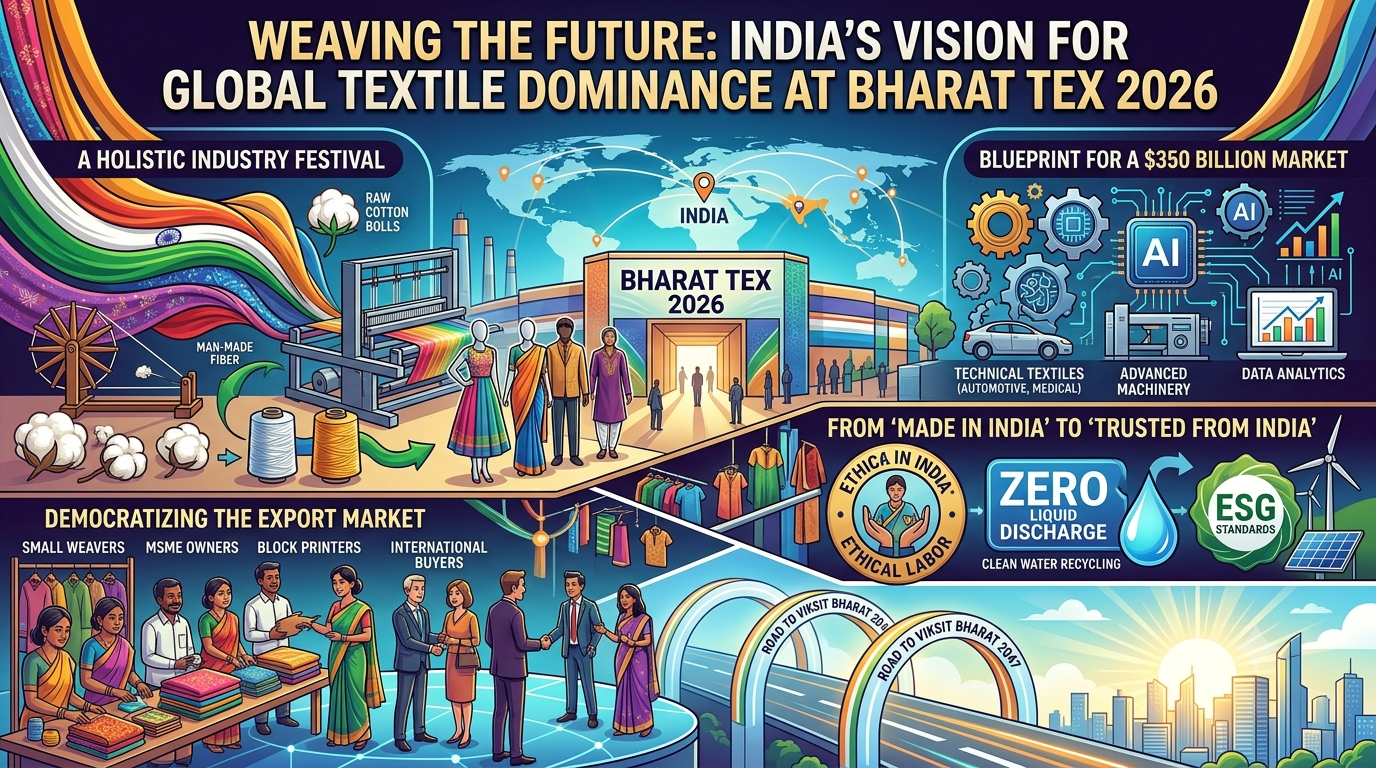
A Holistic Industry Festival
Classifying Bharat Tex as a simple exhibition would be an understatement. According to Bhadresh Dodhia of the Bharat Tex Trade Federation, the event is designed as a complete “Mahotsav” (festival) for the industry.
Global Convergence: The event has attracted buyers, policymakers, and investors from 126 different countries, creating a massive networking hub.
End-to-End Capabilities: It serves as a live demonstration of India’s unique self-sufficiency, showcasing the country’s ability to manage the entire supply chain from raw fiber to finished fashion.
Uplifting Local Artisans: Crucially, the platform gives local weavers and small-scale manufacturers a direct line to international markets, helping them understand and meet global consumer demands.
The Blueprint for a $350 Billion Market
Currently, India’s textile and apparel industry is valued at roughly $179 billion. Hitting the ambitious target of $350 billion by 2030 will require strategic upgrades. Updeep Singh from ASSOCHAM outlines six core pillars necessary to drive this growth:
Balanced Fiber Policies: Shifting focus to include more Man-Made Fibers (MMF), as they account for 70% of global consumption, alongside traditional cotton.
Expanding Capacities: Encouraging both small enterprises and large corporations to scale up their specialized production.
Embracing Technology: Utilizing modern advancements like Artificial Intelligence (AI) to maximize manufacturing productivity.
Expanding Trade Horizons: Continuing to leverage Free Trade Agreements (FTAs) to ensure Indian goods have frictionless access to international markets.
Committing to Sustainability: Making green manufacturing, ethical labor practices, and supply chain traceability non-negotiable standards.
Fostering Innovation: Continuously upgrading workforce skills and making innovation a core part of the industry’s culture.
From “Made in India” to “Trusted from India”
A major theme emerging from the 2026 expo is a shift in global branding. Today’s international buyers care about more than just cheap prices; they demand ethical practices, high Environmental, Social, and Governance (ESG) standards, and consistent quality.
Industry leaders are pushing for the brand identity to evolve into “Trusted from India.” The country is already making serious strides in this direction. For example, the massive Tirupur textile cluster operates entirely on a Zero Liquid Discharge framework, proving that massive export volumes can go hand-in-hand with environmental responsibility.
Democratizing the Export Market
Bharat Tex plays a critical role in bringing grassroots businesses into the global fold. Small and Medium Enterprises (MSMEs) often struggle with international branding, compliance, and funding. This event democratizes the process by allowing small exhibitors from traditional hubs—like Panipat, Ahmedabad, and Ichalkaranji—to showcase their products to global buyers at a fraction of the usual cost. Furthermore, these businesses receive targeted mentorship on how to handle international sampling, navigate export documentation, and fulfill global orders.
The Road to 2047
As international brands look to diversify their supply chains away from a single country, India has a golden window of opportunity. While facing stiff competition from nations like Vietnam and Bangladesh, India’s edge lies in building an ecosystem rooted in reliability, green energy, and complete supply chain independence. Backed by proactive government policies and industry collaboration, India’s textile sector is laying the groundwork to become a dominant, trusted global hub, perfectly aligning with the nation’s broader goal of becoming a developed economy by 2047.