




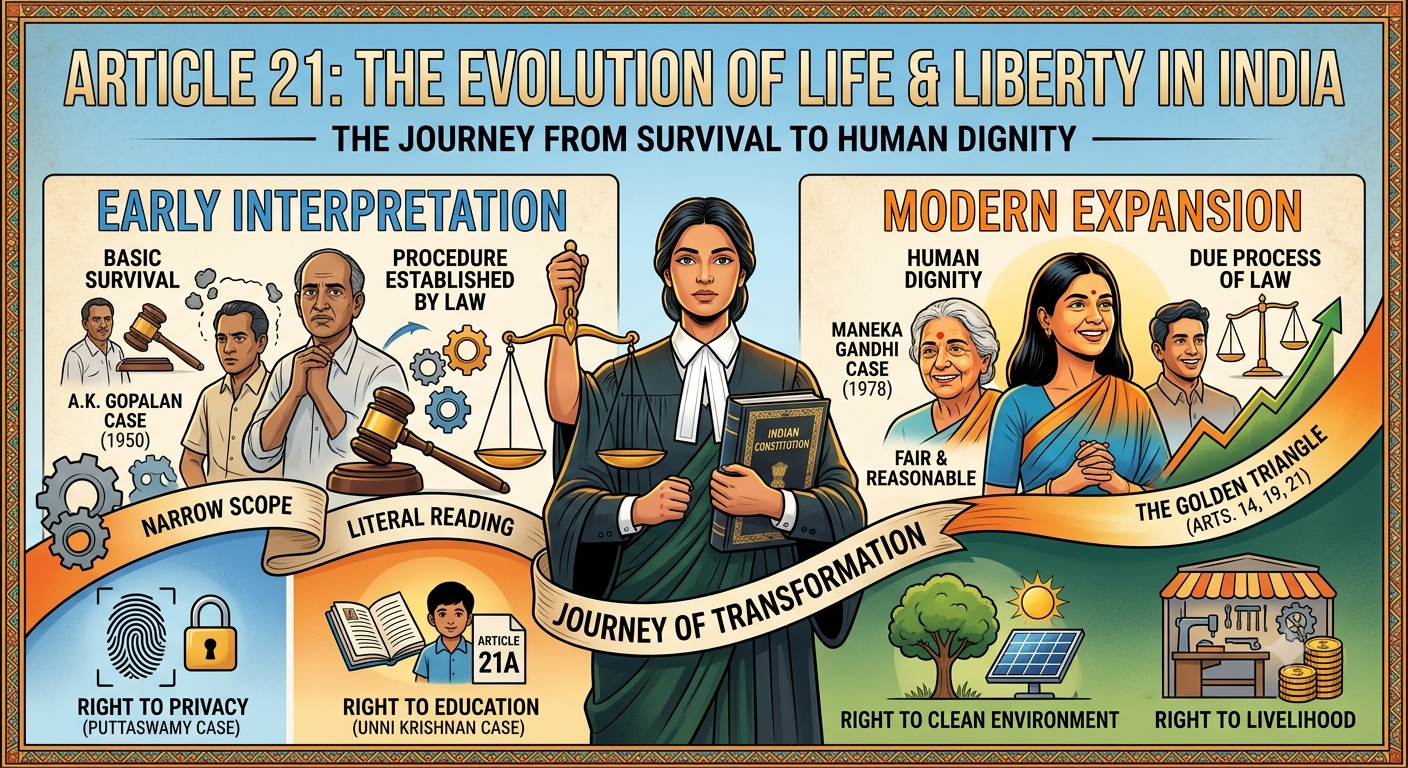
A single, brief sentence in the Indian Constitution has grown into a vast shield protecting everything from an individual’s privacy and education to the air they breathe. This is Article 21, the cornerstone of human dignity in India. When the Constitution was first adopted in 1950, this provision was interpreted very narrowly. Today, thanks to decades of progressive judicial rulings, it has become one of the most powerful and comprehensive rights available to the people.
Decoding the Text of Article 21
The text of the article simply states: “No person shall be deprived of his life or personal liberty except according to procedure established by law.”
To truly grasp its impact, it is helpful to look at its core components:
Universal Application: The phrase “no person” deliberately extends this fundamental right to everyone within the country’s borders, whether they are Indian citizens or foreign nationals.
The Meaning of “Life”: Over time, the courts have clarified that “life” means far more than mere biological survival. It encompasses the right to live with dignity, which inherently includes access to health, shelter, a clean environment, and basic education.
Understanding “Personal Liberty”: This ensures that individuals have the autonomy to make personal choices and move freely without facing unjustified or arbitrary interference from the government.
The Constitutional Debate: Procedure vs. Due Process
When drafting the Constitution, the framers had to choose between two major legal doctrines to govern how the state could limit personal liberty.
- Procedure Established by Law: Under this framework, a court only checks if a law exists and whether the government followed the steps outlined in that law. It does not judge the fairness of the law itself.
- Due Process of Law: Originating in the United States, this doctrine goes a step further. It requires courts to ensure that the law itself is fundamentally fair, just, and reasonable.
Fearing that the judiciary might become too powerful and frequently clash with elected lawmakers, India’s founding fathers initially opted for the narrower “Procedure Established by Law.”
- A Tale of Two Judgments: From Gopalan to Maneka Gandhi
The judicial interpretation of Article 21 has undergone a massive paradigm shift, best illustrated by two historic Supreme Court cases.
In the A.K. Gopalan Case (1950), the Supreme Court took a very literal and restricted approach. After Gopalan was detained under preventive detention laws, the court ruled that as long as a valid law existed and the legal procedures were followed, the state’s actions were perfectly constitutional. The court refused to question whether the law itself was oppressive.
The watershed moment arrived decades later with the Maneka Gandhi Case (1978). After the government seized her passport without providing an adequate explanation, she approached the Supreme Court. In a historic pivot, the judiciary ruled that any procedure established by law to restrict liberty must be fundamentally fair, just, and reasonable. This landmark decision essentially infused the spirit of the American “Due Process” doctrine into Indian constitutional law, ensuring the state could no longer use arbitrary laws to strip away freedoms.
The Interconnected “Golden Triangle”
The Maneka Gandhi judgment also shattered the idea that fundamental rights operate in isolation. The Supreme Court established that Articles 14, 19, and 21 are deeply intertwined, forming a “Golden Triangle” of constitutional protection. For any law affecting personal liberty to be valid, it must survive three distinct tests:
- The Equality Test (Article 14): The law cannot be arbitrary or treat citizens unequally.
- The Freedom Test (Article 19): The law must not place unreasonable restrictions on fundamental freedoms.
- The Liberty Test (Article 21): The legal procedure utilized must be entirely fair and just.
Expanding the Horizon of Rights
Following the 1978 shift, the Supreme Court began to view Article 21 as a composite right, bringing numerous unwritten protections under its massive umbrella:
The Right to Education: In the 1993 Unni Krishnan ruling, the court declared basic education essential to a dignified life. This eventually prompted lawmakers to add Article 21A, guaranteeing free and compulsory education for children between the ages of 6 and 14.
The Right to Privacy: In the monumental 2017 Puttaswamy verdict, a nine-judge bench unanimously recognized privacy—covering data protection, bodily autonomy, and personal choices—as an intrinsic part of the right to life and liberty.
Critiques and Challenges
While the expansion of Article 21 is largely celebrated for bolstering democracy and human rights, it has not been immune to criticism from legal scholars and policymakers:
Judicial Overreach: Critics argue that by constantly expanding this single article, the judiciary often crosses into the territory of policymaking, which should ideally be left to elected representatives.
Practical Enforcement: The courts have read socio-economic rights, such as the right to housing and healthcare, into Article 21. However, fulfilling these rights requires massive financial resources, making them incredibly difficult for the state to guarantee in practice.
Despite these practical challenges, Article 21 remains the beating heart of the Indian Constitution, constantly evolving to protect the dignity and freedom of the individual against the changing tides of time.