




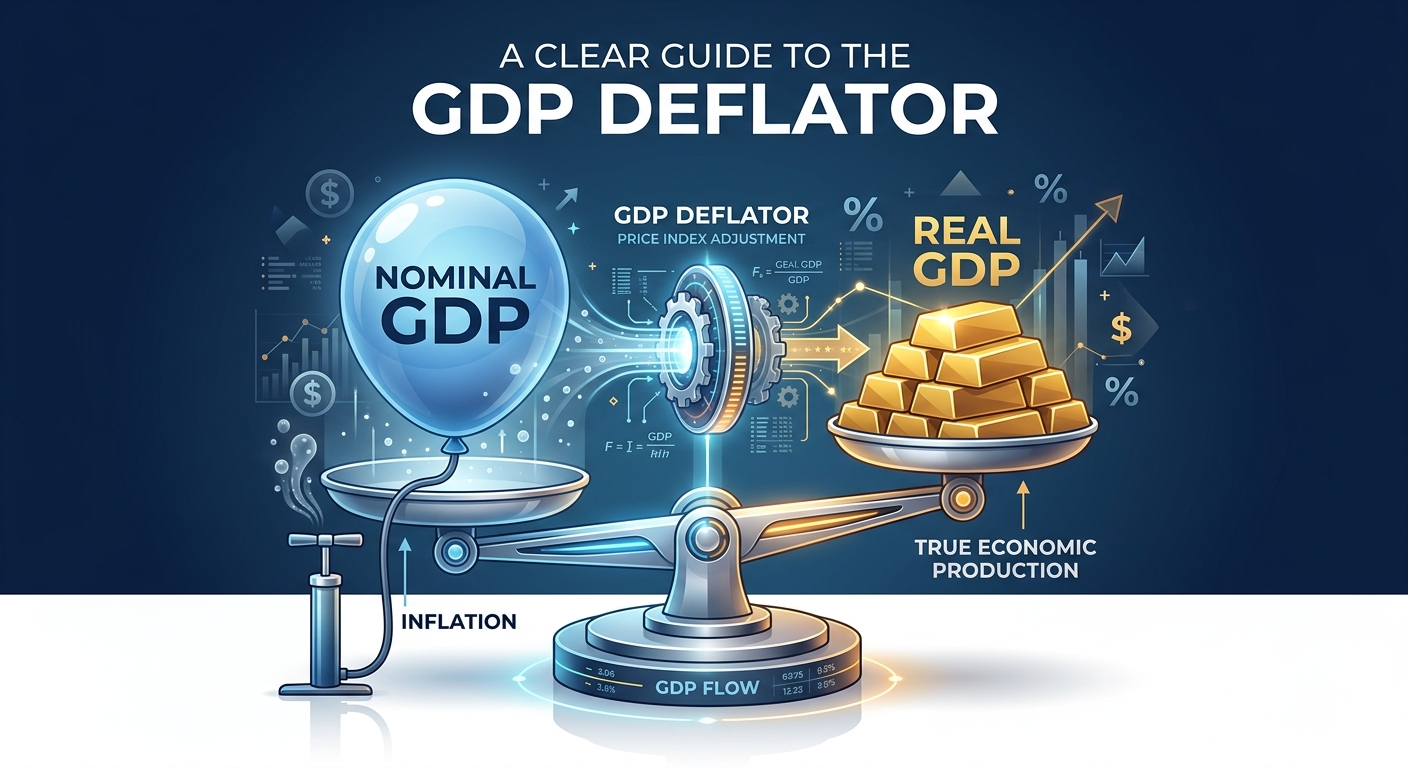
When we evaluate how well a country’s economy is doing, Gross Domestic Product (GDP) is the number everyone watches. However, raw GDP figures can be highly misleading when market prices change due to inflation. To understand if an economy is genuinely producing more goods—or if things are just getting more expensive—economists use an essential metric known as the GDP Deflator.
The Basics: What Exactly is GDP?
GDP represents the total cash value of all final products and services created inside a nation’s borders during one financial year.
What it includes: It counts all goods and services produced domestically, including items sent abroad as exports.
What it leaves out: It strictly ignores imports, because those items were made in another country.
How it is calculated: The basic value is found by multiplying the quantity of everything produced by its selling price.
Two Ways to View Growth: Nominal vs. Real GDP
To see how the deflator works, we first have to separate GDP into two categories:
Nominal GDP: This tracks economic output using today’s current market prices. If a country makes 10 kilograms of grain and it sells for ₹20 per kg this year, the Nominal GDP is ₹200.
Real GDP: Because global events like wars or supply shortages can artificially inflate current prices, Nominal GDP can make an economy look bigger than it actually is. To fix this, Real GDP measures the exact same output (10 kgs of grain) but uses the prices from a stable reference year (the base year), such as ₹10 per kg. The Real GDP here would be ₹100.
Even though the actual amount of food produced didn’t change, the Nominal GDP looks twice as large purely because of price hikes.
Demystifying the GDP Deflator
The GDP Deflator is a mathematical tool that reveals how much of an economy’s growth is just a side effect of rising prices. It shows us the exact ratio by which the economy is inflated.
How the GDP Deflator Differs from CPI
While both the GDP Deflator and the Consumer Price Index (CPI) track inflation, they use completely different methods to do so:
The Scope of Goods: The CPI monitors a specific, fixed basket of goods that average households typically buy. In contrast, the GDP Deflator looks at absolutely every single item produced domestically across the entire nation.
The Treatment of Imports: The CPI includes imported goods since everyday citizens regularly purchase foreign products. The GDP Deflator, however, completely excludes imports because it only measures what is made at home.
The Import Price Test
Consider what happens if global crude oil prices spike dramatically, but all local production costs stay perfectly stable. Because India relies heavily on foreign oil, this shock plays out differently across both metrics:
The CPI will climb significantly, because expensive fuel immediately drives up consumer transport costs and retail prices.
The GDP Deflator will remain flat, because imported oil is not a part of domestic production, meaning the deflator ignores the price jump entirely.
Summary
The GDP Deflator serves as an incredibly thorough lens for looking at true economic health. By stripping away the distortion of shifting market prices and ignoring foreign imports, it allows analysts to see exactly how much real, physical growth an economy is achieving.