


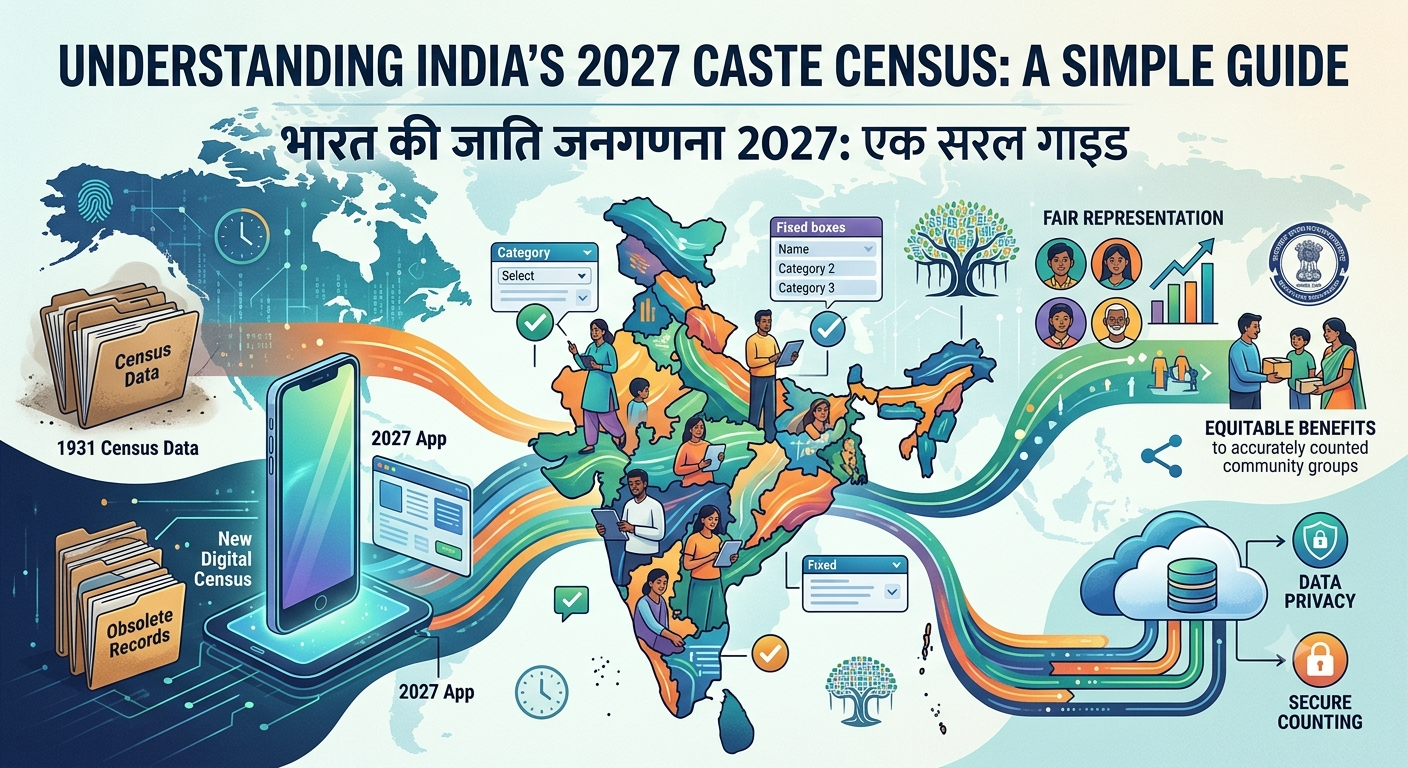
India is gearing up for a major event in 2027: a full caste-based population count. This is a historic moment because the nation has not conducted a complete, official caste census since 1931, which was during British rule. Overall, this will be India’s 16th census, and its 8th since gaining independence.
Why is a Caste Census Important Today?
Currently, the government relies on data from all the way back in 1931 to decide how to distribute welfare schemes and manage reservation quotas (like guaranteed spots in education and government jobs).
By collecting fresh, accurate data, the government can ensure that benefits are handed out fairly based on the true size of different communities today. If the new numbers show that certain groups have a much larger population than previously thought, it could lead to strong demands to increase the current 50% legal limit on reservations.
Learning from the Mistakes of 2011
Counting castes is not easy. In 2011, the government tried to collect this data through a separate survey, but it became a massive headache.
During that survey, people were given a blank space to write down their caste. Most people simply wrote down their surnames. Because surnames do not always clearly indicate a specific caste, and because the same surname can mean different things in different states, the government ended up with a chaotic list of over 4.6 million different names! The data was so confusing that it was never officially published.
How Will the 2027 Census Fix These Problems?
To avoid repeating the chaos of 2011, the government has created a much smarter plan for 2027:
- No More Blank Boxes: Citizens will no longer type in their own answers. Instead, they will choose their caste from a fixed, official list.
- State-Specific Lists: Because caste categories vary greatly depending on where you live, each state government is providing its own accurate list of recognized castes to the central government.
- A Digital First: This will be a modern, paperless census. Data will be collected through specific mobile apps, and citizens might even have the option to fill out their details online.
- Practice Runs: To ensure everything goes smoothly, the government has already conducted practice tests across 16 states to finalize the questions and the digital system.
The Two Phases of the Census
This massive project is split into two main steps:
Phase 1 (House Details): This part focuses on counting houses and asking basic questions about living conditions (like the type of house and vehicles owned). It is already finished in most places and will be wrapped up in the remaining states by September 2026.
Phase 2 (People and Caste): This is the main phase where people will be asked about their caste and personal details. It is scheduled to happen in February 2027.
All the final numbers will be officially recorded based on the country’s population exactly at midnight on March 1, 2027.
Strict Rules for Participation
It is important to know that participating in the census is required by law. According to the rules set back in 1948, providing false information or refusing to answer can lead to serious consequences, including a ₹1,000 fine and up to 6 months in jail.
To pull off this gigantic task in the world’s most populated country, the government has mapped out millions of local blocks and is preparing to deploy around 30 lakh (3 million) officials to complete the counting.