



On July 2, 2026, political and business leaders from India and Japan came together for a major economic event. With Indian Prime Minister Narendra Modi and Japanese Prime Minister Sanae Takaichi leading the way, the meeting highlighted how strong the partnership between the two countries has become.
Here are the main takeaways from the event in simple terms:
Big Business Deals and Growth
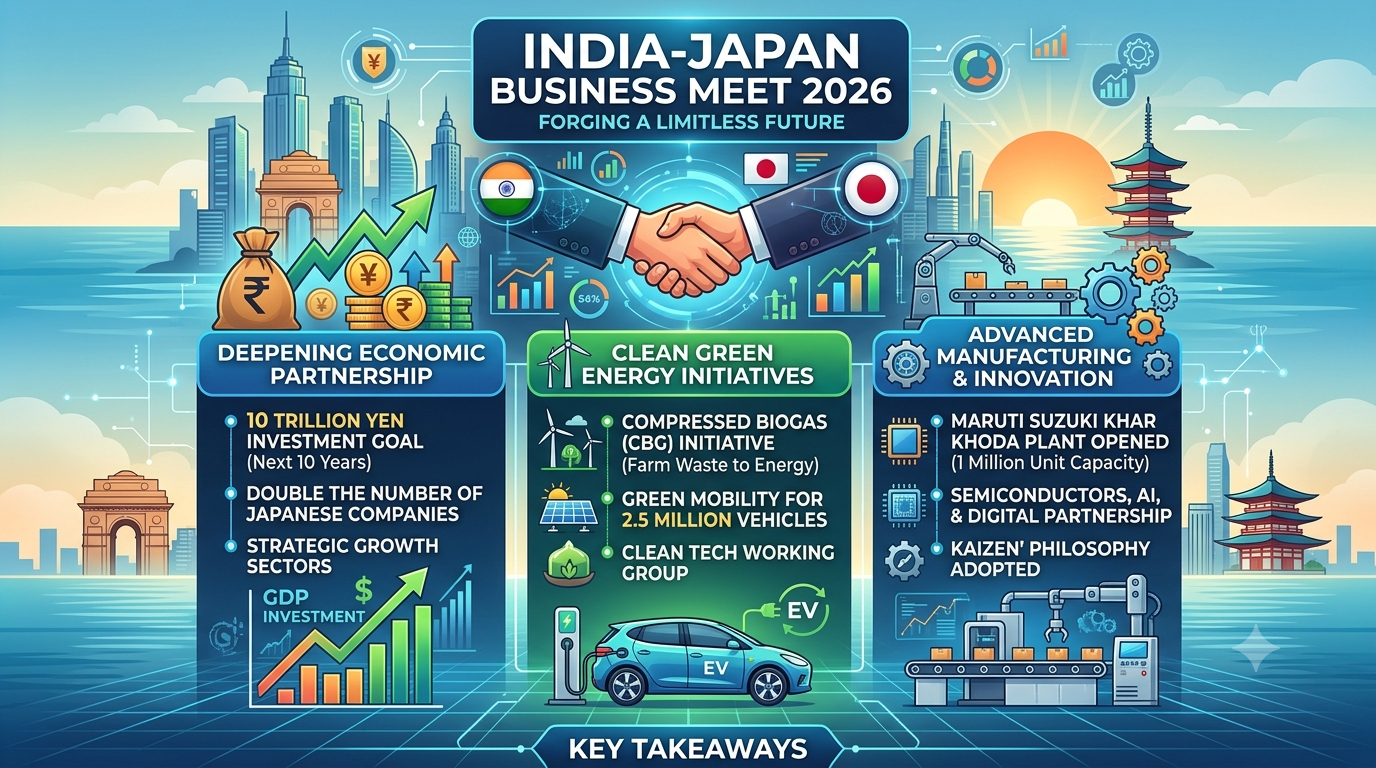
Japanese companies are showing a lot of excitement about working in India. Right now, over 80% of Japanese businesses already operating in India want to grow their operations. In just the past year, Japan has invested about 2 trillion Yen into the Indian economy. During the event, the two nations announced 129 new partnership agreements in modern fields like artificial intelligence (AI), computer chips, and clean energy.
A Giant New Car Factory
A major highlight of the day was the opening of a brand-new, highly advanced Maruti Suzuki car factory in Kharkhoda, Haryana. The head of Suzuki announced that this factory will eventually be able to produce 1 million cars every year, making it one of the largest car manufacturing plants in the entire world. This is a huge success for India’s goal of making more products locally.
Focusing on Clean and Green Energy
Japanese PM Sanae Takaichi spoke about the importance of clean energy and protecting the environment. Both leaders agreed to launch a special project in rural India that will turn farm waste and cow dung into clean biogas. Together, they hope to produce enough of this green fuel to power roughly 2.5 million vehicles. The leaders also discussed how Japan and India can team up to support business and development in other regions, like Africa and Latin America.
Huge Goals for the Next 10 Years
Prime Minister Modi spoke about India’s fast-growing economy, noting that the country has been inspired by the Japanese idea of “Kaizen”, which means continuous improvement.
To make it even easier for Japanese companies to work in India, PM Modi announced a special “Japan Business Week.” During this time, top officials from the Indian government will sit down directly with Japanese business leaders to listen to their ideas and solve any problems.
Finally, PM Modi set two very big goals for the next ten years:
To bring in over 10 Trillion Yen in new investments from Japan.
To double the total number of Japanese companies working in India.
Summary
This meeting proved that India and Japan are ready to work together more closely than ever before. By combining Japan’s advanced technology and funding with India’s massive workforce and fast growth, both countries are building a brighter, greener, and wealthier future together.