




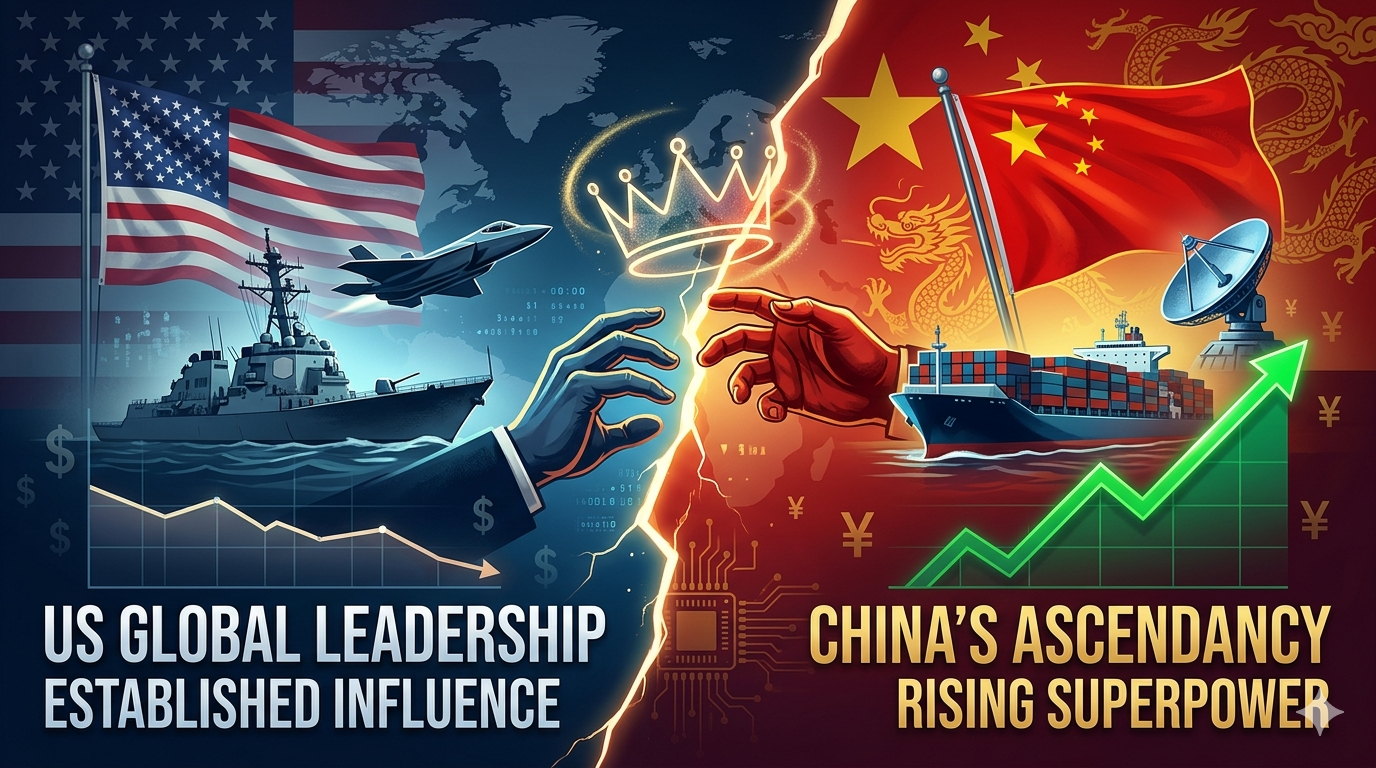
A highly scrutinized meeting recently took place in Beijing, bringing together the leaders of the world’s two foremost powers: Donald Trump and Xi Jinping. Over the past several months, the geopolitical landscape has transformed at a dizzying pace. Accompanied by a delegation of America’s corporate elite—including tech titans like Elon Musk, Tim Cook, and Jensen Huang—the US administration arrived in China under circumstances that highlight a profound shift in the global order. While the United States remains a formidable force, the optics of this summit suggest that Beijing now holds a significant portion of the geopolitical leverage.
The Innovation Race: China’s Technological Ascendancy
Long stereotyped as the world’s factory for low-cost imitations, China has aggressively pivoted to become a pioneer in research, development, and high-level technology.
Patent Dominance: China recently shattered records by surpassing 5 million valid invention patents, establishing a clear global lead. More importantly, the majority of these are concentrated in high-value, strategic sectors such as artificial intelligence (AI), green energy, and robotics.
The AI Revolution: Beijing currently commands roughly 60% of all global AI patents. Showcasing this independence, a relatively small Chinese startup recently deployed an AI model rivaling major US counterparts in efficiency, notably bypassing strict American export controls on advanced microchips. The nation’s domestic AI economy is now vast, serving hundreds of millions of users.
Next-Generation Tech: Chinese innovation extends well beyond software. The country is responsible for the lion’s share of global robotics patents and has achieved remarkable milestones in quantum computing and high-speed satellite communications that currently outperform major Western commercial alternatives.
Although the US retains an advantage in the most advanced semiconductor manufacturing, China’s massive annual investments in R&D are rapidly eroding that lead.
Military Modernization: Out of the Shadows
Historically, Beijing modernized its armed forces with quiet discretion. Today, it confidently projects a self-sufficient and highly advanced military apparatus.
China has tactically utilized proxy conflicts to test and validate its military hardware, allowing it to market these systems internationally as combat-proven.
Recent public military demonstrations have unveiled a stunning array of advanced weaponry, from intercontinental ballistic missiles to hypersonic anti-ship technology and stealth autonomous submarines.
Intelligence reports indicate that China is actively testing sixth-generation fighter aircraft, closing a technological gap that was once thought to be an exclusive American domain.
Conversely, ongoing international engagements, particularly in the Middle East, have heavily strained US military resources and depleted crucial stockpiles of interceptors and munitions.
Economic Realities: The Industrial Juggernaut
While the United States continues to boast the world’s highest nominal GDP, analyzing the underlying economic engines paints a more complex picture.
Purchasing Power: When measured by Purchasing Power Parity (PPP)—a metric that evaluates actual domestic output and consumption—China quietly overtook the United States roughly a decade ago and continues to widen that specific gap.
The Manufacturing Monolith: China is responsible for an estimated 30% of all global manufacturing. Even if the industrial output of the next several runner-up nations were combined, they would still fall short of China’s immense production capacity.
The Rare Earth Chokehold: Perhaps Beijing’s most potent strategic weapon is its near-total monopoly on rare earth elements. These minerals are the lifeblood of modern technology, essential for everything from electric vehicle batteries to stealth fighter jets. By controlling over 90% of the processing capabilities for these materials, China possesses the unique ability to bottleneck global supply chains at will.
Global Diplomacy: Bridging the Divide
Over the past decade, China has aggressively courted the Global South, financing infrastructure and establishing deep economic ties through initiatives like the Belt and Road framework. Meanwhile, the US has navigated a more turbulent path with its historical allies. As a result, several nations and international blocs that have felt sidelined by Washington’s recent foreign policy shifts are increasingly looking to Beijing to establish secure economic partnerships.
Conclusion: A Multipolar Reality
Has the United States completely lost its status as the supreme global superpower? Not quite. Washington still benefits from an unparalleled network of international military alliances, the enduring dominance of the US dollar, and superior living standards for its citizens.
However, China’s unprecedented 40-year evolution from an impoverished agrarian society into an industrial, technological, and military behemoth means the playing field has undeniably leveled. The image of American leadership traveling to Beijing with a cohort of CEOs to secure market stability serves as a powerful testament to this new reality: the unipolar moment has passed, and a deeply interconnected, multipolar world is here to stay.