



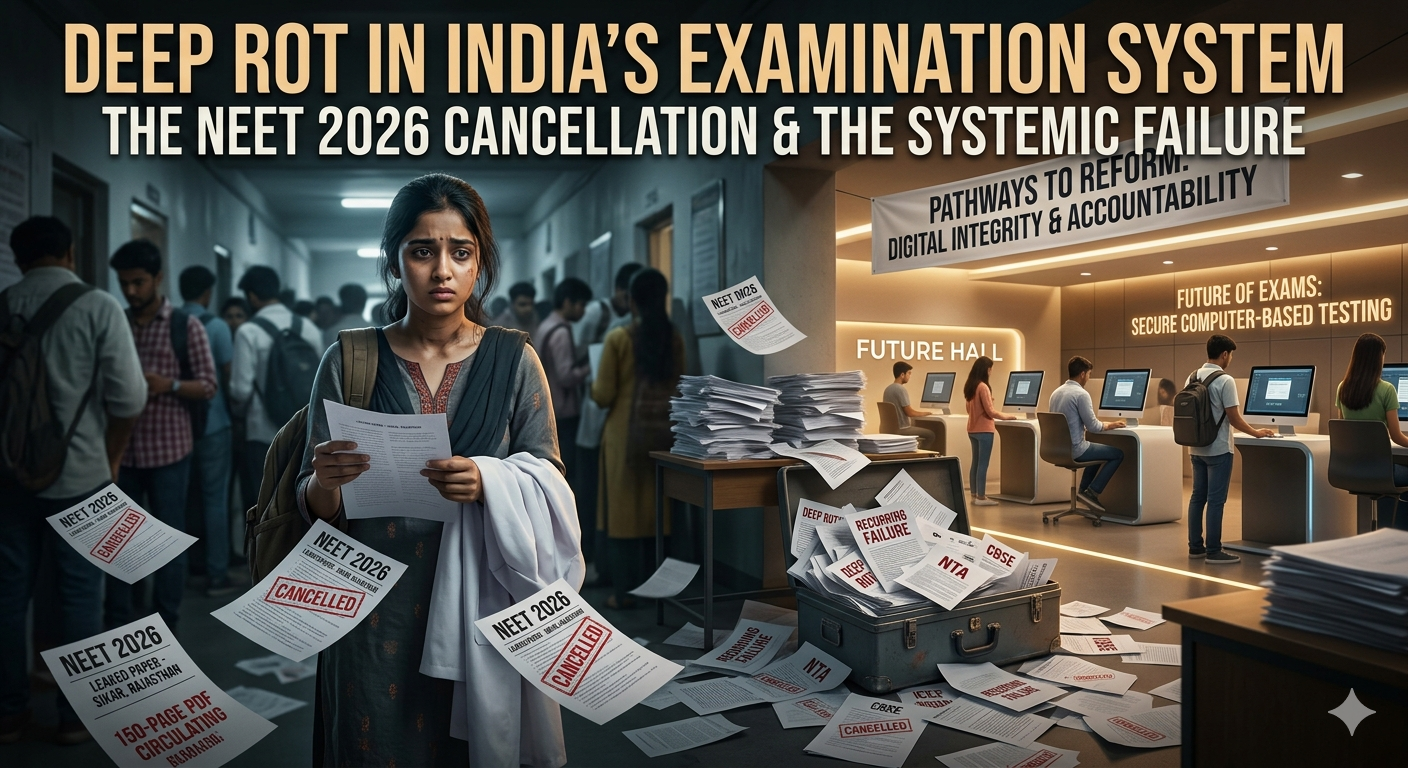
The recent cancellation of the National Eligibility cum Entrance Test (NEET) 2026 following massive paper leak allegations has reignited fierce debates regarding the integrity of India’s competitive examination framework. For the over 2.2 million aspirants vying for roughly 100,000 highly coveted medical seats, the scrapping of the test represents a devastating loss of time, resources, and emotional energy.
Despite repeated promises of reform, the recurring failure of standardized testing bodies highlights a deeply entrenched syndicate that continues to jeopardize the future of the nation’s youth.
The Mechanics of the 2026 Breach
The specifics surrounding the NEET 2026 compromise point to an alarming level of systemic rot. Reports indicate that the epicenter of the leak traces back to Sikar, Rajasthan, a rapidly growing hub for medical coaching.
Well before candidates sat for the exam, a 150-page digital document containing 410 preparation questions began circulating widely on messaging platforms. When the official exam commenced, 130 of those exact questions appeared on the test in the exact same sequence. This included all 90 questions in the Biology section and over 40 questions in the Chemistry section.
This level of precision indicates that the breach did not occur at a vulnerable local transit point or a printing press. Instead, it suggests complicity at the highest levels of exam formulation. According to reports, illicit access to these papers is routinely sold to desperate candidates for exorbitant sums ranging from ₹30 lakh to ₹50 lakh.
The Failure of High-Tech Safeguards
In the wake of previous NEET controversies in 2021 and 2024—which included bizarre scoring anomalies and localized leaks—the National Testing Agency (NTA) had implemented seemingly robust security measures. Following the recommendations of the Radhakrishnan Committee, the NTA introduced:
- GPS tracking for the physical transport of exam papers.
- Extensive CCTV surveillance at examination centers.
- Mandatory biometric verification for candidates.
However, the 2026 leak proves that technological band-aids cannot fix a compromised core. The successful circumvention of these security measures highlights that the masterminds operate well above the reach of standard logistical checkpoints.
A Nationwide Epidemic
The NEET 2026 incident is not an isolated anomaly; it is a symptom of a broader epidemic affecting India’s recruitment and educational sectors. Data suggests that over the past five years, approximately 50 major examination leaks have disrupted the lives of nearly 15 million candidates across various states.
High-profile historical instances include:
Rajasthan REET (2021): A massive breach that forced the nullification of the state’s teacher eligibility test.
UP Police Constable Recruitment (2024): A leak that impacted nearly 5 million aspirants, leading to the exam’s cancellation.
Bihar BPSC (2022): Examination papers were leaked on social media before the test commenced.
Foundational Exams: Prestigious and foundational exams, including the CBSE boards in 2018 and the JEE Main, have also faced significant hacking and leak scandals in the past.
Pathways to Reform
To dismantle this illicit industry and restore faith in the system, experts argue that fundamental, structural shifts are required:
Transition to Fully Digital Testing: The physical printing and transportation of paper exams inherently create multiple points of vulnerability. Just as India has successfully scaled digital infrastructure for voting and financial transactions, entrance exams must shift to secure, randomized, computer-based testing (CBT). If questions are pulled from a secure digital repository at the exact moment the exam begins, the window for pre-exam leaks is practically eliminated.
Stringent Deterrents and Accountability: Currently, the perceived low risk of severe prosecution emboldens criminal syndicates. Establishing swift, severe, and highly public legal penalties for those orchestrating these breaches is necessary to create a genuine deterrent.
The Need for Public Pressure
The recurring collapse of standardized testing is a national crisis. However, public apathy often allows the cycle to continue, with many families hoping to quietly navigate the broken system rather than challenge it. Until civil society uniformly demands unwavering accountability and structural reform from testing authorities, the aspirations and hard work of millions of deserving students will remain under constant threat.