



As India aggressively pursues its goal of becoming a “Viksit Bharat” (Developed Nation) with a $30 trillion economy, the spotlight is turning toward its major urban centers. Cities are the primary drivers of innovation, employment, and economic prosperity. Yet, to truly harness this potential, the underlying structures of how these cities are governed must evolve.
Recently, NITI Aayog outlined a strategic path forward in its report, “Moving Towards Effective City Government: A Framework for Million Plus Cities.” Here is a complete breakdown of the systemic challenges facing Indian municipalities and the sweeping reforms proposed to fix them.
The Focus on “Million-Plus” Urban Centers
Rather than attempting to overhaul every municipality at once, NITI Aayog’s strategy targets India’s 46 cities with populations exceeding one million. This targeted approach makes sense because:
Economic Heavyweights: These cities house roughly a third of India’s urban residents but generate nearly 60% of the national GDP.
Complex but Capable: While they suffer from the highest levels of administrative complexity, they also have the institutional maturity required to test new governance models.
By successfully implementing reforms in these massive hubs first, the government aims to create a blueprint of best practices that can eventually be scaled down to smaller towns.
The Core Bottlenecks in Urban Administration
Experts and policymakers agree that city governments are currently held back by deep structural flaws rather than simple mismanagement. The primary hurdles include:
Scattered Decision-Making: True power in cities is rarely held by the municipal corporation. Essential services like water, transport, and urban planning are often managed by separate, state-controlled agencies. While the Constitution recommends giving urban local bodies authority over 18 civic functions, most only have full control over a handful, primarily waste management and sanitation. This leads to massive accountability gaps.
The Revenue Crisis: Indian cities suffer from severe financial dependency. Property tax collections in India hover around a mere 0.15% of GDP, drastically lower than the 2-3% seen in developed economies. With up to 70% of municipal budgets consumed by daily operations and staff salaries, there is virtually no capital left for infrastructure upgrades.
A Severe “Talent Desert”: Municipalities are functioning with a 30% to 35% staffing deficit. More alarmingly, research indicates that less than 4% of current municipal workers have adequate technological training, making the dream of “Smart Cities” incredibly difficult to execute without significant capacity building.
The Proposed Reforms: Systemic Change by Design
NITI Aayog’s roadmap steps away from temporary fixes, advocating instead for fundamental shifts in how cities are run:
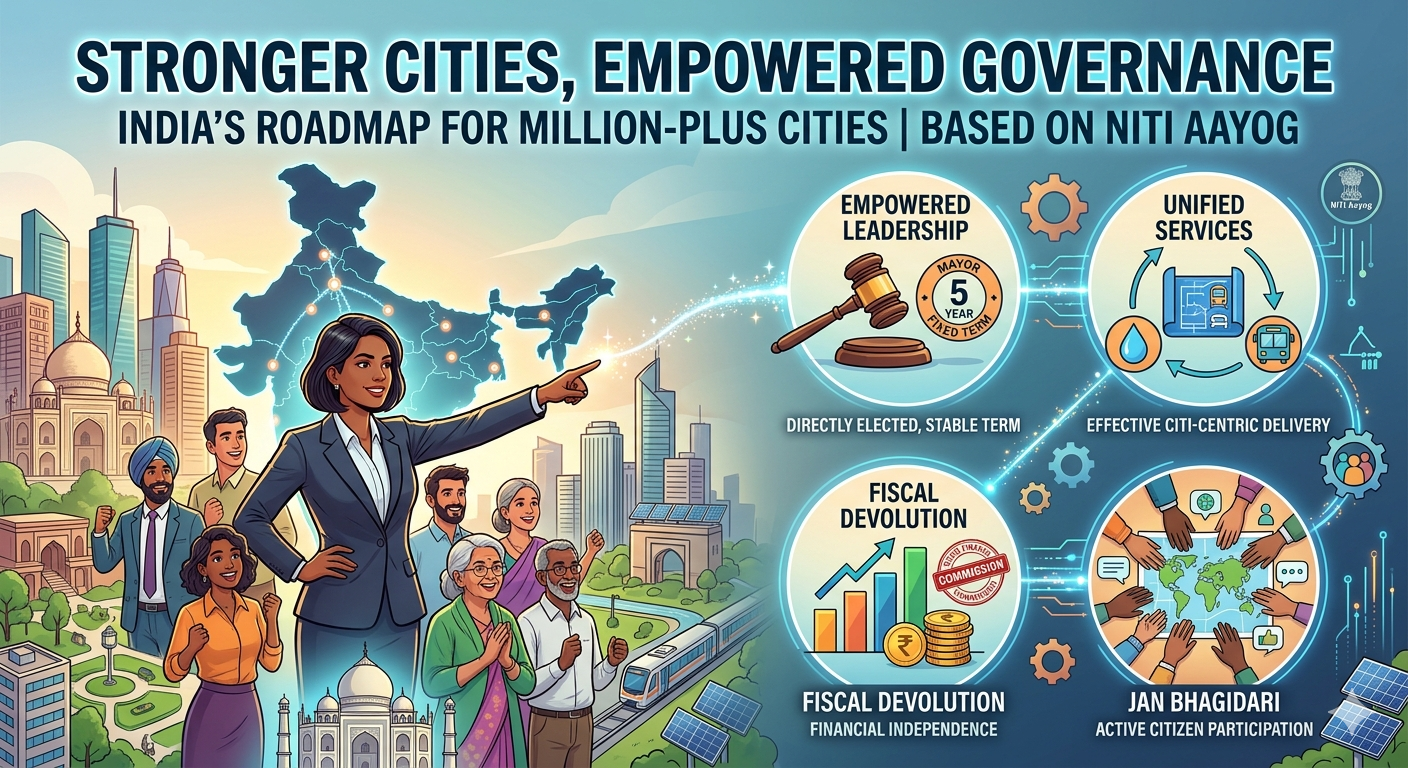
1. Strong, Accountable Leadership
The framework heavily advocates for a directly elected mayor who serves a guaranteed five-year term. This ensures voters have a clear, accountable leader. To prevent the concentration of absolute power, this would be paired with an empowered “Mayor-in-Council” system, similar to a prime minister’s cabinet.
2. Streamlined Civic Services
Instead of demanding total control over all 18 constitutional functions immediately, the report suggests a phased approach. City governments should first be granted absolute authority—or at least strict oversight—over six critical areas: water supply, sanitation, urban planning, solid waste management, bus transport, and fire services.
3. Fiscal Independence
Cities need the freedom to generate their own revenue. The report emphasizes the role of State Finance Commissions in ensuring timely fund allocation, which will empower local leaders to invest in long-term revenue-generating projects rather than just struggling to pay the bills.
4. Active Civic Participation (Jan Bhagidari)
Top-down policies are not enough. The roadmap calls for a cultural shift where citizens move beyond simply filing grievances. By actively participating in ward-level planning and municipal budgeting, residents can help co-create a more responsive governance system.
5. Meaningful Tech Integration
While platforms like the National Urban Digital Mission provide excellent digital infrastructure, technology is only a tool. Bureaucratic delays must be eliminated on the backend so that citizens actually experience the benefits of digital governance and learn to trust these online systems.
The Road Ahead
The NITI Aayog report makes one thing abundantly clear: India’s future depends on the strength of its cities. For these urban centers to accommodate explosive growth and drive the national economy, they must transition from weak, fragmented bodies into empowered, financially independent institutions.
At OnliOnlineEdu, our mission is to empower learners through high-value insights. We believe you should read the quality and write the article to know the world about you and your knowledge. Stay tuned for more in-depth analyses on the policies shaping our future.