




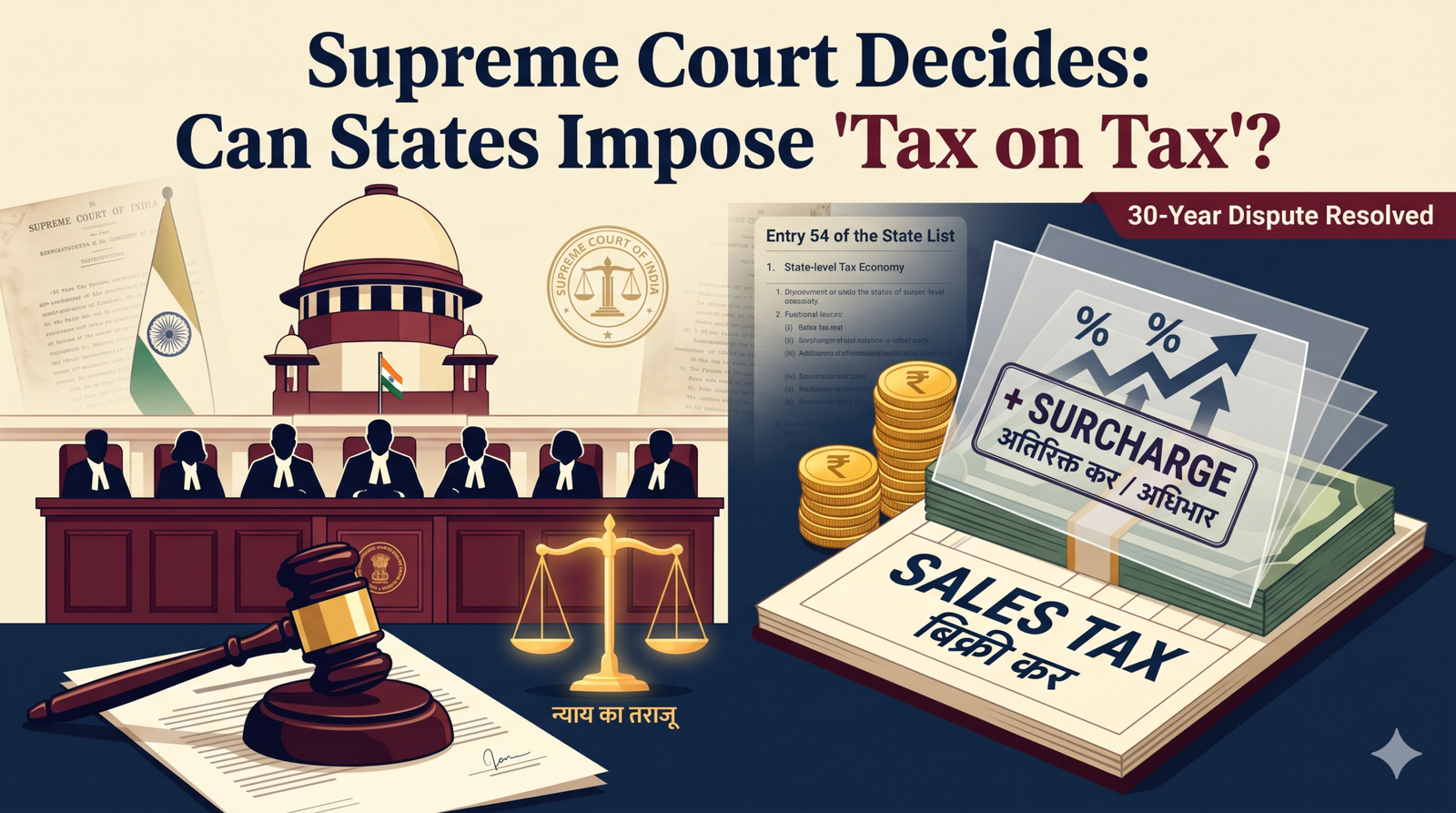
Resolution of a Three-Decade Legal Dispute: The Supreme Court of India recently concluded a long-standing legal debate stretching back over 30 years. The core question was whether state governments have the constitutional authority to impose a surcharge (often described as a “tax on tax”) on the sales tax paid by dealers.
Origins of the Controversy: The conflict began with a 1990 amendment in Odisha that introduced an additional 10% surcharge on the sales tax for dealers with an annual turnover exceeding 10 lakh rupees. Dealers challenged this, arguing that imposing a tax on an existing tax fell outside the state’s legislative powers under Entry 54 of the State List.
The State’s Legal Standpoint: State governments defended their position by explaining that a surcharge is not a completely new tax. Instead, it functions as an increase in the existing rate of the sales tax. They emphasized that the core character of the tax remained tied to the sale and purchase of goods, not on income.
Reaffirming the 1974 Precedent: A 7-judge Constitution Bench settled the matter by upholding the precedent set by the 1974 S. Kodar judgment. The Court agreed with the states, confirming that a surcharge calculated as a percentage of the sales tax payable is simply an additional duty or a higher rate of tax, not an independent or unconstitutional “tax on tax.”
Not an Income Tax: The Supreme Court clarified that the liability to pay this surcharge is based strictly on a dealer’s turnover (sales volume), rather than their profit or income. Consequently, even a dealer running a business at a loss must pay the surcharge if their turnover crosses the prescribed threshold.
Addressing Previous Conflicting Rulings: The prolonged confusion was partly fueled by the 1990 India Cement judgment, which had struck down a cess on mineral royalty. However, the Court clarified that this was irrelevant to sales tax surcharges, as a recent 2024 nine-judge bench ruled that mineral royalty is a contractual consideration, not a tax.
The Impact of GST (101st Amendment): The Supreme Court declared the 1974 reference “infructuous” (no longer practically relevant) going forward. With the introduction of the Goods and Services Tax (GST) through the 101st Constitutional Amendment Act, state powers under Entry 54 have been significantly narrowed. Any future disputes regarding state taxation will now be governed under the GST framework rather than older sales tax precedents.