



Introduction to Sustainable Agriculture Initiatives
India is strategically transitioning its agricultural sector toward environmentally responsible and climate-adapted farming to secure long-term food production while protecting fragile ecosystems.
The overarching objective is to maximize soil vitality, minimize chemical reliance, preserve water resources, and boost farmer incomes through the adoption of modern agricultural technologies.
Because rainfed farming accounts for roughly 60% of India’s sown area and contributes around 40% of the nation’s total food output, upgrading these systems is treated as critical for domestic food security.
Evolution and Strategic Framework
The National Mission for Sustainable Agriculture (NMSA) was established as a proactive defense against climate-induced farming volatility, originating under the national climate action framework.
To streamline operations, it was integrated into the Green Revolution Krishonnati Yojana in 2018–2019, and later consolidated under the Pradhan Mantri Rashtriya Krishi Vikas Yojana starting in 2022–2023.
The framework specifically empowers marginalized and small-scale farmers in drought-prone regions through targeted financial aid, technical awareness campaigns, and access to sustainable tools.
Core Mission Components
Rainfed Area Development:
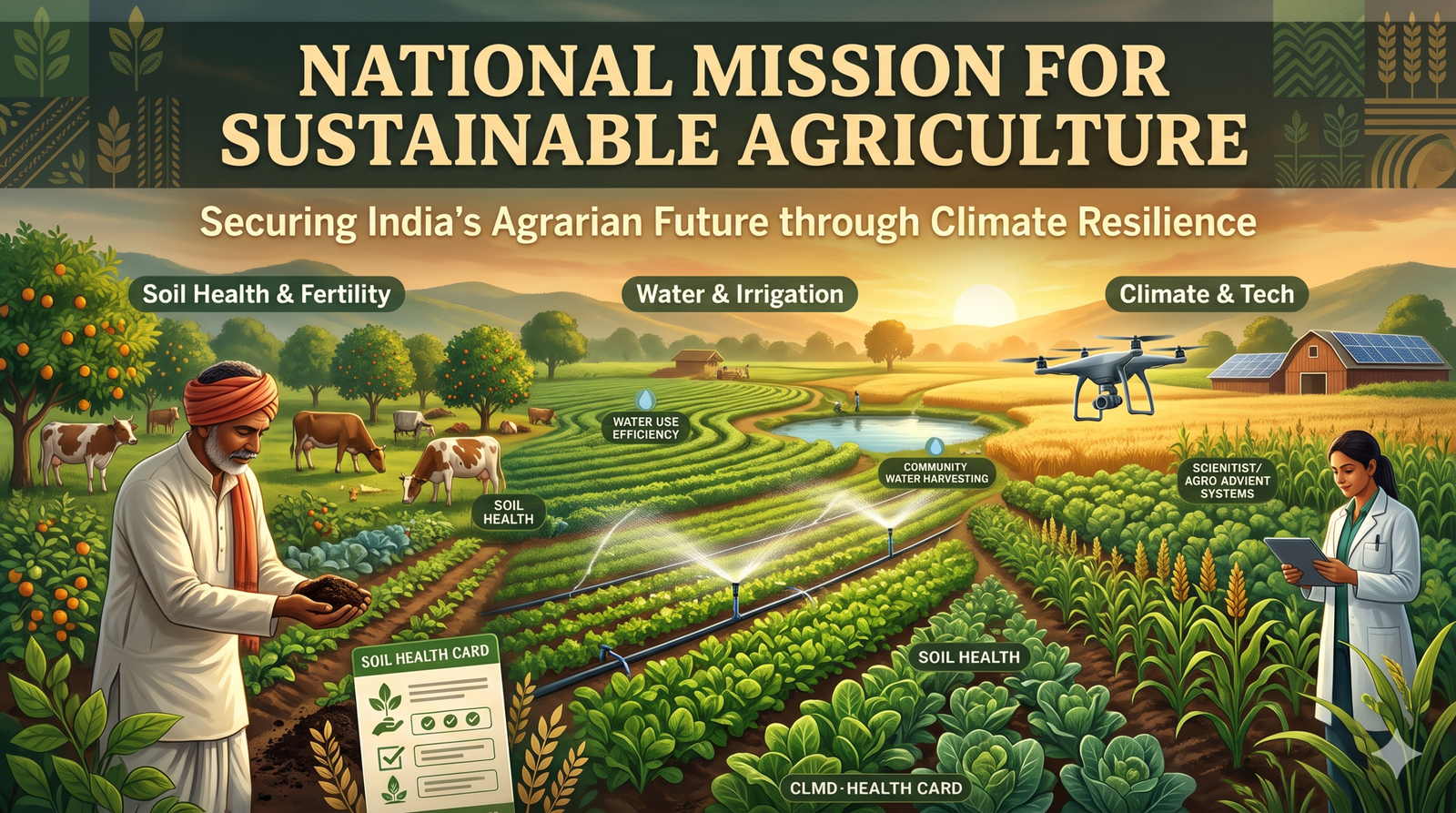
This initiative champions integrated farming systems tailored to specific agro-climatic zones, guided by models developed by the Indian Council of Agricultural Research (ICAR).
It encourages farmers to combine crop rotation and multi-cropping with allied sectors like livestock, fisheries, and horticulture to diversify income and build financial resilience.
Extensive funding allocations continue to support large-scale farmer training programs across various states and union territories.
Enhancing Water Efficiency (Per Drop More Crop):
This program focuses on maximizing water utilization at the farm level through the expansion of micro-irrigation technologies, specifically drip and sprinkler systems.
Drip irrigation targets the plant’s root zone directly to prevent evaporation, while sprinkler systems ensure uniform field coverage, drastically reducing overall resource waste.
The government provides substantial subsidies to help farmers adopt this infrastructure, with ambitious multi-year targets aimed at bringing millions of new hectares under micro-irrigation.
Soil Health and Nutrient Management:
The initiative promotes tailored, location-specific soil treatments, emphasizing organic farming, crop residue management, and balanced fertilizer application to prevent land degradation.
A central pillar of this effort is the Soil Health Card Scheme (introduced in 2015), which translates scientific soil testing into actionable advice for everyday farmers.
By generating localized soil health cards based on millions of tested samples, the scheme has successfully reduced the excessive use of urea, corrected nutrient imbalances, and measurably improved crop yields.
Additionally, specialized village-level soil fertility maps are being publicly deployed to help farmers make hyper-local, informed decisions regarding crop nutrition.
Strengthening Climate Resilience and Innovation
National Innovations on Climate Resilient Agriculture (NICRA):
Launched in 2011, this flagship research program builds farming resilience against extreme weather events like heatwaves, sudden floods, and prolonged droughts.
Following extensive vulnerability assessments, highly susceptible districts were provided with specific agricultural contingency plans and climate-adapted crop management strategies.
Hundreds of specialized “climate-resilient villages” have been established across the country to demonstrate and successfully replicate coping technologies.
Through sustained research, the agricultural system has successfully developed and released nearly 3,000 distinct climate-resilient crop varieties over the last decade.
Complementary practices, such as zero-tillage, direct-seeded rice, and stress-tolerant crop adaptations, are heavily promoted to mitigate climate risks.
Technological Integration:
The mission increasingly relies on next-generation technology, adopting AI-based advisory systems, drone utilization, remote sensing, and sensor-driven farm machinery.
Mobile platforms are widely leveraged to deliver real-time weather updates, localized market intelligence, and immediate crop advisories directly to rural communities.
Economic and Environmental Impact
By weaving together water conservation, localized soil management, and advanced technological innovation, India’s agriculture sector is building a robust defense against climate change.
These consolidated efforts align directly with global Sustainable Development Goals (SDGs), ensuring the enduring prosperity, food security, and environmental stability of the nation’s agrarian economy.