





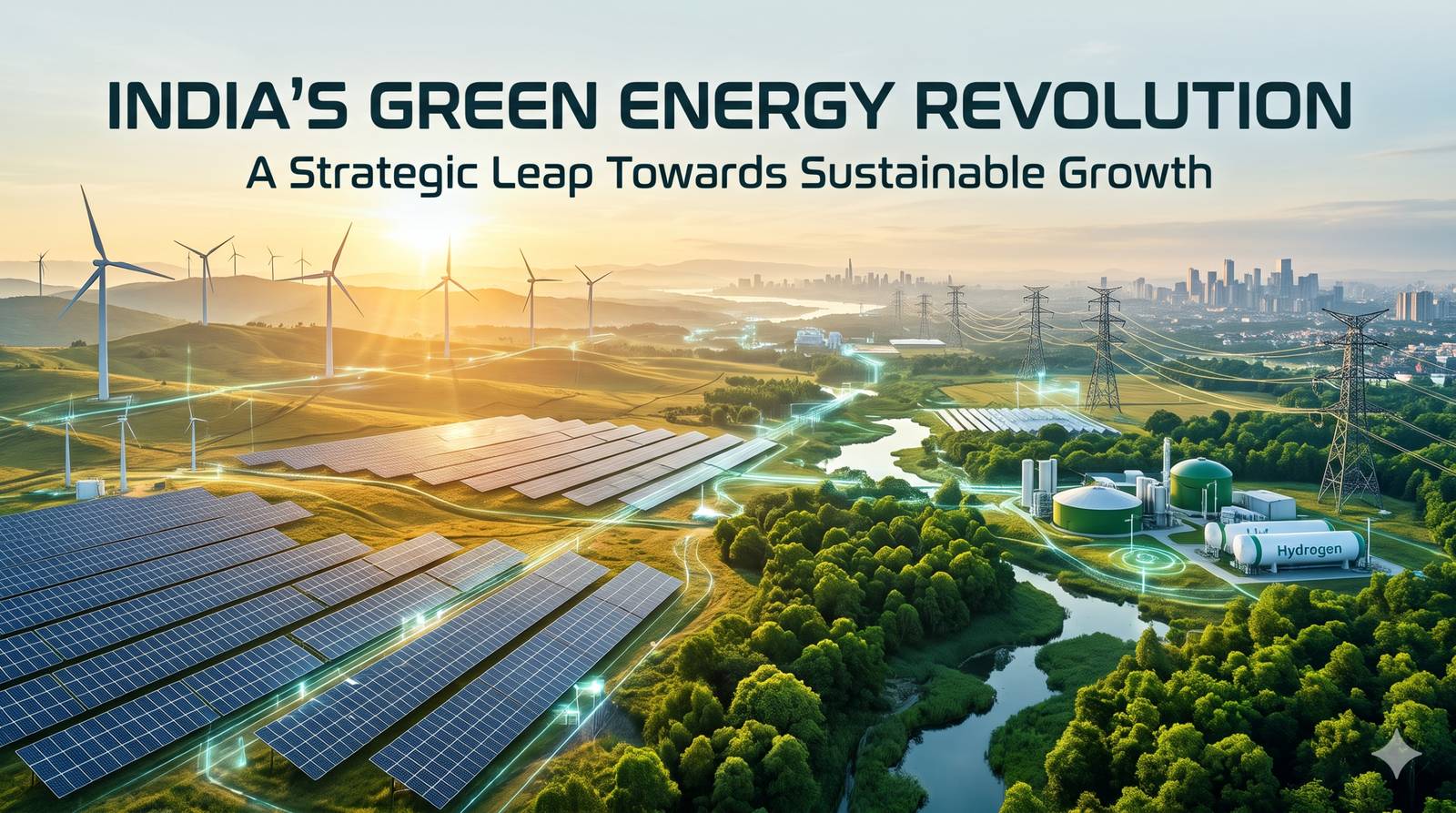
India is currently navigating a monumental shift in its energy landscape. As one of the world’s fastest-growing major economies and the third-largest consumer of crude oil, the nation’s energy demands are surging. With projections indicating that India will account for nearly a quarter of global incremental energy demand by 2050, the country has strategically embraced a green energy transition. This shift is not merely an environmental obligation but a foundational pillar for building a self-reliant and sustainably developed nation.
Accelerating Beyond Targets
A defining moment in this journey occurred in the summer of 2025, when India successfully sourced 50% of its cumulative installed electricity capacity from non-fossil fuel sources. Remarkably, this milestone was reached five years ahead of the 2030 target set under the Paris Agreement. Out of a total installed power capacity of roughly 552 gigawatts by mid-2026, over 300 gigawatts are now derived from clean energy. This rapid transformation is fueled by sweeping policy reforms, infrastructure expansion, and a commitment to balancing economic growth with environmental stewardship.
The Solar and Wind Power Boom
Solar energy has emerged as the crown jewel of India’s renewable portfolio. Expanding from a modest 2.8 gigawatts in 2014 to over 164 gigawatts by 2026, solar power now constitutes the largest segment of the country’s renewable capacity. This explosive growth positioned India as the second-largest solar growth market globally. Ground-level initiatives, such as massive national rooftop solar schemes, have already empowered millions of households, heavily subsidizing installations and driving consumer electricity bills down to zero for many. Complementing this is a new push into floating solar projects paired with advanced energy storage systems.
Wind power also serves as a critical anchor, with India ranking fourth globally in installed capacity. Having reached over 58 gigawatts, the country is continuously tapping into onshore resources across states like Gujarat, Tamil Nadu, and Maharashtra, while concurrently laying the regulatory and financial groundwork for future offshore wind projects along its extensive coastlines.
Diversifying the Clean Energy Mix
To ensure grid stability and resilience, India is actively diversifying beyond solar and wind. Hydropower continues to provide flexible and reliable energy, boasting a cumulative capacity of over 57 gigawatts, supplemented by new investments in small hydro projects particularly suited for hilly terrains. Additionally, bio-energy ecosystems are expanding rapidly, transforming agricultural waste and biomass into productive energy and compressed biogas.
For heavy industrial sectors where traditional electrification falls short—such as steelmaking, fertilizers, and petroleum refining—green hydrogen is stepping in as the clean fuel of the future. Driven by a dedicated national mission, India is scaling up its domestic green hydrogen production and piloting hydrogen-powered transportation, including indigenous fuel-cell trains. Furthermore, nuclear energy is undergoing significant modernization, with ambitions to dramatically scale capacity over the next two decades through domestic innovation and international cooperation.
Balancing Transition with Stability
The cornerstone of India’s approach is ensuring a transition that is both just and orderly. Acknowledging that conventional fuels remain necessary for meeting baseline demands during renewable fluctuations, the country is focusing on a gradual, stabilized transformation. This requires massive investments in modern transmission networks, domestic manufacturing of green technologies, and next-generation battery storage.
Ultimately, India’s green leap is a careful balancing act of affordability, energy security, and environmental sustainability. By mobilizing private investments, fostering domestic supply chains, and establishing robust localized infrastructure, the nation is steadily turning its ambitious climate goals into a measurable, everyday reality.