




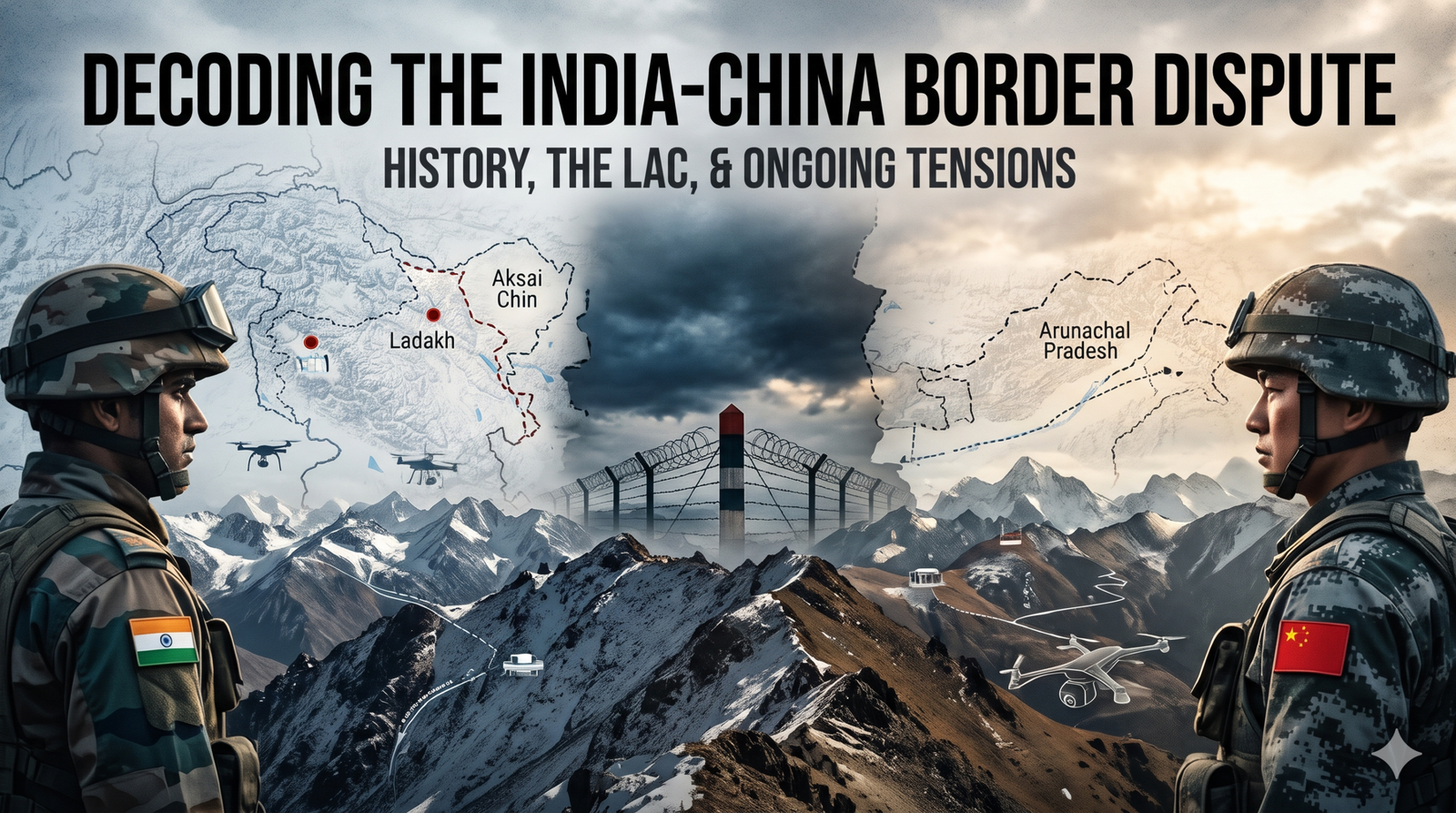
The ongoing border dispute between India and China is fundamentally driven by a lack of mutual agreement on their shared boundary. When military patrols from both nations encounter each other in disputed territories, local confrontations can quickly escalate into international crises. In October 2026, tensions flared again as India expressed concerns over Chinese forces deviating from established patrolling patterns, while China maintained that its troops were conducting standard patrols in accordance with existing agreements.
The Roots of the Boundary Dispute
India and China share an approximately 3,488-kilometer border that spans Ladakh, Himachal Pradesh, Uttarakhand, Sikkim, and Arunachal Pradesh. However, the exact boundary has never been mutually agreed upon. The conflict has deep historical origins stemming from how borders were drawn, interpreted, and inherited during the colonial era:
The Western Sector: In the western region, the dispute centers around Aksai Chin. While India claims this area as part of Ladakh, China currently controls it, viewing it as a vital strategic link between Xinjiang and Tibet.
The Eastern Sector: China disputes India’s sovereignty over the entirety of Arunachal Pradesh, a region India strictly considers an integral part of its territory. This disagreement is tied to the McMahon Line, drawn during the 1914 Simla Convention, which India accepts as the boundary but China rejects.
The Middle Sector: There are also overlapping claims and disagreements in the middle sector of the Himalayan boundary.
Understanding the Line of Actual Control (LAC)
The Line of Actual Control (LAC) serves as the dividing line between areas currently controlled by India and those controlled by China. It is crucial to distinguish the LAC from a formalized, mutually agreed-upon international border. Because the LAC is not mutually delineated across all sectors, both nations often have different perceptions of its exact location. This ambiguity leads to overlapping patrols where both sides believe they are operating within their own sovereign property, creating a dangerous environment that requires immense trust. Despite several agreements established in 1993, 1996, 2005, and 2013 to maintain peace and build military confidence, the underlying boundary issue remains unresolved.
Escalation: From 1962 to the Galwan Clash
The 1962 war between India and China left a lasting impact on bilateral relations, yet it did not permanently resolve the boundary dispute. For decades, both nations relied on diplomatic mechanisms and border agreements to prevent military crises. However, this fragile status quo was shattered in June 2020 when a violent clash erupted in the Galwan Valley in eastern Ladakh. The confrontation resulted in the deaths of 20 Indian soldiers, and China also acknowledged casualties. This event prompted substantial military deployments from both sides and initiated numerous rounds of diplomatic and military negotiations.
Disengagement vs. Resolution
Following the 2020 crisis, some progress has been made, such as an October 2024 agreement on patrolling arrangements in Depsang and Demchok, which led to troop disengagement at remaining friction points. However, it is vital to understand the distinctions between different phases of conflict resolution:
Disengagement: Opposing troops physically move apart at a specific location.
De-escalation: A broader reduction in military confrontation, including troop deployments and combat readiness.
Boundary Settlement: Both countries formally agree on the exact, final location of their shared border.
Achieving disengagement does not automatically guarantee de-escalation or a final settlement to the boundary dispute.
Diplomatic efforts and on-ground tensions continue to run parallel in 2026:
August 2026: The 25th round of Special Representatives talks took place in Beijing between India’s National Security Advisor Ajit Doval and China’s Foreign Minister Wang Yi. They agreed on establishing additional military meeting points and hotlines, with the next round of talks scheduled in India for 2027.
September 2026: Indian Prime Minister Narendra Modi and Chinese President Xi Jinping met during the BRICS summit in New Delhi, where India reiterated that border peace is essential for improving overall bilateral relations.
October 2026 Tensions: By late October, warnings emerged from the Indo-Tibetan Border Police (ITBP) regarding ongoing faceoffs along the Arunachal Pradesh border, highlighting the deployment of specialized commando teams and anti-drone capabilities. India’s Ministry of External Affairs attributed these disturbances to Chinese deviations from patrolling norms, while China reiterated that its troops were simply operating normally.
Both nations continue to navigate this complex geopolitical issue through a mix of military readiness and diplomatic dialogue, underscoring that while the dispute is currently being managed, a permanent resolution remains elusive.