





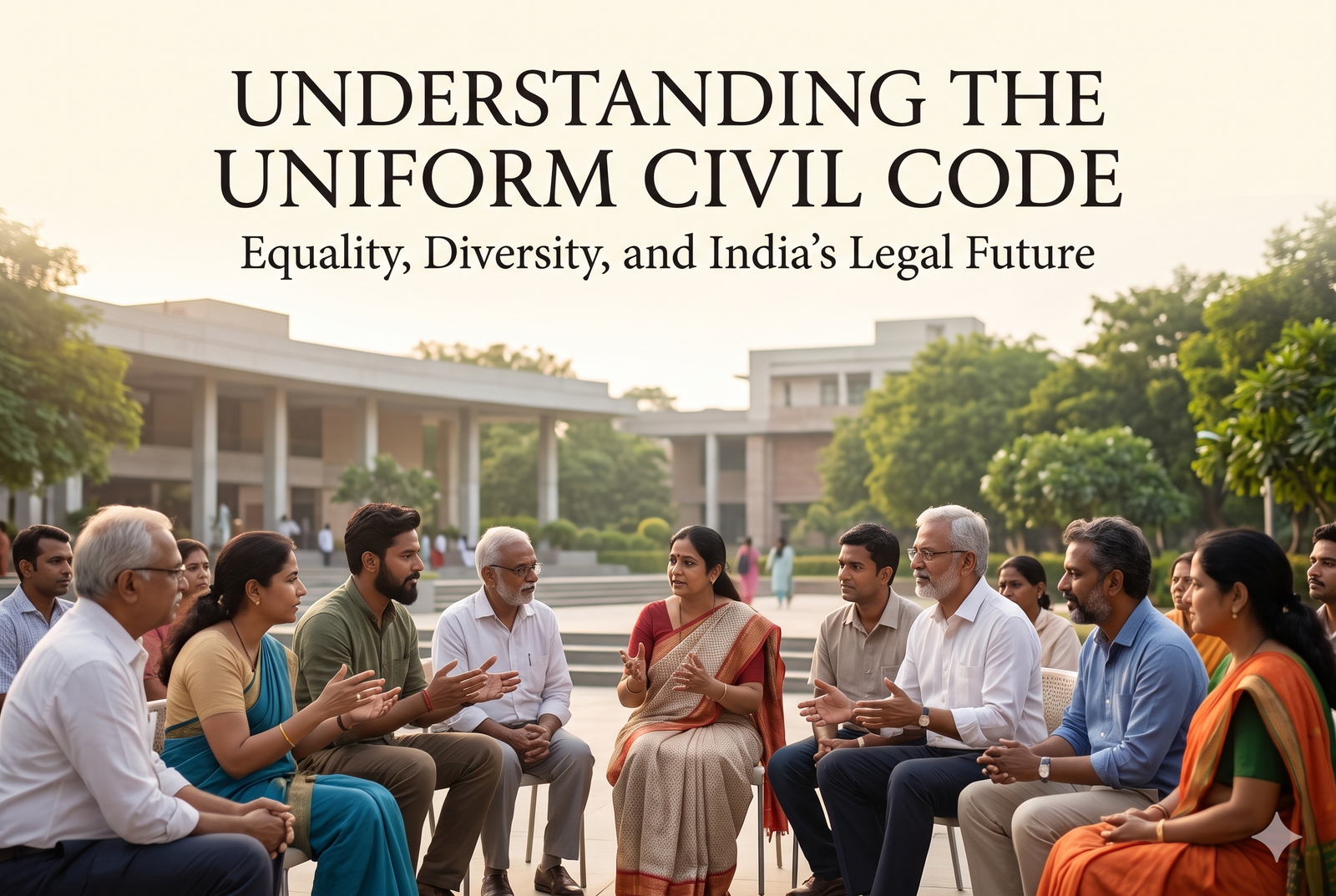
In India, crimes like theft or fraud are judged by the same laws for everyone. However, family matters—like marriage, divorce, adopting children, and inheriting property—are governed by different rules depending on a person’s religion.
The Uniform Civil Code (UCC) is a proposal to create one common set of family laws for every Indian, regardless of their faith. The goal isn’t to interfere with religious practices, but to make sure everyone is treated equally and fairly under the law.
What Does the Constitution Say?
When India’s Constitution was written, the creators included the UCC under Article 44. This article acts as a suggestion. It tells the government that it should try to create a uniform law for all citizens, but it doesn’t force them to do it right away. Because family law is a shared subject, both the central government and individual states have the power to create these rules.
A Quick Look at History
During British rule, the government standardized most laws but left religious family rules alone to avoid angering the public. After independence, leaders like Dr. B.R. Ambedkar wanted to reform these laws because many traditional rules were unfair to women. However, people couldn’t agree. In the end, only the family laws for Hindus, Buddhists, Jains, and Sikhs were updated in the 1950s, while other communities kept their traditional laws.
How Things Stand Today (As of 2026)
Instead of one big national law, individual Indian states are now taking the lead.
Goa has actually had a uniform civil code since 1867 (from Portuguese rule).
Uttarakhand made history by launching its own UCC in January 2025.
In 2026, the movement grew much faster, with Gujarat, Assam, and Madhya Pradesh all passing their own UCC laws.
Why Do People Support a UCC?
Equality for Women: Many traditional religious laws favor men, giving them more rights in inheritance and divorce. A common law would guarantee that men and women get equal rights.
Simpler Court Cases: Having different rules for different religions makes the legal system confusing. A single rulebook would make settling property and family disputes much faster and cheaper.
Financial Fairness: Right now, certain tax benefits (like the Hindu Undivided Family tax rules) are only available to specific religions. A UCC would ensure that tax and property rules are the same for everyone.
What Do the Courts and Experts Say?
Over the years, India’s Supreme Court has dealt with many cases (like the famous Shah Bano case in 1985) where religious laws clashed with basic human rights. The courts have frequently nudged the government to bring in a UCC to keep the country united.
Legal experts, known as the Law Commission, have debated this heavily. In 2018, they felt a UCC wasn’t needed just yet and said the focus should just be on fixing discriminatory practices. However, in 2023, a new Law Commission decided it was time to look into the issue again and ask the public for their opinions.
The Way Forward
The main idea behind the Uniform Civil Code is to build a fairer society. The challenge for India is to find the right balance—creating a system that protects basic human rights, ensures fairness in marriage and property, and treats women as equals, while still respecting the country’s beautiful cultural diversity.