


Recently, news reports have brought attention to alleged internal disagreements within India’s Election Commission (EC). The controversy largely centers on Chief Election Commissioner (CEC) Gyanesh Kumar and the methods used to manage the country’s voter lists.
Here is a simple breakdown of the main issues being discussed:
1. Internal Disagreements
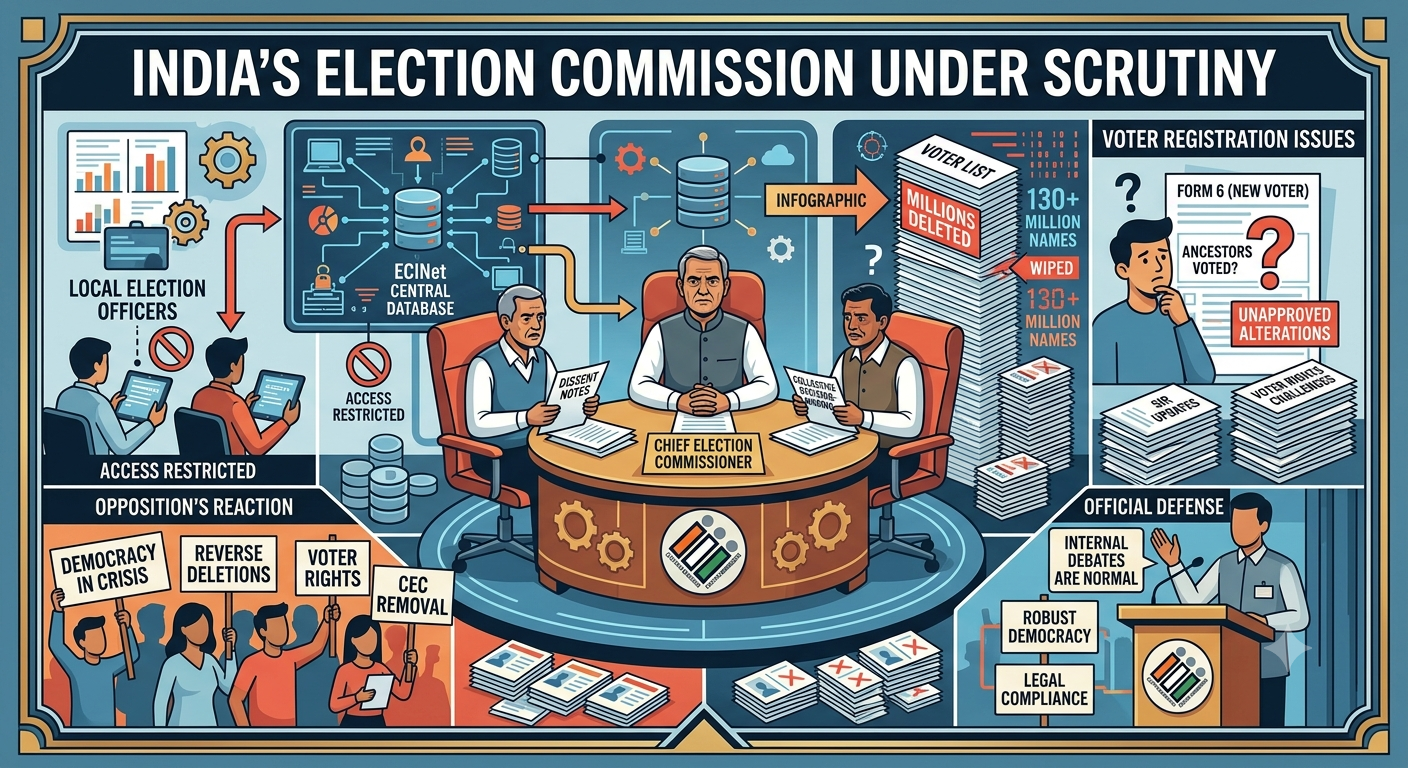
According to a media investigation, two of the Election Commissioners have formally disagreed with the CEC’s decisions multiple times over the past year. Usually, the three members of the Commission make decisions together. However, reports claim that the CEC has been making major decisions independently, bypassing the standard team-voting process.
2. Concerns Over Voter List Updates
A major point of debate is the “Special Intensive Revision” (SIR), an exercise meant to clean up and update voter lists across the country. Reports suggest this process led to millions of names being removed. Furthermore, critics claim that “Form 6” (the form used to register new voters) was altered to ask applicants if their ancestors had voted previously. Critics argue this change was made without getting the necessary legal approval from Parliament.
3. Software and Centralization Issues
The Election Commission recently introduced a centralized, nationwide software system for voter data. While intended to organize information, critics argue it took power away from local election officers.
In some states, the software automatically flagged millions of voters for minor errors like spelling mistakes.
In states like Goa, local officers reportedly complained that the new centralized software did not give them the option to add legitimate voters back onto the list, even after their documents were physically verified.
Additionally, requests from other commissioners to have the software independently checked by IT experts were allegedly ignored by the CEC.
4. Official Responses
In response to these reports, the Election Commission has stated that having different opinions and internal debates is a normal, healthy part of how a democratic organization operates. The ruling political party has also defended the EC, stating that discussions and disagreements among commissioners show that the system is independent and working as it should.
5. The Opposition’s Reaction
Opposition political leaders have strongly criticized the CEC. Many leaders have accused the Election Commission of managing the voter lists unfairly. Several political figures have demanded the CEC’s removal, while others have called for future elections to be conducted using traditional paper ballots instead of electronic systems.
6. The Rules of Removal
Can the Chief Election Commissioner be easily removed? The short answer is no. To protect the independence of the Election Commission, the Indian Constitution makes it very difficult to remove a CEC. The process is the same as removing a Supreme Court judge, requiring a complex investigation and a special majority vote in both houses of Parliament. Because the current ruling government holds a majority in Parliament, removing the CEC through this process is highly unlikely. Opposing parties would likely have to rely on the court system or public protests to push their demands.