




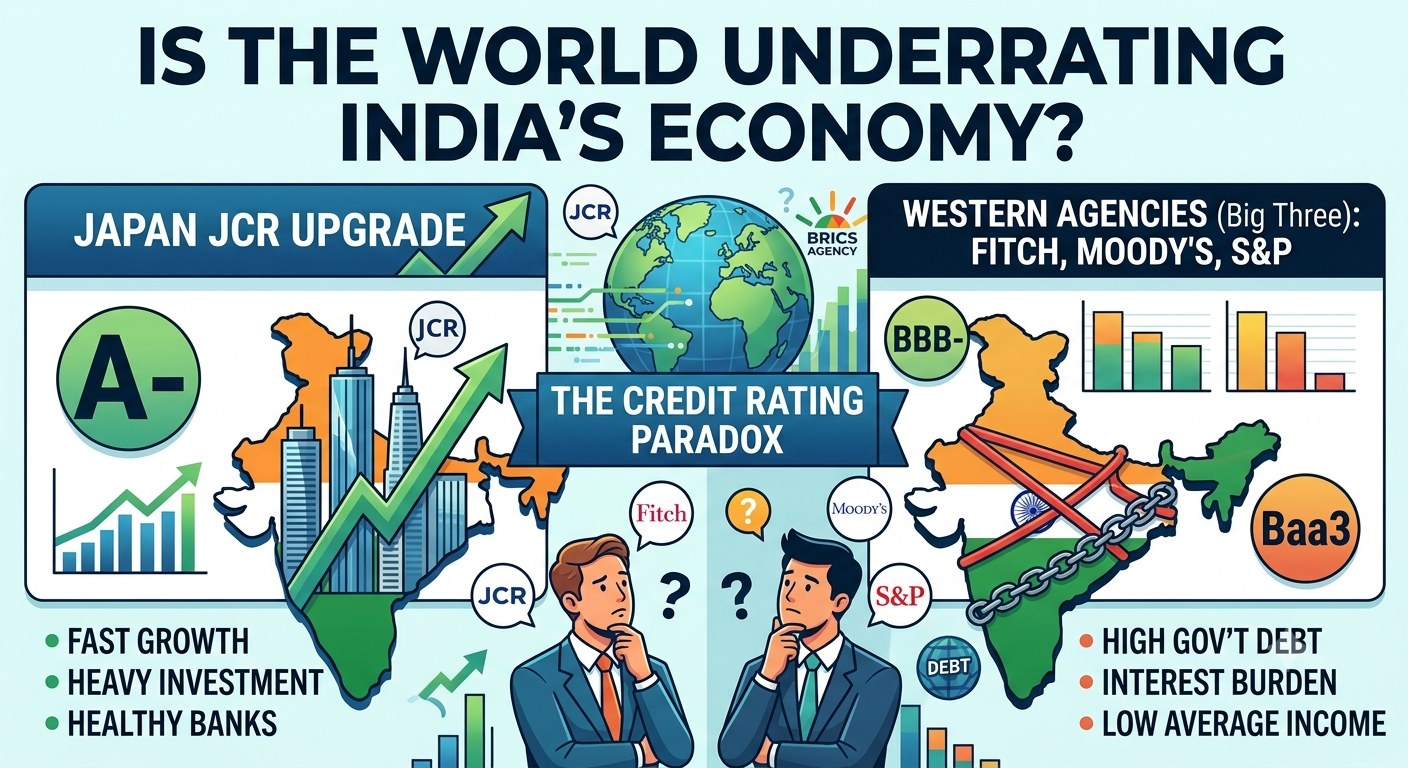
For the first time in 35 years, India has been promoted to the “A-rated” club by the Japan Credit Rating Agency (JCR). They upgraded India’s status from BBB+ to A-. While this is a proud moment that highlights India’s economic progress, it also reveals a confusing situation: why are the biggest Western credit rating agencies still refusing to give India a higher score?
What is a Country’s Credit Rating?
To understand why this matters, think of a country’s rating like a person’s credit score (like a CIBIL score). When you apply for a loan, the bank checks your score to see if you are reliable. If your score is high, you get the loan easily and at a cheaper interest rate.
The same rule applies to countries. A higher “sovereign rating” tells global investors that a country is safe to invest in. This allows the government and businesses to borrow money at lower costs, which helps them build better infrastructure and grow the economy faster.
Why Did Japan Upgrade India?
The Japanese agency didn’t upgrade India’s rating just out of friendship; they based it on strong numbers. Here is why they gave India a better score:
Fast Growth: India’s economy is growing rapidly, showing very strong GDP numbers.
More Investments: Both the public and private sectors are investing heavily in the country.
Healthy Banks: The number of bad loans (NPAs) in Indian banks has dropped to very safe levels (below 2%).
Along with high domestic demand and excellent digital infrastructure, India has proven it has a strong and stable economy.
Why the “Big Three” Are Holding Back
Despite India’s strong performance, the top three global rating agencies—Fitch, Moody’s, and S&P—still keep India at the lowest possible investment grade. But why?
These agencies are worried about three main things:
High Government Debt: India’s total government debt is much higher than the average for other A-rated countries.
High Interest Payments: A large chunk of the government’s income goes just toward paying interest on its existing loans.
Low Average Income: The per capita income (average money earned per person) in India is still quite low compared to other highly-rated nations.
India’s Reply and Future Plans
The Indian government strongly disagrees with the “Big Three.” In fact, officials have argued that these Western agencies are being unfair.
India points out that they are ignoring a crucial fact: almost all of the government’s debt is in local currency (Rupees). The amount of money India owes to foreign countries is actually very small (less than 5% of its GDP), meaning the risk of a debt crisis is extremely low. India believes these agencies are focusing too much on average income and ignoring how fast the country’s structure and economy are improving.
Because of this bias, India and other BRICS countries (Brazil, Russia, China, and South Africa) are discussing a new idea: creating their own global credit rating agency. This would help developing nations rely less on Western institutions.