

The 130th Constitutional Amendment Bill of 2026 is currently a major topic in the Indian Parliament. Although it was introduced in both the Budget and Monsoon sessions, it hasn’t become a law yet. Right now, it is being reviewed by a special group called a Joint Parliamentary Committee (JPC) to figure out why it is stuck and how to fix it.
Here is an easy-to-understand breakdown of what this proposed law is all about.
The Main Idea: Stricter Rules for Leaders
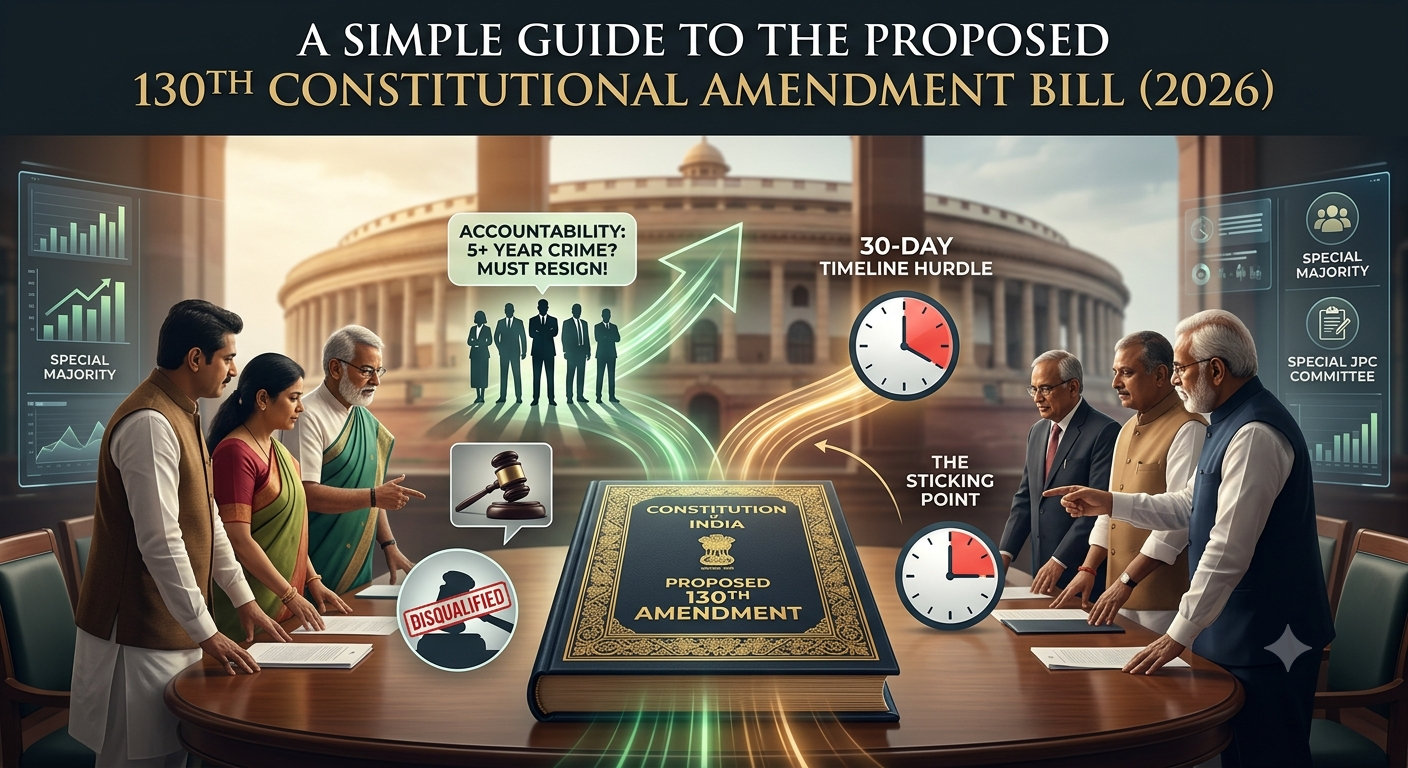
The central goal of this bill is to hold top political leaders more accountable for serious criminal actions.
Who it affects: The Prime Minister, Chief Ministers, and their respective Council of Ministers.
The new rule: If any of these leaders are found guilty of a crime that carries a prison sentence of more than five years, they must immediately resign from their position.
The biggest hurdle: The bill demands that this resignation must happen within exactly 30 days. This strict 30-day deadline is highly debated and is the main reason the bill has not been passed yet.
Why Is It Hard to Pass?
Changing the rules for top government officials is a complicated process. To make this bill a reality, Parliament needs a “Special Majority,” meaning a much larger-than-normal number of lawmakers must vote in favor of it. It also requires changing three specific parts of the Indian Constitution:
Article 75: Which deals with the Prime Minister and central government ministers.
Article 164: Which handles the rules for Chief Ministers and state ministers.
Article 239AA: Which contains special rules for Delhi’s government.
The Difference Between a “Bill” and an “Act”
You might wonder why it is called the 130th Bill when India only has 106 Constitutional Amendment Acts.
A Bill is just a proposed law. They are numbered in the order they are introduced.
An Act is a bill that has successfully passed through Parliament and become official law.
Because many proposed bills in the past have failed, expired, or been delayed, the bill number is much higher than the actual act number. If the 130th Bill successfully passes, it will become the 107th Act.
How the Parliament Committee Helps
Because Parliament couldn’t agree on the bill, they handed it over to a 31-member Joint Parliamentary Committee (JPC). Parliament uses different types of groups to handle its work. While some are permanent (Standing Committees), this JPC is an Ad-Hoc Committee. This means it is a temporary team of experts gathered for one specific job: to review the 30-day rule, fix the issues in the bill, and suggest changes so Parliament can vote on it again. Once they finish this specific task, the group will be dissolved.