


Small businesses are the heart of the economy. They manufacture goods, provide services, and create millions of jobs. However, they constantly face one major problem: big companies often buy from them but take months to pay the bills.
When payments are delayed, small businesses run out of everyday cash. They struggle to pay their workers, buy raw materials, or keep their machines running. To fix this unfair situation, the government introduced the MSME Amendment Act of 2026.
Here is a simple breakdown of what these new rules mean for small businesses.
1. Who Counts as a Small Business?
First, the government categorizes businesses based on two things: how much money they put into the business (investment) and how much they sell in a year (turnover). Here are the current limits:
Micro Businesses: Invest up to ₹2.5 Crore AND sell up to ₹10 Crore a year.
Small Businesses: Invest up to ₹25 Crore AND sell up to ₹100 Crore a year.
Medium Businesses: Invest up to ₹125 Crore AND sell up to ₹500 Crore a year.
2. Getting Cash Quickly for Unpaid Bills
The biggest change is how small businesses can get their money if a big buyer (like a government company) delays payment.
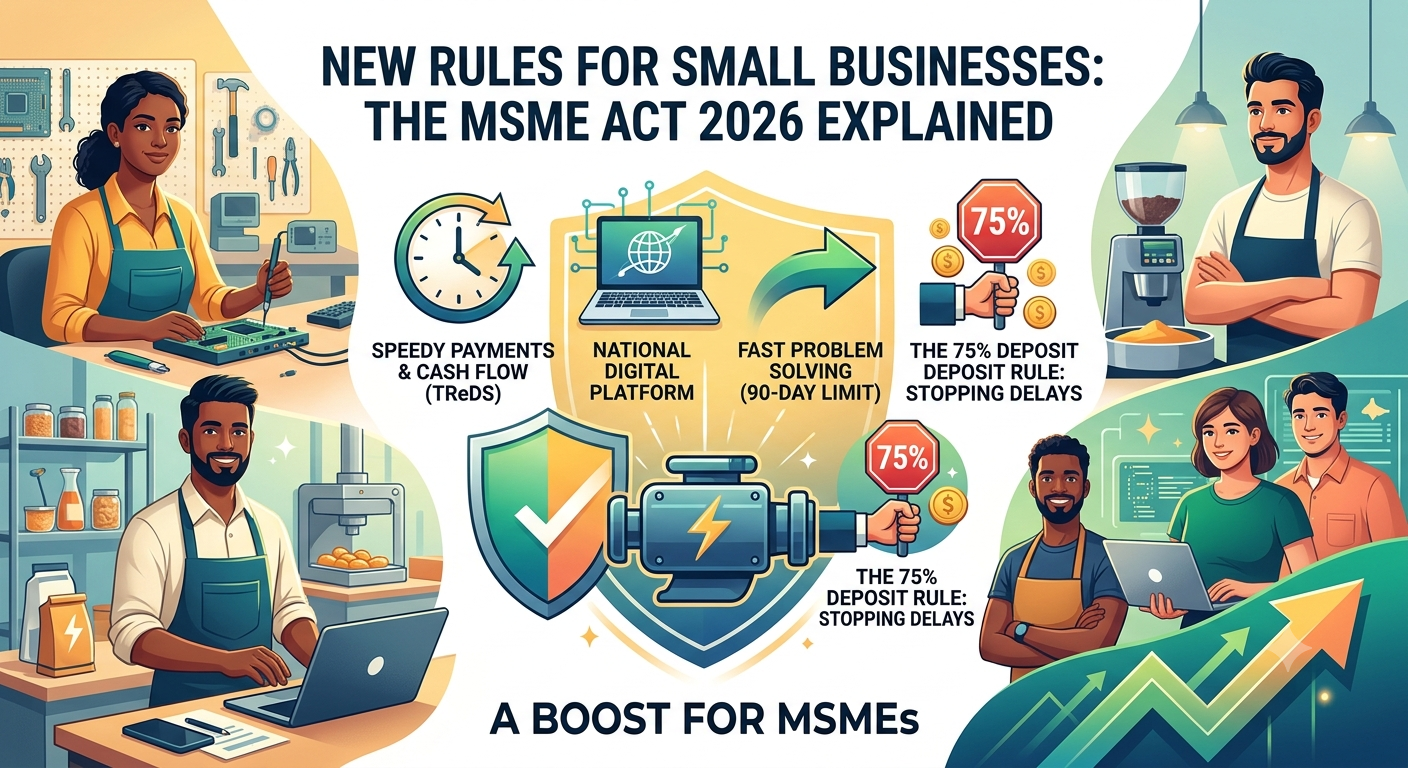
The government has made it mandatory to use a digital platform called TReDS. Think of it as a place to trade unpaid bills for instant cash. If a small business finishes an order but the buyer says, “We will pay you in a few months,” the small business doesn’t have to wait. They can upload their unpaid bill to the TReDS app. Financial companies on the app will give the small business the cash immediately (minus a tiny fee). Later on, the big buyer pays that financial company instead. This ensures the small business never runs out of cash to operate.
3. Everything is Now Digital
Business owners no longer have to run to government offices with stacks of paper to file a complaint. The new rules introduce a National Digital Platform. If someone owes you money, you can file your complaint and track the progress entirely online from your computer or phone.
4. Fast Problem-Solving (No More Long Court Battles)
If a buyer refuses to pay, the new law forces a quick solution so small businesses don’t get stuck in endless legal fights.
Video Call Settlements: First, an online meeting (mediation) is set up with a neutral third party to try and get both sides to agree.
90-Day Limit: If talking doesn’t work within the first 30 days, formal legal orders (arbitration) will begin. The entire problem must be resolved within 90 days.
5. The 75% Deposit Rule (Stopping Unfair Delays)
This is a massive win for small businesses. In the past, big companies would purposely drag out legal fights for years just to avoid paying what they owed.
Under the 2026 rules, if a legal body orders a big company to pay up, but the company tries to appeal or delay the process further, they are forced to deposit 75% of the owed money upfront. For example, if a big company owes ₹1 Lakh and wants to keep fighting the decision, they must put down ₹75,000 right away. This strict penalty discourages big companies from using legal tricks to avoid paying on time.
Summary
The MSME Act of 2026 is designed to protect the “little guy.” By making dispute resolution faster, forcing big companies to pay heavy deposits for delaying, and providing platforms for instant cash, the government is ensuring that small businesses can work peacefully and grow without financial fear.