




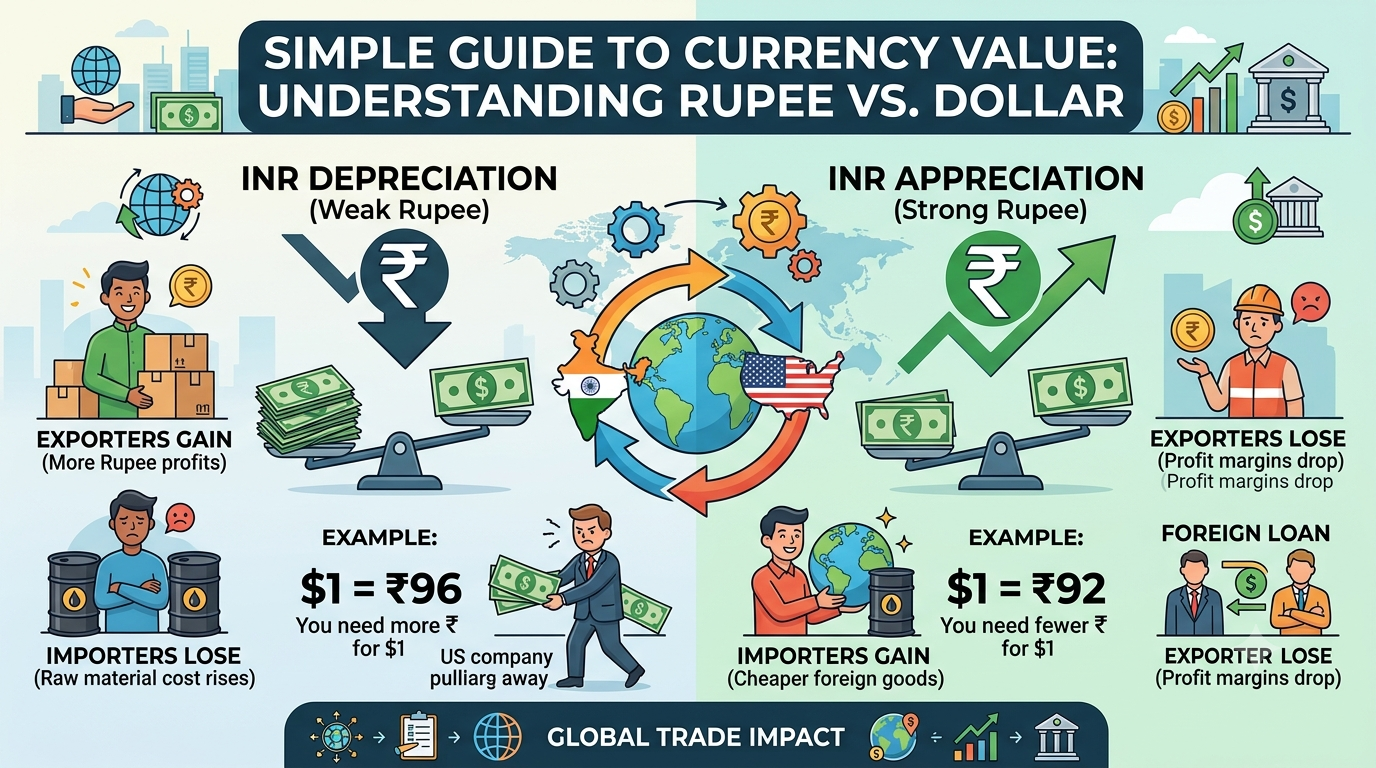
Money values change every day in the global market. If you have ever wondered why the Indian Rupee sometimes gets stronger or weaker against the US Dollar—and why it matters—here is a simple breakdown.
What is an Exchange Rate?
An exchange rate is simply the price tag of one country’s money in terms of another’s. For example, if the exchange rate is $1 = ₹94, it means you need 94 Indian Rupees to buy one US Dollar. Any business buying or selling things internationally uses this rate to figure out their costs and profits.
When the Rupee Falls: Currency Depreciation
Currency depreciation happens when the local money (Rupee) loses value compared to foreign money (Dollar).
How it works:
Imagine investors think the US economy is safer, so they pull their money out of India and send it back to America. Suddenly, there are fewer dollars floating around in the Indian market. Just like tomatoes or gold, when something is in short supply, its price goes up.
Old Price: $1 = ₹94
New Price: $1 = ₹96
Because you now have to spend more rupees just to get the exact same dollar, the Rupee has become weaker.
When the Rupee Rises: Currency Appreciation
Currency appreciation is the exact opposite. This happens when the local money becomes stronger compared to foreign money.
How it works:
If foreign companies are investing heavily in India, they bring a lot of dollars with them. Now, there is an oversupply of dollars in the market, which makes the dollar cheaper to buy.
Old Price: $1 = ₹94
New Price: $1 = ₹92
Now, you spend fewer rupees to get the same dollar. The Rupee has gained strength.
Who Wins and Who Loses?
Whenever the Rupee’s value changes, it directly affects businesses that trade internationally:
Exporters Love a Weak Rupee (Depreciation): If an Indian business sells software to the US for $1, they used to get ₹94. If the Rupee falls, they now get ₹96 for that same dollar. They make more profit without changing their prices.
Importers Love a Strong Rupee (Appreciation): If an Indian company buys raw materials (like crude oil) from abroad for $1, a stronger Rupee means they only have to pay ₹92 instead of ₹94. Buying things from other countries becomes much cheaper.
What About Foreign Loans?
If an Indian company took a loan from a US bank for $1, they naturally want the Rupee to get stronger (appreciate). If the rate drops from ₹94 to ₹92, they have to spend less of their own local money to pay back that $1 debt.
The Role of the Big Banks
Global banks have a massive impact on these numbers:
The US Federal Reserve: If the central bank in the US raises its interest rates, borrowing money becomes expensive there. This means US companies invest fewer dollars in India. A shortage of dollars in India makes the Rupee weaker (depreciation).
The Reserve Bank of India (RBI): If the Rupee starts falling too fast, the RBI steps in to fix it. Since the problem is a shortage of dollars, the RBI will take dollars out of its own emergency reserves and sell them in the open market. This sudden flood of dollars stabilizes the prices and stops the Rupee from crashing.