




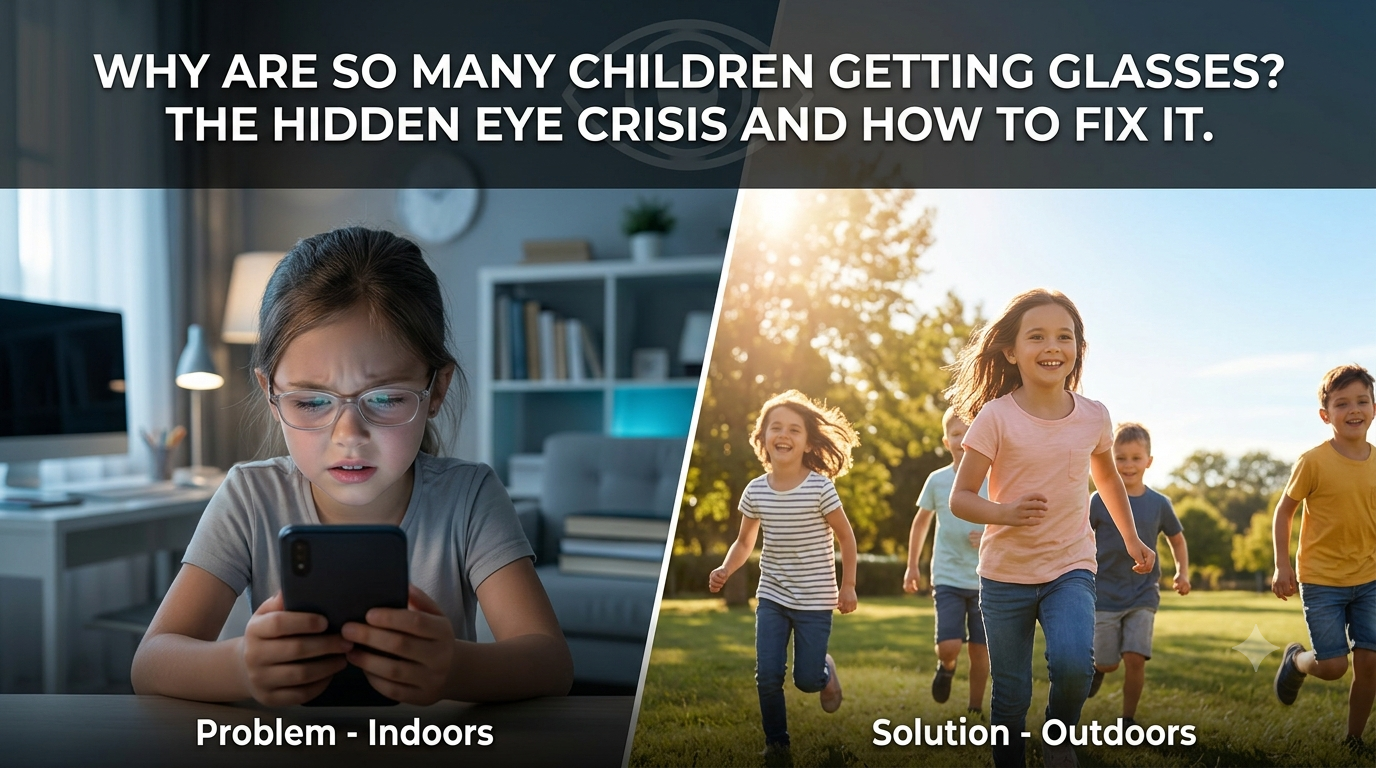
If you look inside any school classroom today, you will notice something surprising: a large number of young children are wearing glasses. A few decades ago, this was rare. Today, it is so common that we hardly question it.
However, this rapid rise in nearsightedness, also known as myopia, is a growing health crisis. In Indian cities, the number of kids needing glasses jumped from about 4% in 1999 to over 21% in 2019. If things don’t change, experts believe that nearly half of all city-dwelling children will have vision problems by the year 2050.
But why is this happening so fast?
The Biology: Eyes Weren’t Made for Screens
To understand the problem, we have to look at human history. For thousands of years, human eyes were used to look at things far away, like hunting for food or spotting danger in the distance. When we look at faraway objects, our eye muscles are completely relaxed.
When we look at things up close, like a book or a phone, a tiny muscle inside our eye has to squeeze tightly to focus. When kids spend hours staring at screens just a few inches from their faces, this constant squeezing stresses the eye. To handle this stress, a child’s growing eyeball will physically stretch and become longer.
Once the eyeball stretches out of its normal round shape, it cannot shrink back. This makes everything in the distance look blurry, which is why a child needs glasses.
The Three Main Causes
While genetics play a small role, the real problem is how children live today. Here are the three main reasons our kids’ eyes are changing:
1. Staring at Screens Too Much
Phones and tablets force the eyes to work incredibly hard. The closer a child holds a device, the more strain it puts on their developing eyes.
2. A Lack of Sunlight
This is the most surprising and important factor. Our eyes need bright, natural sunlight to grow properly. When sunlight enters the eye, it creates a special chemical called dopamine. This chemical acts like a biological brake—it stops the eyeball from stretching too much. Because kids spend so much time indoors, they aren’t getting this free, natural medicine. Indoor lights are simply not bright enough to do the job.
3. The Indoor Lifestyle
We often reward children for studying inside for hours, but this comes at a cost to their vision. Combined with living in crowded cities where kids don’t have open spaces to look far into the horizon, the modern childhood keeps kids trapped indoors.
It Is More Than Just Needing Glasses
Many parents think that getting glasses solves the problem, but nearsightedness is not just a mild inconvenience. When an eyeball stretches and becomes longer, the walls of the eye become very thin and fragile. Later in life, this can lead to severe eye diseases and even permanent vision loss. Taking care of their eyes now prevents major health risks when they are adults.
How We Can Save Their Sight
The good news is that we do not need expensive medical treatments to stop this crisis. The solutions are entirely free and start right at home:
Two Hours of Outdoor Play: The best way to protect a child’s eyes is to send them outside. Playing outdoors under the open sky for at least two hours a day gives their eyes the bright sunlight they need to stay healthy.
The 20-20-20 Rule: When kids are studying or using a screen, teach them to take a break every 20 minutes. They should look at something 20 feet away for at least 20 seconds. This allows their eye muscles to relax.
Limit Screen Time: Try to keep screen time for entertainment to under two hours a day, especially for younger children.
We have given our children the internet and smart devices, but we have accidentally taken away the outdoors. The best thing you can do for a child’s vision today is to put away the tablet, open the door, and let them play outside.